New Zealand Dollar steadies near 0.6040 as markets brace for Wednesday's RBNZ rate decision
- The Reserve Bank of New Zealand is widely expected to hold rates at 2.25%, with updated rate projections and Governor Breman's first policy statement in focus.
- Price is holding above the 0.6035 support flip zone with the daily RSI near 62, though resistance at 0.6122 caps the near-term upside.

The Reserve Bank of New Zealand (RBNZ) holds its first monetary policy meeting of 2026 on Wednesday and is overwhelmingly expected to keep the Official Cash Rate (OCR) steady at 2.25%, following 325 basis points of cumulative easing since August 2024. This will be the first decision under new Governor Anna Breman, and markets are closely watching whether the bank adjusts its previous guidance pointing to mid-2027 as the likely timing for a rate increase. Recent data has been mixed; January electronic retail card spending fell 1.1% and service-sector growth slowed, but inflation moved above target and one- and two-year business inflation expectations both rose in Q1. Money markets currently price a 68% probability of a rate hike by September and fully expect one by October.
On the US Dollar side, the Federal Open Market Committee (FOMC) minutes due Wednesday will shape near-term rate expectations. New Zealand trade balance data on Thursday and US flash Purchasing Managers Index (PMI) and Personal Consumption Expenditures Price Index (PCE) on Friday round out a packed economic calendar for the pair.
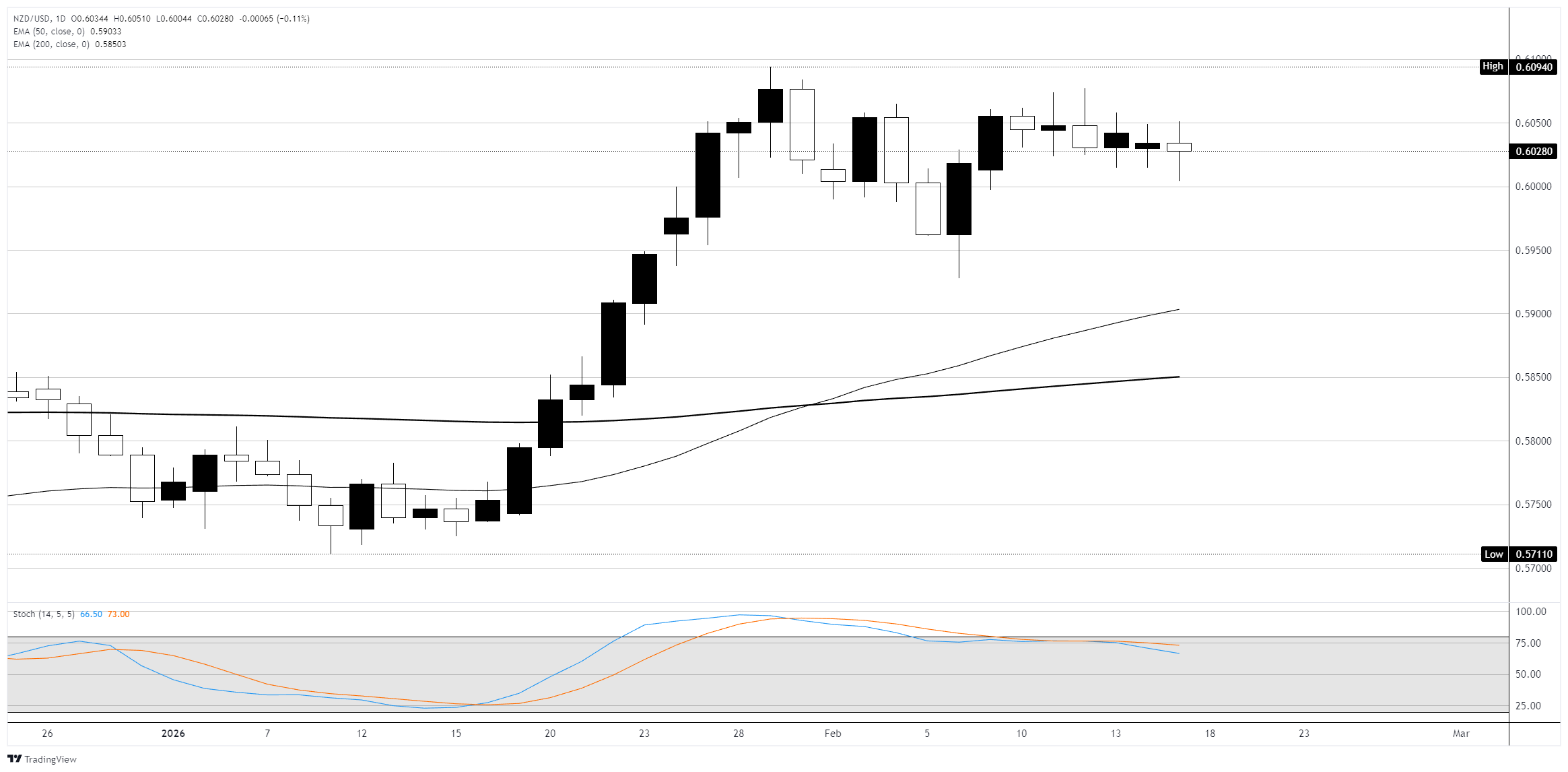
On the daily chart, NZD/USD is trading near 0.6037 on Tuesday after consolidating in a narrow range below the February 10 high of 0.6065. The broader trend structure is bullish, with price holding well above the 50-day SMA at 0.6047 and the 200-day EMA at 0.6029, both of which are trending higher and converging to provide a dynamic support cluster around the 0.6030 to 0.6050 zone. The 14-day Relative Strength Index (RSI) reads 62, confirming positive momentum without stretched conditions, while the Moving Average Convergence-Divergence (MACD) histogram is holding above zero.
On the 4H timeframe, price action shows the pair building above the 0.6035 to 0.6040 zone, where prior resistance has flipped to demand following a breakout from a descending channel earlier this month. The 52-week high at 0.6122 stands as the key resistance level above, with an intermediate ceiling near 0.6065 to 0.6075. Support below sits at 0.6000 (psychological), followed by 0.5935 where a recent liquidity sweep was absorbed. A close above 0.6065 would signal continuation toward the 0.6122 high; a break below 0.6000 risks a deeper pullback to the 0.5935 support and the rising 200-day EMA.
NZD/USD daily chart
New Zealand Dollar FAQs
The New Zealand Dollar (NZD), also known as the Kiwi, is a well-known traded currency among investors. Its value is broadly determined by the health of the New Zealand economy and the country’s central bank policy. Still, there are some unique particularities that also can make NZD move. The performance of the Chinese economy tends to move the Kiwi because China is New Zealand’s biggest trading partner. Bad news for the Chinese economy likely means less New Zealand exports to the country, hitting the economy and thus its currency. Another factor moving NZD is dairy prices as the dairy industry is New Zealand’s main export. High dairy prices boost export income, contributing positively to the economy and thus to the NZD.
The Reserve Bank of New Zealand (RBNZ) aims to achieve and maintain an inflation rate between 1% and 3% over the medium term, with a focus to keep it near the 2% mid-point. To this end, the bank sets an appropriate level of interest rates. When inflation is too high, the RBNZ will increase interest rates to cool the economy, but the move will also make bond yields higher, increasing investors’ appeal to invest in the country and thus boosting NZD. On the contrary, lower interest rates tend to weaken NZD. The so-called rate differential, or how rates in New Zealand are or are expected to be compared to the ones set by the US Federal Reserve, can also play a key role in moving the NZD/USD pair.
Macroeconomic data releases in New Zealand are key to assess the state of the economy and can impact the New Zealand Dollar’s (NZD) valuation. A strong economy, based on high economic growth, low unemployment and high confidence is good for NZD. High economic growth attracts foreign investment and may encourage the Reserve Bank of New Zealand to increase interest rates, if this economic strength comes together with elevated inflation. Conversely, if economic data is weak, NZD is likely to depreciate.
The New Zealand Dollar (NZD) tends to strengthen during risk-on periods, or when investors perceive that broader market risks are low and are optimistic about growth. This tends to lead to a more favorable outlook for commodities and so-called ‘commodity currencies’ such as the Kiwi. Conversely, NZD tends to weaken at times of market turbulence or economic uncertainty as investors tend to sell higher-risk assets and flee to the more-stable safe havens.
Author

Joshua Gibson
FXStreet
Joshua joins the FXStreet team as an Economics and Finance double major from Vancouver Island University with twelve years' experience as an independent trader focusing on technical analysis.

















