Dow Jones Industrial Average dips as AI disruption fears persist, FOMC Minutes loom
- The Dow Jones slipped on Tuesday as tech stocks continued to weigh on sentiment after the long weekend.
- Software-as-a-service names remained under pressure on fears that AI tools will displace demand.
- Warner Bros reopened deal talks with Paramount after Netflix granted a seven-day waiver.
- Danaher announced a $9.9 billion deal to acquire Masimo, sending its own shares sharply lower.

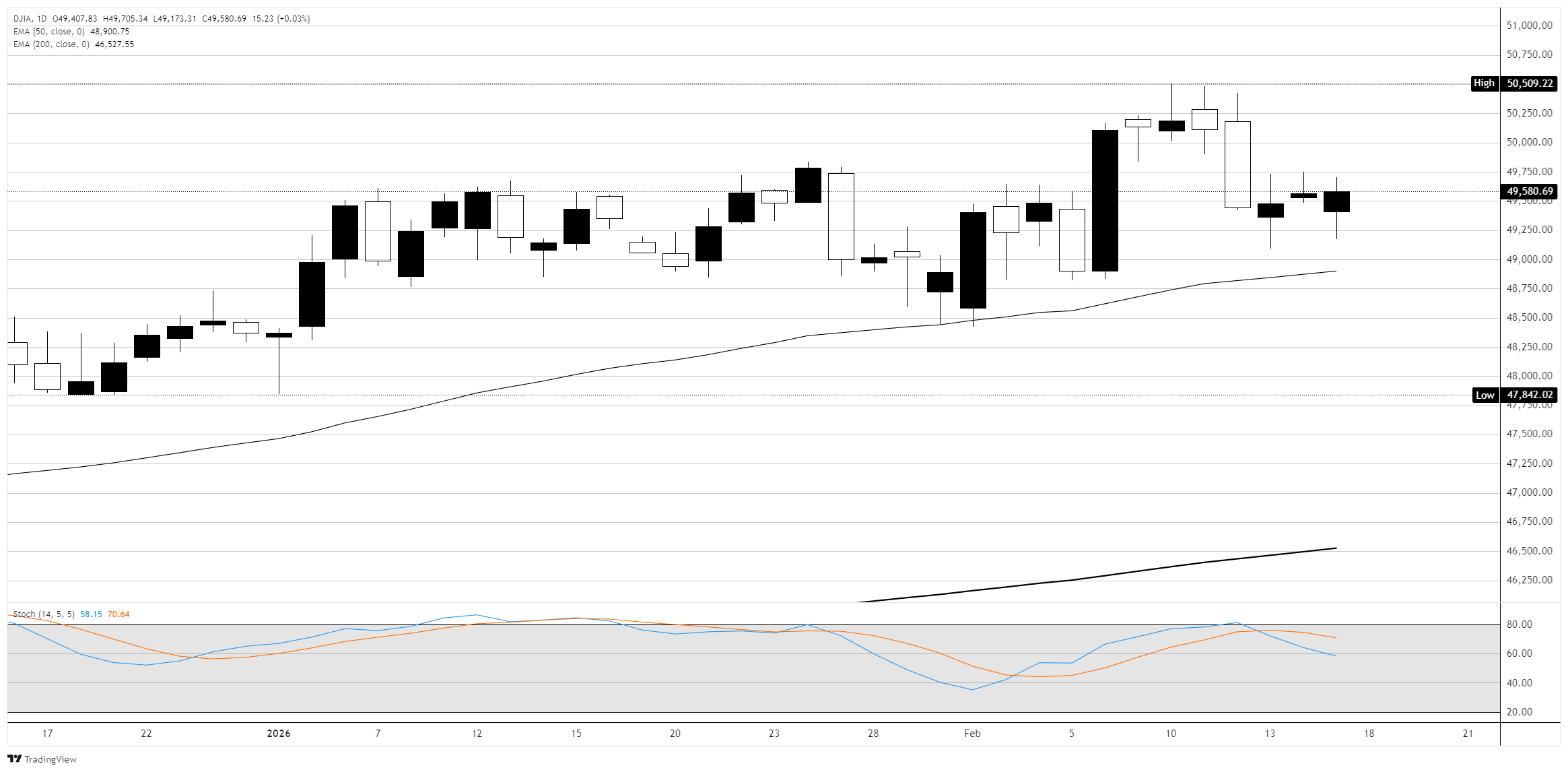
The Dow Jones Industrial Average (DJIA) fell around 120 points, or 0.24%, on Tuesday as investors returned from the Presidents' Day holiday and picked up right where they left off: selling tech. The S&P 500 shed roughly 0.5% while the Nasdaq Composite led losses, dropping around 0.8% as software and semiconductor names bore the brunt of ongoing AI disruption anxiety. The session continued a pattern that has dogged markets for weeks: the Dow and S&P 500 have now fallen in four of the past five weeks, and the Nasdaq notched its fifth straight weekly decline heading into this week. A drop in the 10-year Treasury yield to fresh two-month lows near 4.03%, following last Friday's cooler-than-expected Consumer Price Index (CPI) print, offered limited support to rate-sensitive sectors.
AI disruption trade rolls on
The software-as-a-service (SaaS) selloff showed no sign of letting up. Salesforce (CRM) dropped around 2.5%, while Intuit (INTU), Oracle (ORCL), and ServiceNow (NOW) all traded lower as fears that AI automation tools could erode demand for traditional enterprise software continued to ripple through the sector. CrowdStrike (CRWD) fell more than 2% after Mizuho cut its recommendation. On the hardware side, Nvidia (NVDA) slipped, as did AMD (AMD) and Broadcom (AVGO), with investors questioning whether massive datacenter capital expenditures will translate into the returns that have been priced in. Chevron (CVX) led Dow decliners, falling 2.6%, while Caterpillar (CAT) shed 2.1%. On the flip side, Travelers Companies (TRV) rose 1.8%, Visa (V) gained 1.5%, and Apple (AAPL) added 1% as financials found support from lower Treasury yields.
Danaher strikes $9.9 billion deal for Masimo
Danaher (DHR) plunged around 6% after announcing a definitive agreement to acquire medical device maker Masimo (MASI) for $180 per share in an all-cash deal valued at approximately $9.9 billion. The deal represents a 38% premium to Masimo's Friday close, and Masimo shares surged roughly 34% on the news. It marks Danaher's biggest acquisition since its $5.7 billion purchase of Abcam in 2023, as the life sciences giant looks to expand into patient monitoring. The transaction is expected to close in the second half of 2026. Medtronic (MDT) slipped 2.5% despite beating quarterly expectations, as investors were underwhelmed by forward guidance that included the expected impact of tariffs.
Warner Bros reopens Paramount deal talks
Warner Bros Discovery (WBD) rose more than 2% after announcing it would reopen takeover negotiations with Paramount Skydance (PSKY), which gained around 3%. Netflix (NFLX), Warner Bros' preferred bidder, granted a seven-day waiver allowing the discussions, which are set to run through February 23. Paramount has signaled willingness to raise its all-cash offer to at least $31 per share, up from the previously rejected $30 bid. Netflix's existing agreement to acquire Warner's studio and streaming businesses for roughly $83 billion in enterprise value remains the board's recommended deal, but the reopened window adds a fresh layer of intrigue to one of the biggest M&A battles in entertainment history.
Looking ahead: FOMC Minutes, PCE, and Palo Alto earnings
The economic calendar this week is back-loaded with market-moving events. Today's NY Empire State Manufacturing Index came in at 7.1, just above the consensus estimate of 6 and down marginally from 7.7 in January, showing that New York State manufacturing activity continued to expand modestly. The Federal Open Market Committee (FOMC) Minutes from the January meeting drop on Wednesday and should offer color on why policymakers held rates steady at 3.50-3.75%. Markets are still pricing in roughly two 25-basis-point rate cuts by year-end, with the first cut most likely arriving in June. Friday's Personal Consumption Expenditures Price Index (PCE) report and preliminary fourth-quarter Gross Domestic Product (GDP) data will be the week's main events. After the bell on Tuesday, Palo Alto Networks (PANW) reports fiscal second-quarter results, with consensus looking for revenue of $2.58 billion and adjusted earnings per share (EPS) of $0.94. The cybersecurity firm has beaten revenue estimates in every quarter over the past two years.
Dow Jones daily chart
Dow Jones FAQs
The Dow Jones Industrial Average, one of the oldest stock market indices in the world, is compiled of the 30 most traded stocks in the US. The index is price-weighted rather than weighted by capitalization. It is calculated by summing the prices of the constituent stocks and dividing them by a factor, currently 0.152. The index was founded by Charles Dow, who also founded the Wall Street Journal. In later years it has been criticized for not being broadly representative enough because it only tracks 30 conglomerates, unlike broader indices such as the S&P 500.
Many different factors drive the Dow Jones Industrial Average (DJIA). The aggregate performance of the component companies revealed in quarterly company earnings reports is the main one. US and global macroeconomic data also contributes as it impacts on investor sentiment. The level of interest rates, set by the Federal Reserve (Fed), also influences the DJIA as it affects the cost of credit, on which many corporations are heavily reliant. Therefore, inflation can be a major driver as well as other metrics which impact the Fed decisions.
Dow Theory is a method for identifying the primary trend of the stock market developed by Charles Dow. A key step is to compare the direction of the Dow Jones Industrial Average (DJIA) and the Dow Jones Transportation Average (DJTA) and only follow trends where both are moving in the same direction. Volume is a confirmatory criteria. The theory uses elements of peak and trough analysis. Dow’s theory posits three trend phases: accumulation, when smart money starts buying or selling; public participation, when the wider public joins in; and distribution, when the smart money exits.
There are a number of ways to trade the DJIA. One is to use ETFs which allow investors to trade the DJIA as a single security, rather than having to buy shares in all 30 constituent companies. A leading example is the SPDR Dow Jones Industrial Average ETF (DIA). DJIA futures contracts enable traders to speculate on the future value of the index and Options provide the right, but not the obligation, to buy or sell the index at a predetermined price in the future. Mutual funds enable investors to buy a share of a diversified portfolio of DJIA stocks thus providing exposure to the overall index.
Author

Joshua Gibson
FXStreet
Joshua joins the FXStreet team as an Economics and Finance double major from Vancouver Island University with twelve years' experience as an independent trader focusing on technical analysis.