Stock Market Today: US markets end mixed as markets assess latest US data
- Wall Street's main equity indexes mixed on Tuesday.
- US Durable Goods Orders declined sharper than expected in January.
- Investors and Fed watchers await Thursday's US PCE figures.

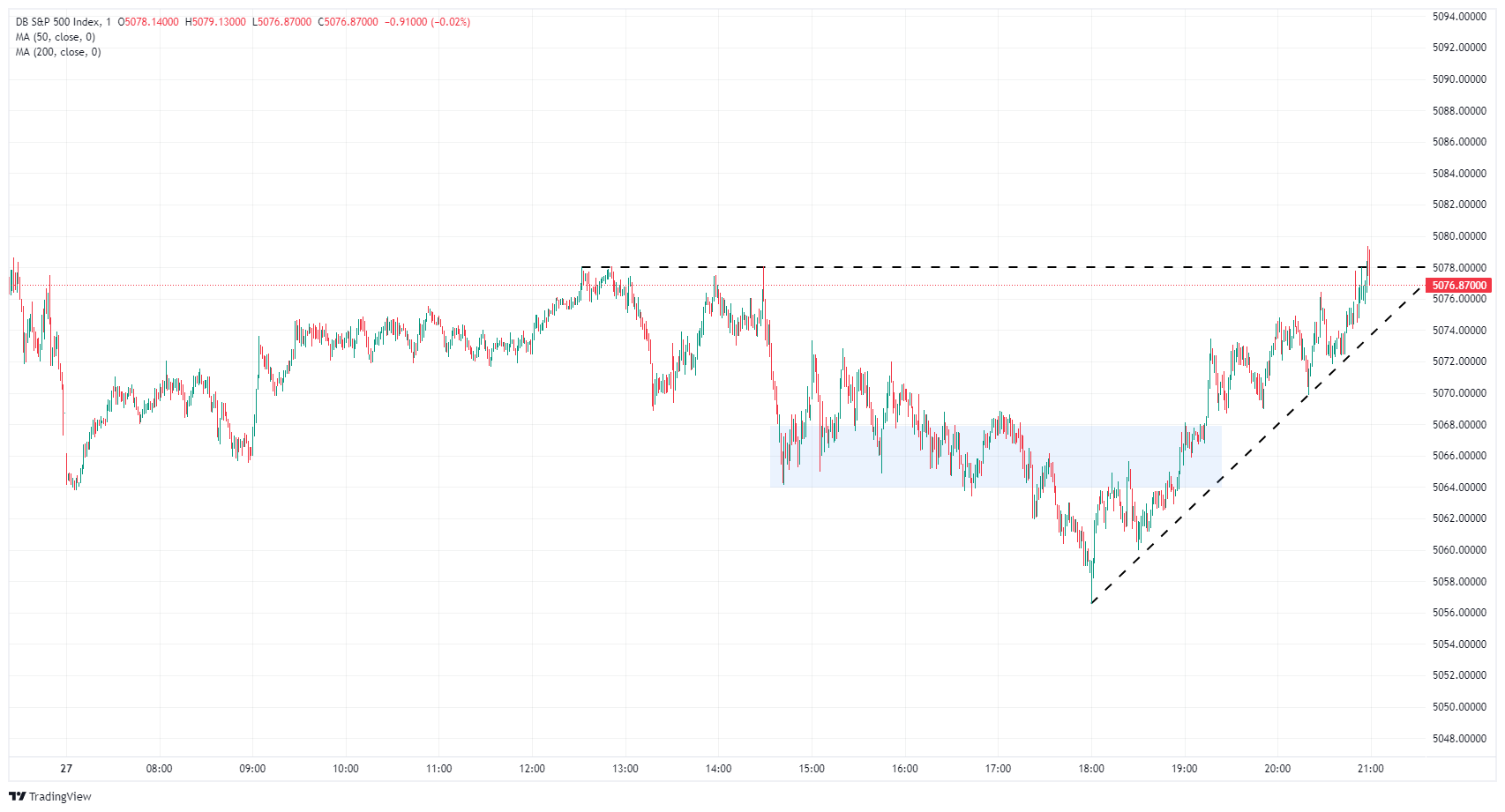
The S&P 500 (SPX) index rose 0.17% to close the session at 5,078.18. The Dow Jones (DJIA) dropped 0.25% to end at 38,972.41, while the Nasdaq (IXIC) gained 0.37% to finish at 16,035.3.
Stock market news
The Utilities Sector climbed 1.89% on Tuesday as the best-performing sector for the day, followed by the Communication Services Sector, which rose 1.03%. The Energy Sector fell on the day, but recovered slightly to close down 0.43%.
Norwegian Cruise Line Holdings Ltd. (NCLH) and Carnival Corp. (CCL) were the biggest stock gainers for the day. NCLH rose 19.837% with CCL ending the day up 16.919%. Tuesday's worst performer was the NASDAQ-listed Workday Inc. (WDAY), which backslid 3.958% to hit $295.05 at the closing bell.
Assessing the recent action in US stock markets, "it's an interesting week for equities as the recent run is starting to get into once in a couple of generation territory. The S&P 500 has now posted 15 weekly gains in the last 17 for the first time since 1989," said Jim Reid, global head of economics and thematic research at Deutsche Bank, and continued:
"Moreover, if we get another positive week this week, then it would be 16 out of 18 weeks for the first time since 1971, and it would also be a joint record since the index’s formation. So even though there’s been lots of positive catalysts, from lower inflation to excitement about AI, it’s actually very unusual to see the sort of sustained rally that’s occurred over the last few months."
Republic Services Inc. (RSG), Agilent Technologies Inc. (A), Extra Space Storage Inc. (EXR) and Coupang Inc. (CPNG) will release quarterly earnings after the closing bell on Tuesday.
US Gross Domestic Product (GDP) figures are due Wednesday, and US growth figures will serve as a precursor to Thursday's US Personal Consumption Expenditure Price Index (PCE) inflation slated for Thursday.
GDP FAQs
What is GDP and how is it recorded?
A country’s Gross Domestic Product (GDP) measures the rate of growth of its economy over a given period of time, usually a quarter. The most reliable figures are those that compare GDP to the previous quarter e.g Q2 of 2023 vs Q1 of 2023, or to the same period in the previous year, e.g Q2 of 2023 vs Q2 of 2022.
Annualized quarterly GDP figures extrapolate the growth rate of the quarter as if it were constant for the rest of the year. These can be misleading, however, if temporary shocks impact growth in one quarter but are unlikely to last all year – such as happened in the first quarter of 2020 at the outbreak of the covid pandemic, when growth plummeted.
How does GDP influence currencies?
A higher GDP result is generally positive for a nation’s currency as it reflects a growing economy, which is more likely to produce goods and services that can be exported, as well as attracting higher foreign investment. By the same token, when GDP falls it is usually negative for the currency.
When an economy grows people tend to spend more, which leads to inflation. The country’s central bank then has to put up interest rates to combat the inflation with the side effect of attracting more capital inflows from global investors, thus helping the local currency appreciate.
How does higher GDP impact the price of Gold?
When an economy grows and GDP is rising, people tend to spend more which leads to inflation. The country’s central bank then has to put up interest rates to combat the inflation. Higher interest rates are negative for Gold because they increase the opportunity-cost of holding Gold versus placing the money in a cash deposit account. Therefore, a higher GDP growth rate is usually a bearish factor for Gold price.
S&P 500 FAQs
What is the S&P 500?
The S&P 500 is a widely followed stock price index which measures the performance of 500 publicly owned companies, and is seen as a broad measure of the US stock market. Each company’s influence on the computation of the index is weighted based on market capitalization. This is calculated by multiplying the number of publicly traded shares of the company by the share price. The S&P 500 index has achieved impressive returns – $1.00 invested in 1970 would have yielded a return of almost $192.00 in 2022. The average annual return since its inception in 1957 has been 11.9%.
How are companies chosen to be included in the S&P 500?
Companies are selected by committee, unlike some other indexes where they are included based on set rules. Still, they must meet certain eligibility criteria, the most important of which is market capitalization, which must be greater than or equal to $12.7 billion. Other criteria include liquidity, domicile, public float, sector, financial viability, length of time publicly traded, and representation of the industries in the economy of the United States. The nine largest companies in the index account for 27.8% of the market capitalization of the index.
How can I trade the S&P 500?
There are a number of ways to trade the S&P 500. Most retail brokers and spread betting platforms allow traders to use Contracts for Difference (CFD) to place bets on the direction of the price. In addition, that can buy into Index, Mutual and Exchange Traded Funds (ETF) that track the price of the S&P 500. The most liquid of the ETFs is State Street Corporation’s SPY. The Chicago Mercantile Exchange (CME) offers futures contracts in the index and the Chicago Board of Options (CMOE) offers options as well as ETFs, inverse ETFs and leveraged ETFs.
What factors drive the S&P 500?
Many different factors drive the S&P 500 but mainly it is the aggregate performance of the component companies revealed in their quarterly and annual company earnings reports. US and global macroeconomic data also contributes as it impacts on investor sentiment, which if positive drives gains. The level of interest rates, set by the Federal Reserve (Fed), also influences the S&P 500 as it affects the cost of credit, on which many corporations are heavily reliant. Therefore, inflation can be a major driver as well as other metrics which impact the Fed decisions.
Author

FXStreet Team
FXStreet
Composed of a group of economic journalists and FX experts, the FXStreet content team produces and oversees all content published on FXStreet. It provides a purely journalistic approach to the Forex market.