|

S&P 500 opens higher for second straight day despite uninspiring US data

  • Wall Street's main indexes post strong gains on Friday.
  • Retail Sales in US stayed unchanged in April.
  • All major sectors of the S&P 500 trade in the positive territory.

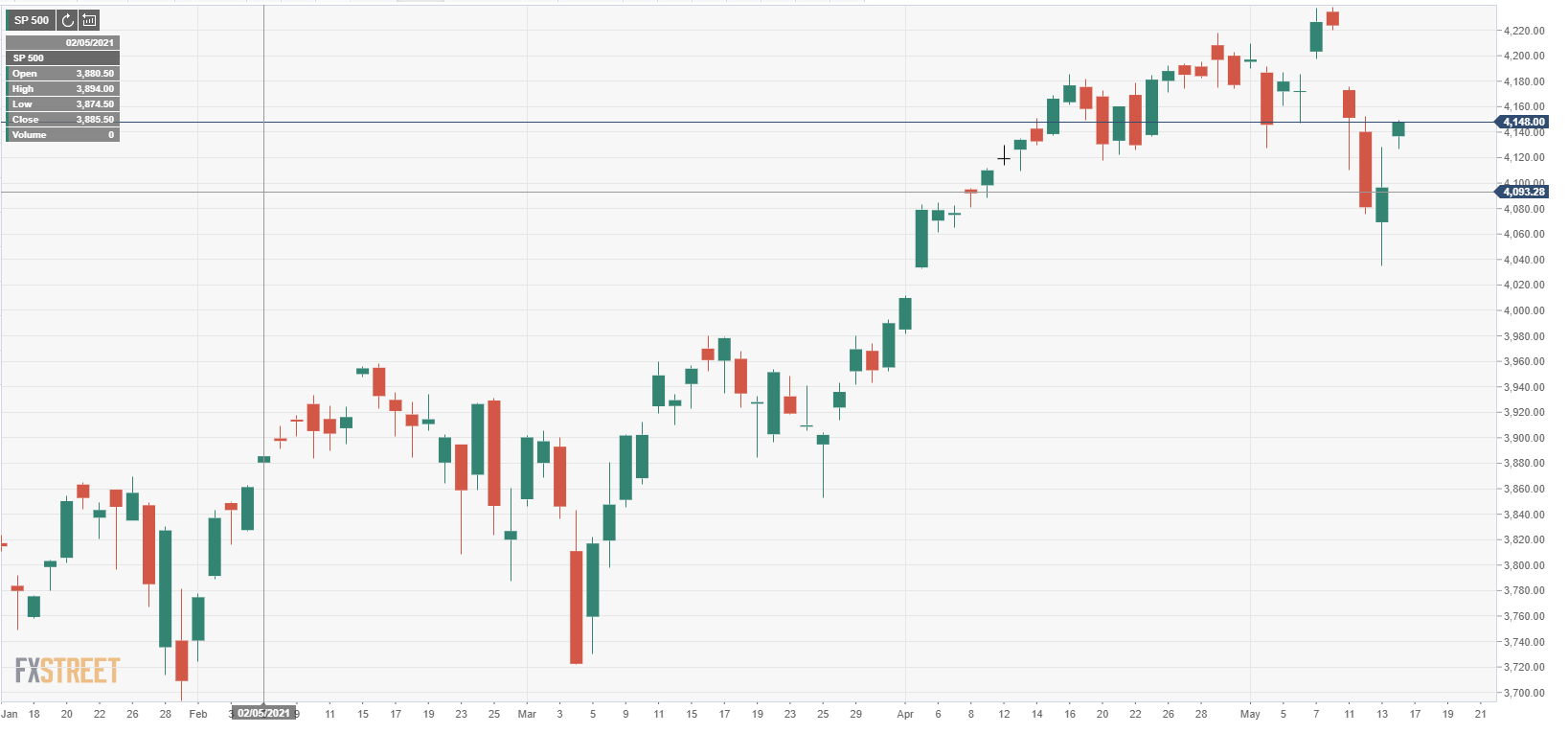
Following Thursday's strong rebound, major equity indexes started the last day of the week sharply higher. As of writing, the Dow Jones Industrial Average was up 0.6% on the day at 34,230, the S&P 500 Index was rising 0.83% at 4,145 and the Nasdaq Composite was gaining 1% at 13,237.

All major sectors of the S&P 500 trade in the positive territory after the opening bell. The Energy Index is up nearly 2% on the back of rising crude oil prices. The risk-sensitive Technology Index is rising 1% as the second-best performer. On the other hand, the defensive Real Estate Index is rising only 0.4%.

Earlier in the day, the data from the US showed that Retail Sales in April stayed unchanged, compared to analysts' estimate for an increase of 1%. Additionally, the US Federal Reserve reported that Industrial Production expanded by 0.7%. Nevertheless, these figures failed to trigger a noticeable market reaction.

S&P 500 chart (daily)
Author

Eren Sengezer

As an economist at heart, Eren Sengezer specializes in the assessment of the short-term and long-term impacts of macroeconomic data, central bank policies and political developments on financial assets.


More from Eren Sengezer
Share:

Editor's Picks

USD/JPY stays below 160.50 as markets assess BoJ decision

USD/JPY fluctuates in a relatively narrow range above 160.00 on Tuesday as markets assess the Bank of Japan's (BoJ) decision to raise the policy rate by 25 at the June meeting. Meanwhile, investors keep a close eye on news coming out of the Middle East, while preparing for the critical Fed meeting.

AUD/USD trades in tight channel near 0.7050 despite hawkish RBA message

AUD/USD trades modestly lower on the day at around 0.7050 on Tuesday as markets adopt a cautious stance amid a lack of details surrounding the US-Iran peace agreement. The Reserve Bank of Australia (RBA) left the door open for possible policy tightening after leaving the interest rate unchanged, as expected, at the June meeting but failed to boost the Australian Dollar.

Gold trims gains, approaches $4,300

Gold now surrenders part of its initial advance and recedes to the vicinity of the $4,350 mark per troy ounce on Tuesday. The early enthusiasm sparked by the US-Iran peace deal has faded somewhat, prompting investors to adopt a more prudent stance as they await further details of the agreement and key guidance from the Fed.

Why a hawkish RBA is no longer enough to lift the Australian Dollar

The Reserve Bank of Australia delivered more than what markets expected: a hawkish hold that should have supported the Aussie. But markets widely ignored it.

BoJ just hiked and US-Iran deal is on the table: Why Japanese Yen is still around 160.00

The Bank of Japan lifted interest rates from 0.75% to 1.00%, its highest level in more than three decades. The landmark move aims to stabilize a sharply weakening Japanese Yen, but by looking at the immediate market reaction, it doesn’t look like it’s going to work.

Why a hawkish RBA is no longer enough to lift the Australian Dollar

The Reserve Bank of Australia delivered more than what markets expected: a hawkish hold that should have supported the Aussie. But markets widely ignored it, focusing instead on slowing economic growth and proving that central bank messaging alone isn’t always enough to drive currencies.