S&P 500 end week lower, despite Friday gains amid mixed economic outlook
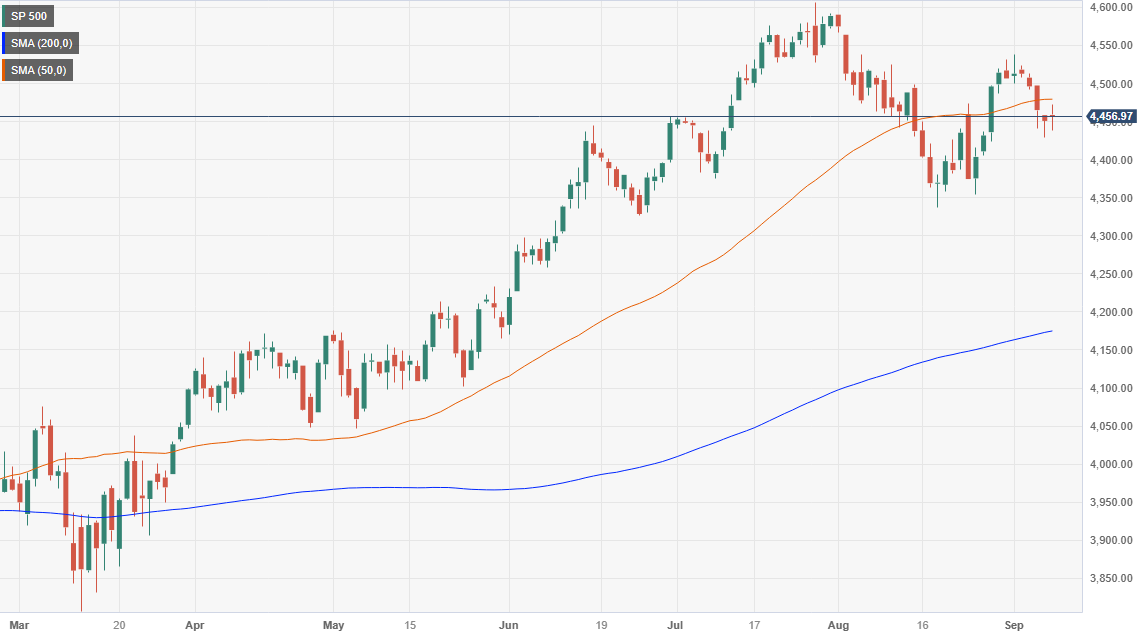
- S&P 500 closed up 0.14% at 4,457.49 on Friday but lost 1.13% for the week, reflecting investor caution amid global economic uncertainties.
- US economic data shows resilience with solid service sector activity and tight labor market, contrasting with gloomy outlooks in China and Europe.
- US Treasury bond yields advance to 4.268% on 10-year note, while the US Dollar Index finishes the week up 0.76%, signaling cautious optimism.

Wall Street finished Friday’s session clinging to minuscule gains after a week that witnessed economic data from the United States (US) would keep the US Federal Reserve sitting on its hand but keeping rates “higher for longer,” as Chair Powell stated in several speeches. Consequently, US Treasury bond yields advanced, while the Greenback finished above a crucial level.
Wall Street clings to modest gains on Friday, but broader concerns over the global economic outlook and mixed Fed stances weigh on weekly performance
Daily, the S&P 500 finished the session at 4,457.49, up 0.14%, while the Nasdaq 100 printed gains of 0.09%, at 13,761.53 and the Dow Jones Industrial Average rose 0.22%, at 34,576.59. However, on a weekly basis, the S&P 500 lost 1.13%, the Nasdaq 100 1.09%, and the Dow Jones 0.75%.
Sector-wise, the biggest winner was Energy, followed by Utilities and Communication Services, each gained 0.97%, 0.96% and 0.35%. On the flip side, Real Estate, Industrials, and Health post losses of 0.63%, 0.46% and 0.04%.
Several reasons affected US equities, but mostly on traders slashing bets on riskier assets, as the global economic outlook looks slightly pessimistic. Data from China and Europe shows the economy is losing steam, with the former set to enter a deflationary scenario, while the Eurozone shows signs of recession.
Recent data in the US shows the economy stays strong and resilient as business activity in the services space picks up, as announced by the ISM Non-Manufacturing PMI. Also, the latest labor market data showed that fewer Americans than expected filed for unemployment claims, a sign of tightness in the labor market.
On the European front, traders slashed bets the European Central Bank would raise rates next week despite dealing with high inflationary levels at around 5.3%. Hence, a stagflationary scenario looks like a possibility in the EU.
Several Regional Federal Reserve Presidents have expressed their views on monetary policy. Presidents Collins, Williams, and Bostic have taken a more dovish stance. In contrast, Chicago Fed President Austan Goolsbee has leaned towards a more neutral position. On the other hand, Lorie Logan from the Dallas Fed emphasized the need for the US central bank to be data-dependent but also stressed the necessity for more rate hikes to address inflationary pressures.
US Treasury bond yields finished the session with the 10-year benchmark note rate at 4.268%, gaining 0.47%. The Greenback, shown by the US Dollar Index, was almost flat at around 105.056 but achieved gains of 0.76% in the week.
WTI rose by 0.51% daily, around 7% weekly, in the commodity space underpinned by tight supplies after Saudi Arabia and Russia’s 1.3 million barrel crude oil cut.
S&P 500 Price Action - Daily Chart
S&P 500 Technical Levels
Author

Christian Borjon Valencia
FXStreet
Markets analyst, news editor, and trading instructor with over 14 years of experience across FX, commodities, US equity indices, and global macro markets.