|premium|

RR Stock Price: Rolls-Royce Holding PLC dips slightly as its volatile week continues

  • LSE:RR sheds 0.29% as the LSE dips alongside global markets.
  • Rolls-Royce continues to recover from its steep drop in October.
  • News of potential COVID-19 vaccines has renewed investor interest.

LSE:RR has been hit hard during the coronavirus pandemic and it is not just because people are not buying its cars. Shares have had a tumultuous couple of months including a near 65% loss back in October. On Tuesday, RR’s stock traded flat as it lost 0.29% to close the trading session at $102.70, which is already a nice 30% recovery from its drop off last month. The stock has been wildly volatile so far this year with a 52-week price range of $1.57 to $746.20. 

When people hear the name Rolls-Royce, the first thing that comes to mind are its luxury vehicles that are hand-crafted and widely considered of the highest quality. But one of the reasons that the stock has struggled throughout the COVID-19 pandemic is that Rolls-Royce is one of the largest manufacturers of jet engines for the commercial airline industry. Similar to Boeing (NYSE:BA) and other companies in the aerospace industry, COVID-19 has completely knocked their businesses offline. Recent announcements from Pfizer (NYSE:PFE) and Moderna (NASDAQ:MRNA) about the efficacy of their current COVID-19 vaccine candidates has re-ignited interest in many of the stocks that have been beaten down throughout the pandemic.

Rolls-Royce share price
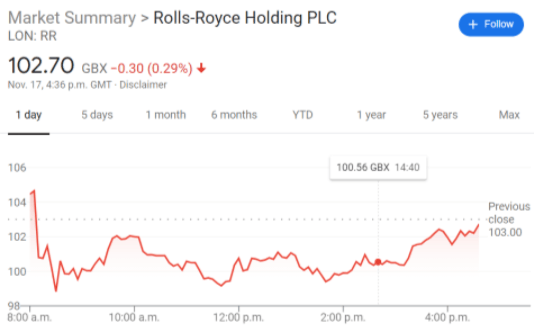
RR stock price chart

So is the stock worth diving back into at its current price levels? Perhaps. We could be in the midst of a rebound from stocks that have struggled during the coronavirus, just like in America where investors have shifted away from at-home companies. Rolls-Royce remains a volatile stock though, especially for one with an established brand and trading on a large exchange. A return to normal for air travel may still not be imminent so the increased optimism surrounding companies like Rolls-Royce could be labelled as an overreaction. 

Premium

You have reached your limit of 3 free articles for this month.

Start your subscription and get access to all our original articles.

Subscribe to PremiumSign In

Author

More from Stocks Reporter
Share:

Editor's Picks

AUD/USD falls to near 0.7100 after slipping below 50-day EMA

AUD/USD depreciates after registering minor gains in the previous day, trading around 0.7120 during the Asian hours. The technical analysis of the daily chart shows the pair consolidating sideways within a rectangle pattern, as neither bulls nor bears gain control. The AUD/USD pair is holding a slight bearish tone however as it sits beneath both the nine-day and 50-day EMAs.

160.00: USD/JPY back near intervention territory after upbeat US jobs report

US Nonfarm Payrolls beat expectations by a wide margin in May, with 172K jobs added. The US Dollar rebounds after the release, helping USD/JPY recover from its intraday lows. Warnings from Japanese authorities continue to limit upside potential near the 160.00 threshold.

Gold targets $4,300 amid stronger Dollar

Gold faces increasing selling interest and navigates the area of three-month lows near the $4,300 mark per troy ounce on Friday. The precious metal’s decline comes as traders assess the stronger-than-expected NFP, while the bid bias in the Greenback and higher US Treasury yields also collaborate with the retracement.

Cardano hits five-year low even as Hoskinson clarifies "break" isn't an exit

Cardano (ADA) price is down 10% at press time on Friday, extending losses over 30% so far this week amid Charles Hoskinson's clarification that "break" isn't an exit.

Week ahead – Fed countdown begins amid US inflation data and geopolitical risks

Fed Chair Warsh’s first meeting approaches as key US inflation data could reshape expectations. Oil prices remain elevated as US-Iran talks continue; tariffs also return to the spotlight. ECB is expected to hike; will it be a one-off move or is July live?

The US economy defies the rules: 100 days into the Oil shock and the recession signal is still missing

More than three months after the start of the Iran war and the resulting disruption to global energy markets, the US economy continues to display remarkable resilience. The conflict has triggered a sharp rise in Oil prices, reignited inflationary pressures and fueled widespread concerns about a potential economic slowdown.