Powell Speech: Fed chairman to answer questions about dovish FOMC statement
- Jerome Powell will answer questions from the press after the Fed decided to raise Fed funds rate by 25 basis points.
- Dovish FOMC statement indicates near end to Fed rate hike quest.
- More hints on whether this has been the final rate hike of the current cycle could trigger wild swings on US Dollar, other asset classes.
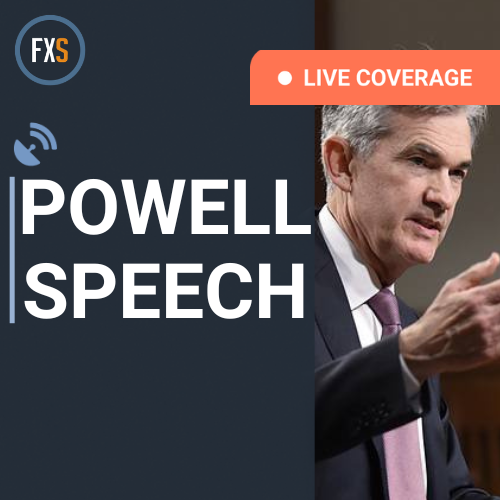
Jerome Powell, Chairman of the Federal Reserve System (Fed), is speaking at the time of writing on a press conference after the Federal Reserve decided to raise the Fed funds rate by 25 basis points, setting the Fed funds rate in the 5%-5.25% range as expected. Powell’s speech will read the Federal Open Market Committee (FOMC) statement, which has been clearly dovish, and answer questions about it afterwards.
Jerome Powell will be asked about whether the Federal Reserve has ended its interest rate hiking quest after the FOMC statement revealed some dovish clues. In its policy statement, the Fed dropped language that it 'anticipates' more policy firming may be appropriate to attain a 'sufficiently restrictive' stance.
Powell’s words will carry enormous importance for the market. The US Dollar has been sold off heavily after the statement and the Fed's chairman press conference could either extend it or trigger a relief reaction to Greenback bulls.
These are the main takeaways from Powell's Q&A sessions at the FOMC press conference:
Clear we need to strengthen supervision, regulation for large banks
"Support for rate hike today was very strong."
"There were a number of policymakers at today's meeting talking about pausing, but not so much at this meeting."
"There is a sense we are much closer to the end than the beginning."
"We feel like we are close, or maybe even there."
"We can afford to look at the data and make a careful assessment."
"Speed of SVB run needs to be reflected in supervision, regulation."
"It's clear we need to strengthen supervision, regulation for large banks."
Would not be appropriate to cut rates
"There are no promises, but it's possible we can continue to have labor market cooling without big increases in unemployment."
"Case of avoiding recession is more likely than having a recession."
"If we have recession, would hope it would be mild."
"Do not think wages are principle driver of inflation."
"As goods pipelines get back to normal, will see prices, corporate margins coming down."
"A particular focus now and going forward is what's happening with credit tightening."
"Need to factor credit tightening into whether our policy stance is sufficiently restrictive."
"Would not be appropriate to cut rates, given our view that inflation will take some time to come down
"Non-housing services inflation hasn't moved much."
Possibly at sufficiently restrictive level, may not be far off
"We are trying to reach and then stay at for an extended period a sufficiently restrictive stance to bring down inflation."
"We have to balance risk of not doing enough against risk of slowing economic activity too much."
"Felt that this rate hike and change in statement was the right way to balance that."
"Will be an ongoing process to assess appropriate level of rates."
"Policy is tight."
"Real rates are around 2%, meaningfully above neutral rate."
"We might possibly be at sufficiently restrictive level, may not be far off."
"We have a goal of getting to 2%, will take some time and will not be a smooth process."
"We think we will need to stay on this for a while."
"Wages still above level consistent with 2% inflation over time."
"Labor market is very very strong, inflation is running high and well above goal."
"Right now we need to focus on bringing inflation down."
Hard to predict how much credit tightening will replace need for any further rate hikes
"Don't have an agenda for further bank consolidation."
"Bank consolidation has been going on for a while."
"Have long felt that having small, medium and large banks is a great part of our banking system."
"Hard to predict how much credit tightening will replace need for any further rate hikes."
"Assessing the extent to which firmer policy will be needed will be ongoing, and meeting by meeting."
"Credit tightening complicates that assessment, adds uncertainty."
"Will be an ongoing assessment whether Fed has reached sufficiently restrictive."
"Not possible to say with confidence if we have reached sufficiently restrictive level."
"Will revisit that at June meeting."
"Before declaring we've reached sufficiently restrictive stands will need more data."
Debt limit issue was not important in today's policy decision
"No one should assume the Fed can protect the economy from a failure to pay bills on time."
"Debt ceiling did come up in discussions."
"Talked about debt limit issue as a risk to the outlook."
"Debt limit issue was not important in today's monetary policy decision."
"Was raised by some as a risk but not critical to today's decision."
"The feFebruary 14 presentation was a general presentation on interest rate risks."
"There was one page on Silicon Valley Bank."
"Nothing in the February 14 briefing about the risk of a bank run."
"Staff was going to do a horizontal assessment of banks, not presented as urgent or alarming."
"Many banks are now attending to liquidity."
"Financial stability tools and monetary policy tools are working well together."
A decision on a pause was not made today
"A decision on a pause was not made today."
"Statement change was meaningful."
"It is a meaningful change to no longer say we anticipate more firming of policy."
"Staff forecast is independent of Fed policymakers."
"Broadly the staff forecast was for a mild recession."
"Staff forecast for this meeting was broadly similar to march forecast."
"Debt limit is a fiscal policy matter for elected officials to deal with."
"It is essential for debt limit to raised in timely way."
"Consequences of a default would be quite adverse."
We are prepared to do more if more is warranted
"Highly attentive to risks of inflation to both sides of mandate."
"We are seeing the effects of policy tightening, particularly in housing and investment."
"Will take time for full effects of monetary restraint to be realize."
"Economy is likely to face headwinds from credit conditions."
"Strains from banking sector resulting in tighter conditions."
"Extent of effects is uncertain."
"Strains from banking system in March is resulting in even tighter conditions."
"Our future policy actions will depend on how events unfold."
"We will make rate determination meeting by meeting."
"We are prepared to do more if more is warranted."
"Reducing inflation likely to require period of below trend growth, softer labor market."
"Restoring price stability is essential."
We will take a data-dependent approach from here
"Conditions in banking sector have broadly improved."
"US banking system is sound and resilient."
"Committed to learning right lessons."
"Focus remains on dual mandate."
"Strongly committed to bringing inflation back down to 2%."
"Without price stability will not achieve sustained strong labor market."
"We will take a data-dependent approach from here."
"Activity in housing sector remains weak."
"Labor market remains very tight."
"Some signs that supply and demand in labor market coming back into better balance."
"Nominal wage growth has shown signs of easing."
"Inflation has moderated somewhat."
Inflation pressures continue to run high."
"Have a long way to go to bring down inflation."
About Jerome Powell
Jerome H. Powell first took office as Chair of the Board of Governors of the Federal Reserve System on February 5, 2018, for a four-year term. He was reappointed to the office and sworn in for a second four-year term on May 23, 2022. Powell also serves as Chairman of the Federal Open Market Committee, the System's principal monetary policymaking body.
Powell has served as a member of the Board of Governors since taking office on May 25, 2012, to fill an unexpired term. He was reappointed to the Board and sworn in on June 16, 2014, for a term ending January 31, 2028.
Author

FXStreet Team
FXStreet
Composed of a group of economic journalists and FX experts, the FXStreet content team produces and oversees all content published on FXStreet. It provides a purely journalistic approach to the Forex market.