|

Pound Sterling Price News and Forecast: GBP/USD may find the primary barrier at the nine-day EMA

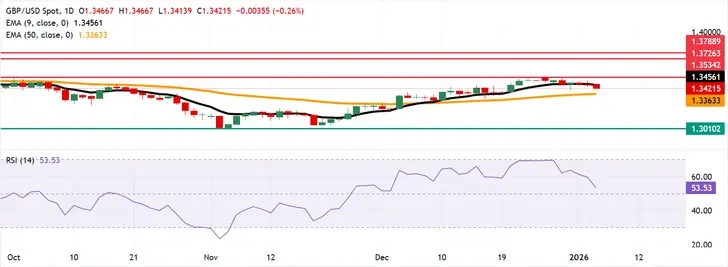
GBP/USD Price Forecast: Falls toward 1.3400 near 50-day EMA

GBP/USD extends its losses for the second successive session, trading around 1.3420 during the Asian hours on Monday. The technical analysis of the daily chart indicates that the 14-day Relative Strength Index (RSI) at 53 (neutral) has eased from near overbought, indicating that momentum has cooled while remaining above the midline. RSI holds above 50, keeping a modest bullish bias.

The nine-day Exponential Moving Average (EMA) stands above the 50-day EMA, preserving a bullish bias as price consolidates below the short-term average but holds over the medium-term line. This suggests a shallow pullback within the prevailing uptrend. The short-term trend pauses as the nine-day EMA flattens, while the rising 50-day EMA underpins the broader advance. Read more...
GBP/USD trades with modest losses below mid-1.3400s as geopolitical tensions lift USD

The GBP/USD pair opens with a modest bearish gap at the start of a new week and trades just below mid-1.3400s during the Asian session, down 0.10% for the day. Spot prices, however, lack follow-through selling and manage to hold above last week's swing low amid mixed fundamental cues.

Against the backdrop of the protracted Russia-Ukraine war and unrest in the Middle East, the US military attack on Venezuela adds to concerns about rising geopolitical tensions and drives some safe-haven flows towards the US Dollar (USD). This assists the USD Index (DXY), which tracks the Greenback against a basket of currencies, to build on its recent recovery from the lowest level since early October and turns out to be a key factor exerting pressure on the GBP/USD pair. Read more...

Author

FXStreet Team

Composed of a group of economic journalists and FX experts, the FXStreet content team produces and oversees all content published on FXStreet. It provides a purely journalistic approach to the Forex market.


More from FXStreet Team
Share:

Editor's Picks

AUD/USD sticks to positive bias above 0.7100; lacks bullish conviction

AUD/USD trades with a positive bias for the second straight day, holding above 0.7100 in the Asian session on Friday as softer US bond yields keep US Dollar bulls on the back foot. Furthermore, hawkish RBA Governor Bullock's comments boost rate hike bets and support the Aussie. However, the Fed's hawkish outlook, along with geopolitical uncertainties, limits USD losses and caps the pair.

USD/JPY approaches 158.00 as Japanese Yen resumes decline

USD/JPY is resuming its upside in the European session on Friday, refreshing two-week highs and nearing 158.00. The Japanese Yen extends losses, despite the Bank of Japan's (BoJ) expected rate hike to 1.25% and hawkish Governor Ueda's comments, as two surprise dissents against the rate hike weigh on it.

Gold keeps the bid tone in place; still below $4,400

Gold adds to the optimism seen in the second half of the week, trading with decent gains just below the $4,400 mark per troy ounce on Friday. The precious metal’s advance finds traction in declining crude oil prices and fresh selling pressure on the US Dollar.

Why altcoin season isn't coming back — and what stole its capital
If, after two years of being frozen in ice, Katara and Sokka woke you up to the crypto market, it would seem like 100 years have passed. With Bitcoin soaring to record highs just over a year ago, everyone expected a routine altcoin season, where investors take profits from the top crypto to chase higher returns in altcoins.
BoJ Recap: Not as hawkish as expected

The BoJ raised its short-term interest-rate target to 1.25% from 1.00% in a 7-2 vote, marking another step in the normalisation of monetary policy and widely matching what everyone has been expecting for weeks. Governor Kazuo Ueda said the policy phase had changed.

BoJ Recap: Not as hawkish as expected

The Bank of Japan (BoJ) raised its short-term interest-rate target to 1.25% from 1.00% in a 7-2 vote, marking another step in the normalisation of monetary policy and widely matching what everyone has been expecting for weeks.












