Think ahead: 2026 in ten charts – Part one


2025 was chaotic. 2026 might be even more so, if this weekend’s drama is anything to go by. James Smith has the pick of the top charts to watch as we start the new year.
Will tariffs fall in 2026?
Sometime soon, the Supreme Court will rule on President Trump’s use of emergency powers to impose country‑level tariffs - and betting markets put the odds of him losing at 70–80%. Comments from the White House suggest it's bracing itself for that too.
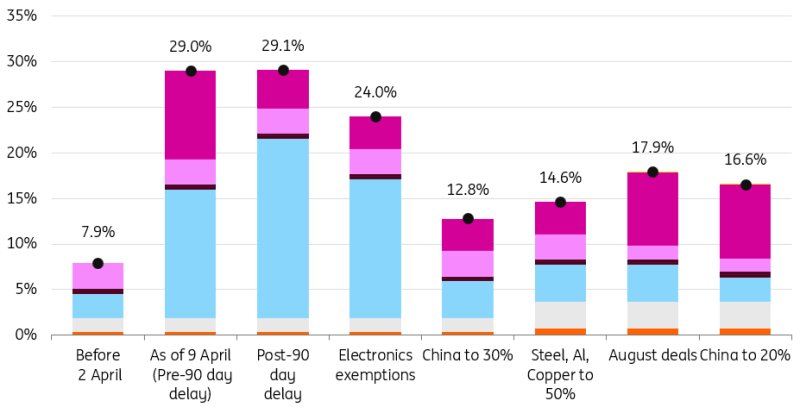
If the Court strikes down the policy, “reciprocal” tariffs disappear, pulling the average tariff rate from roughly 16–17% (on paper) to below 10%, triggering a messy scramble for refund claims. What the President does next is crucial. The Venezuela intervention - risky with his Republican base - hints he may double down on policies central to his ideology. But if emergency powers are off the table, his tariff options become messier.
A temporary fix would be a blanket 15% tariff on all imports, though it only lasts 150 days. More durable sector‑specific tariffs require lengthy investigations and, as Carsten noted in our 2026 outlook, would be damaging. Either way, the President will want to keep tariff revenue flowing if he hopes to sell Congress on his “tariff rebate checks”.
Yet with approval ratings sliding ahead of the midterms - and with some food‑related levies already slashed - broader tariff cuts can’t be ruled out if political pressure builds, regardless of what the Court decides. I certainly wouldn't bet against it...
How Trump's tariffs have changed since 'Liberation Day'
Source: White House, USA Trade, ING
Will the Fed bow to political pressure and slash rates?
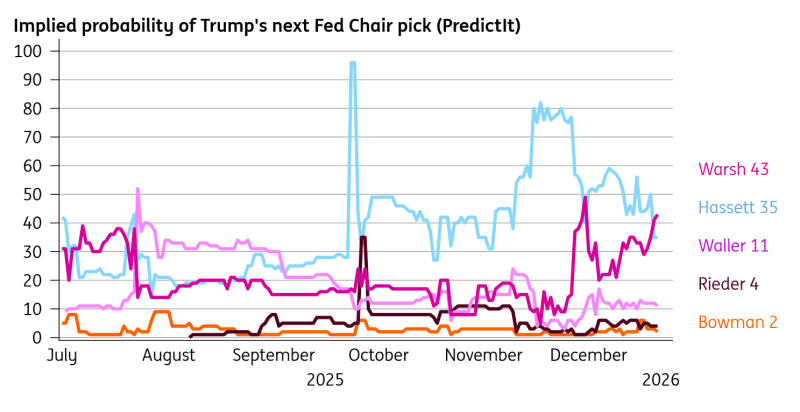
It's the battle of the Kevins - Trump's pick for the next Fed Chair, due imminently. And interestingly, according to betting site PredictIt, former Fed governor Kevin Warsh has just narrowly overtaken Hassett (Director of the National Economic Council) as favourite.
Whoever is picked, remember the Chair is only one vote among twelve. Past Trump appointees – Bowman and Waller – haven’t backed calls for drastic rate cuts, despite being in the running for Chair. And quietly, all twelve regional Fed presidents — who vote on a rotating basis — were reappointed last month without drama, despite fears a more political Fed might try to reappoint only the doves. Deeper rate cuts are not an automatic consequence of a new Fed Chair, but their appointment could herald a more activist central bank, James Knightley reckons.
Still, I'm minded to say the Supreme Court case, starting 21 January, on whether the President can remove Governor Lisa Cook, will be more interesting. A ruling against Cook could theoretically open the door to broader firings and perhaps a far more political Fed. Otherwise, the Fed lineup won’t change again until 2028, when Chair Powell’s term ends, if he doesn’t voluntarily leave before.
Kevin Hassett favourite to become Fed Chair in betting markets
Source: Macrobond
Will US unemployment keep rising?
Remember the Sahm Rule? It says recessions typically follow when the three‑month average unemployment rate rises more than half a percentage point above its 12‑month low. Except in 2024, when a brief immigration-driven spike proved a false alarm. More workers, not all immediately finding work, meant temporarily higher unemployment rates.
The same couldn’t be less true today. Net immigration is collapsing, from 2.8 million in 2024 to 0.4 million in 2025 and 0.6 million this year, according to the CBO.
That may explain softer monthly payroll growth figures, but not rising unemployment. And signs of weakening labour demand are piling up. James Knightley notes that consumer surveys now show most people expect unemployment to rise, and recent payroll gains have been heavily concentrated in just three sectors.
Friday’s numbers will be pivotal. Most expect the unemployment rate to ease back to 4.5% as post‑shutdown distortions fade. But if it doesn’t, the Sahm Rule will be triggered again.
Whether it proves a reliable signal this time remains to be seen, but either way, it strengthens the case for earlier Fed cuts. Markets aren’t fully pricing another move until June; James K sees cuts in March and June and doesn’t rule out rates below 3% if unemployment keeps climbing.
Most US consumers expect unemployment to keep rising

Recession periods judged by NBER
Source: Macrobond, ING
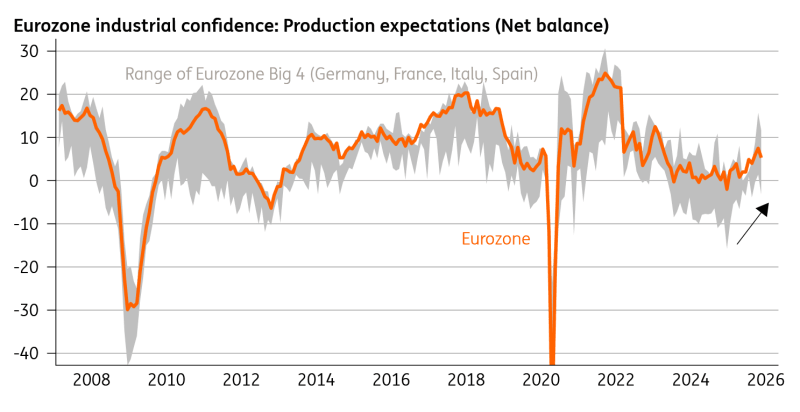
Will European industry surge back to life?
It’s easy to be gloomy about Europe’s manufacturing sector, given China’s move up the value chain and its overcapacity. But the data is finally improving. The manufacturing PMI, while still below 50, generally rose through 2025, and European Commission industrial confidence has picked up. Lower energy prices should reinforce this: our commodities team expects natural gas to stay cheap despite low storage levels. They also expect oil prices to fall sustainably below USD 60/bbl, even after the weekend’s events.
Government efforts should help too. Think of Germany's subsidies for energy prices in intensive industries. And 2026 is "use it or lose it" for the post‑Covid Recovery and Resilience Fund, only half of which had been spent by the end of 2024. This money should be a sizeable, investment-heavy boost for Spain and Italy in particular this year.
Taken together, these forces should keep the ECB in its current “good place”, and that’s why we’re not expecting another rate cut this year.
Production expectations are rising across industry
Source: Macrobond, ING
Will European inflation fall through 2026?
Better industrial growth isn’t the only thing putting a smile on ECB President Lagarde’s face – inflation has been remarkably well behaved, too. And it's likely to stay that way.
That's helped not only by falling energy prices, but also those of key ingredients. Food inflation was a big story in 2025 – it looks like much less of one in 2026. With one exception: Britain.
Supermarket inflation is the highest in Western Europe or the CEE3 (which tends to lead the UK), even if it came a little lower in November. Last year’s tax hikes and National Living Wage hikes amplified the impact of higher costs on British consumers.
But I struggle to see how UK food inflation doesn’t fall with the rest. At a time when the labour market is cooling and wage growth is falling rapidly, the Bank of England still has work to do. December’s meeting was surprisingly hawkish – and on reflection, I think a February rate cut is looking less likely. But I still think we’ll get two cuts through the first half of this year – probably in March and June.
Britain's high food inflation can't last for long

THINK ahead in developed markets
United States (James Knightley)
- Jobs report (Fri): Payrolls growth of roughly 40k would be broadly consistent with recent ADP data, but the focus is likely to be more on the unemployment rate this time. If it fails to fall back - or even rises again - it would boost market rate cut expectations. We are forecasting March and June, but the market isn't fully pricing the first one until June and then September.
United Kingdom (James Smith)
- Bank of England Decision Maker Panel survey (Thu): Though not top of the releases markets look at, Thursday's DMP survey will have a bearing on the next couple of Bank of England decisions. In December, multiple officials cited the survey question showing wage growth expectations have ceased falling over recent months as a reason for additional caution on rate cuts.
THINK Ahead in Central and Eastern Europe
Czech Republic (David Havrlant)
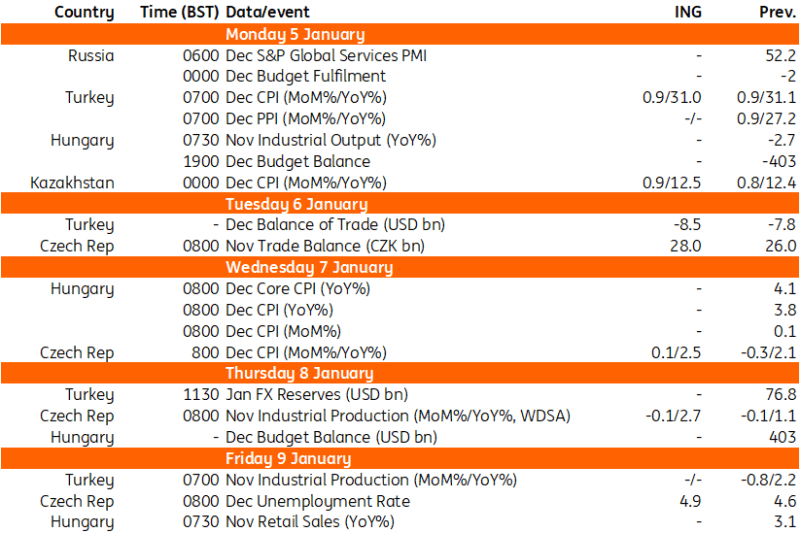
- Trade Balance & CPI (Tue/Wed): The trade balance remained in good shape in November, as Czech exporters were able to direct their products more effectively overseas and are no longer at the mercy of the still lukewarm demand from the EU. Inflation likely bounced back in December, driven by a correction of the previous pronounced dip in food prices. Core inflation likely continued to hover above target. Annual growth of industrial output likely remained in positive territory in November. Meanwhile, the registered unemployment rate likely increased in December, driven by seasonal factors and a still somewhat hesitant industrial performance, suggesting no appetite for hiring.
Turkey (Muhammet Mercan)
- CPI (Mon): Following the significant downside surprise in food inflation last month, we will likely see a rebound in December, leading to monthly inflation at 1.0%, and a slight decline in the annual figure to 31.0% from 31.1%. However, risks are on the downside, supported by limited lira depreciation.
Key events in developed markets next week

Source: Refinitiv, ING
Key events in EMEA next week
Source: Refinitiv, ING
Author
ING Global Economics Team
ING Economic and Financial Analysis
From Trump to trade, FX to Brexit, ING’s global economists have it covered. Go to ING.com/THINK to stay a step ahead.