Pound Sterling falls further against US Dollar while US NFP takes centre stage
- The Pound Sterling remains under pressure against the US Dollar on Thursday.
- Investors await the US NFP report on Friday for fresh cues on the Fed’s monetary policy outlook.
- The next major trigger for the Pound Sterling will be the UK employment data for the three months ending in November.

The Pound Sterling (GBP) extends the decline for the third consecutive day against the US Dollar (USD), trading near 1.3450 during the European trading session on Thursday. The GBP/USD pair is under pressure as the US Dollar trades firmly, following the release of an unexpectedly strong United States (US) ISM Services Purchasing Managers’ Index (PMI) data for December.
At press time, the US Dollar Index (DXY), which tracks the Greenback’s value against six major currencies, trades close to the four-week high of 98.86 posted on Monday.
The data released on Wednesday showed that the ISM Services PMI rose to 54.4 in December from 52.6 in November, marking the highest level since October 2024. Economists expected the data to come in lower at 52.3. Meanwhile, the subcomponents of the Services PMI, such as the Employment Index and New Orders Index, also came in stronger than the previous readings.
Market experts believe that upbeat US Services PMI could be a drag on Federal Reserve (Fed) dovish expectations. Analysts at ING said in a note that “soaring US services clouds the Fed rate cut story".
US Dollar Price Today
The table below shows the percentage change of US Dollar (USD) against listed major currencies today. US Dollar was the strongest against the New Zealand Dollar.
| USD | EUR | GBP | JPY | CAD | AUD | NZD | CHF | |
|---|---|---|---|---|---|---|---|---|
| USD | 0.05% | 0.18% | -0.05% | 0.19% | 0.44% | 0.54% | 0.06% | |
| EUR | -0.05% | 0.13% | -0.09% | 0.14% | 0.38% | 0.47% | -0.00% | |
| GBP | -0.18% | -0.13% | -0.21% | 0.01% | 0.26% | 0.35% | -0.13% | |
| JPY | 0.05% | 0.09% | 0.21% | 0.22% | 0.48% | 0.54% | 0.09% | |
| CAD | -0.19% | -0.14% | -0.01% | -0.22% | 0.25% | 0.34% | -0.14% | |
| AUD | -0.44% | -0.38% | -0.26% | -0.48% | -0.25% | 0.09% | -0.39% | |
| NZD | -0.54% | -0.47% | -0.35% | -0.54% | -0.34% | -0.09% | -0.48% | |
| CHF | -0.06% | 0.00% | 0.13% | -0.09% | 0.14% | 0.39% | 0.48% |
The heat map shows percentage changes of major currencies against each other. The base currency is picked from the left column, while the quote currency is picked from the top row. For example, if you pick the US Dollar from the left column and move along the horizontal line to the Japanese Yen, the percentage change displayed in the box will represent USD (base)/JPY (quote).
Daily Digest Market Movers: Investors await US NFP, UK Employment data
- The Pound Sterling trades lower against safe-haven currencies, but higher vs. its risky currency peers on Thursday. The British currency has been majorly driven by risk sentiment amid a light United Kingdom (UK) economic calendar week.
- Going forward, the major trigger for the Pound Sterling will be the UK employment data for the three months ending in November, which is scheduled for early next week. Investors will pay close attention to the UK labor market data as it will influence market expectations for the Bank of England’s (BoE) monetary policy outlook.
- In December’s policy meeting, the BoE guided that the monetary policy will remain on a “gradual downward path”.
- This week, the GBP/USD pair will be influenced by the US Nonfarm Payrolls (NFP) data for December, which will be published on Friday. Investors will pay close attention to the US official employment data to get fresh cues on the Fed’s monetary policy outlook. In 2025, the Fed delivered three interest rate cuts of 25 basis points (bps) to support weakening job market conditions.
- Ahead of the US NFP, the ADP Employment Change report showed on Wednesday that private employment rebounded by adding 41K workers in December after firing 29K payrolls in November. Meanwhile, the US JOLTS Job Openings data showed that fresh jobs posted in November were 7.146 million, lower than estimates of 7.6 million and the prior reading of 7.449 million.
Technical Analysis: GBP/USD faces selling pressure above 61.8% Fibo retracement at 1.3500
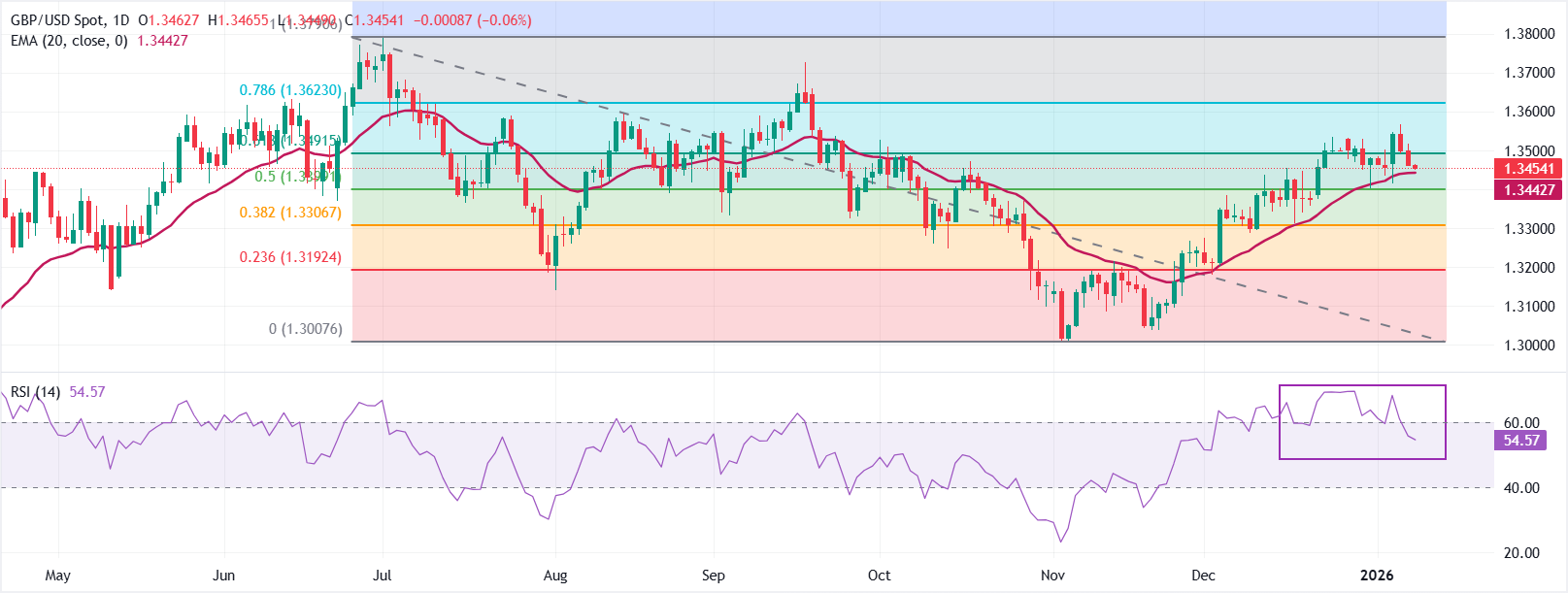
GBP/USD trades lower around 1.3455 as of writing. The price holds marginally above the rising 20-day Exponential Moving Average (EMA) at 1.3443, keeping the near-term bias supported. The 20-day EMA has edged higher in recent sessions, maintaining an upward tilt.
The 14-day Relative Strength Index (RSI) at 54.51 (neutral) after easing from the high-60s shows bullish momentum cooled but remains above the midline.
Measured from the 1.3791 high to the 1.3008 low, the 61.8% Fibonacci retracement at 1.3491 caps the immediate upside. A breakout above this level would extend the rebound toward the 78.6% Fibonacci retracement at 1.3623. Conversely, a close below the 20-EMA at 1.3443 would stall the advance and could open the door for further retracement towards the December 17 low and the 38.2% Fibonacci retracement near 1.3310.
(The technical analysis of this story was written with the help of an AI tool.)
Employment FAQs
Labor market conditions are a key element to assess the health of an economy and thus a key driver for currency valuation. High employment, or low unemployment, has positive implications for consumer spending and thus economic growth, boosting the value of the local currency. Moreover, a very tight labor market – a situation in which there is a shortage of workers to fill open positions – can also have implications on inflation levels and thus monetary policy as low labor supply and high demand leads to higher wages.
The pace at which salaries are growing in an economy is key for policymakers. High wage growth means that households have more money to spend, usually leading to price increases in consumer goods. In contrast to more volatile sources of inflation such as energy prices, wage growth is seen as a key component of underlying and persisting inflation as salary increases are unlikely to be undone. Central banks around the world pay close attention to wage growth data when deciding on monetary policy.
The weight that each central bank assigns to labor market conditions depends on its objectives. Some central banks explicitly have mandates related to the labor market beyond controlling inflation levels. The US Federal Reserve (Fed), for example, has the dual mandate of promoting maximum employment and stable prices. Meanwhile, the European Central Bank’s (ECB) sole mandate is to keep inflation under control. Still, and despite whatever mandates they have, labor market conditions are an important factor for policymakers given its significance as a gauge of the health of the economy and their direct relationship to inflation.
Author

Sagar Dua
FXStreet
Sagar Dua is associated with the financial markets from his college days. Along with pursuing post-graduation in Commerce in 2014, he started his markets training with chart analysis.

















