O’Reilly and AutoZone outperform the S&P 500: Is either a better stock?
-
Auto parts retailer O’Reilly may be forming a constructive cup-with-high-handle pattern.
-
Analysts expect the company to earn $31.82 per share this year, which would be an increase of 2%.
-
Shares of rival AutoZone are up 5.4% since it reported fiscal fourth-quarter results in mid-September.
-
The company topped earnings estimates and delivered stronger-than-ever same-store sales.


Car parts retailers O’Reilly Automotive (NASDAQ: ORLY) and AutoZone (NYSE: AZO) are both attempting to climb out of consolidations, as they outperform the broader market.
O'Reilly Automotive
O’Reilly has been correcting since mid-August when it retreated from a high of $750.88. On a weekly chart, it’s clear that its current consolidation is part of a larger cup-with-high-handle pattern.
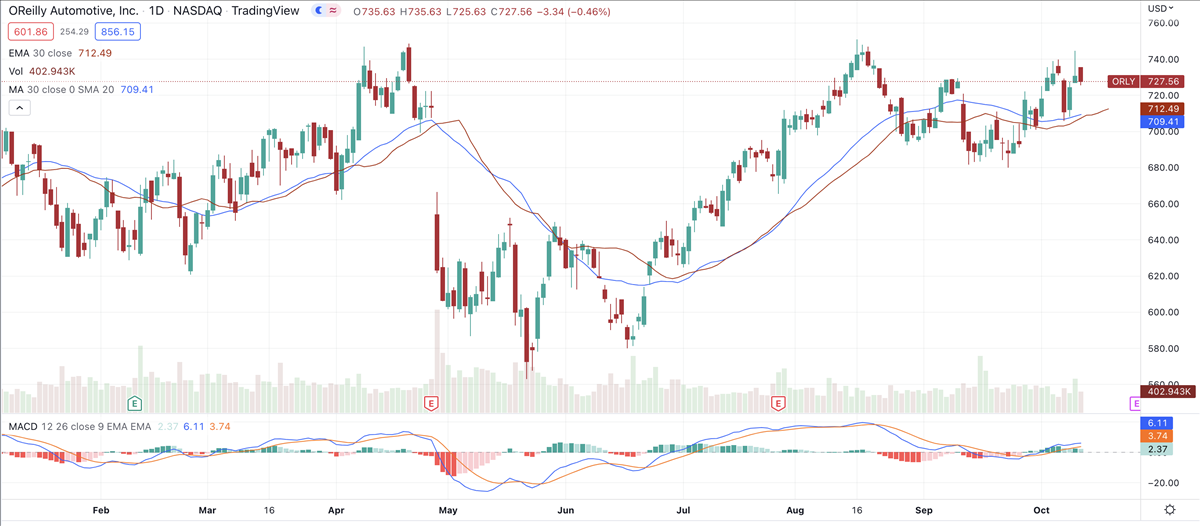
Historically, that pattern can be constructive, as the slight pullback after an interim high serves to shake out weak holders, or those who are snagging some profits. In a bull market, though not necessarily a bear, that price action can set up a fresh rally as buyers with conviction snap up shares.
With a market cap of $46.18 billion, O’Reilly easily qualifies for S&P 500 membership. However, it only comprises 0.155% of index weighting. That means it will tend to follow the broader market, rather than having any influence on its price actions.
MarketBeat earnings data for O’Reilly show the company missed bottom-line views in the past two quarters, and missed revenue expectations in the most recent quarter.
Nonetheless, economic conditions have been favorable for O’Reilly, as well as AutoZone and smaller rivals. Inflation, and especially higher costs of both new and used vehicles, mean consumers keep cars longer, opting to repair problems rather than get a new vehicle.
Indeed, the earnings data also show increases coinciding with the pandemic. Analysts expect the company to earn $31.82 per share this year, which would be an increase of 2%.
O’Reilly operates more than 5,800 stores in 47, and through acquisition, now operates stores in Mexico using the Orma banner.
When it reported its second quarter in late July, the company actually lowered its same-store sales guidance, citing inflationary pressures on its customers. Even so, the stock is up 5.5% since the report. Its sector, Consumer Discretionary, as tracked by the Consumer Discretionary Select Sector SPDR ETF (NYSEARCA: XLY).
That sector is also home to AutoZone, which has an 8.16% year-to-date gain, meaning it’s also outperforming. Analysts have a “moderate buy” rating on AutoZone, the same rating as O’Reilly.
AutoZone
AutoZone shares are up 5.4% since it reported fiscal fourth-quarter results in mid-September. The company topped earnings estimates and delivered stronger-than-ever same-store sales.
Earnings data compiled by MarketBeat show that AutoZone outpaced both sales and earnings views in each of the past 10 quarters. That’s a better past track record than O’Reilly, and that can often bode well for future performance, but is there any indication that AutoZone can continue driving up with strong results?
Wall Street sees earnings coming in at $123.98 per share for the full year, up 8%. For fiscal 2024, that’s expected to rise another 15%, to $142.45 per share.
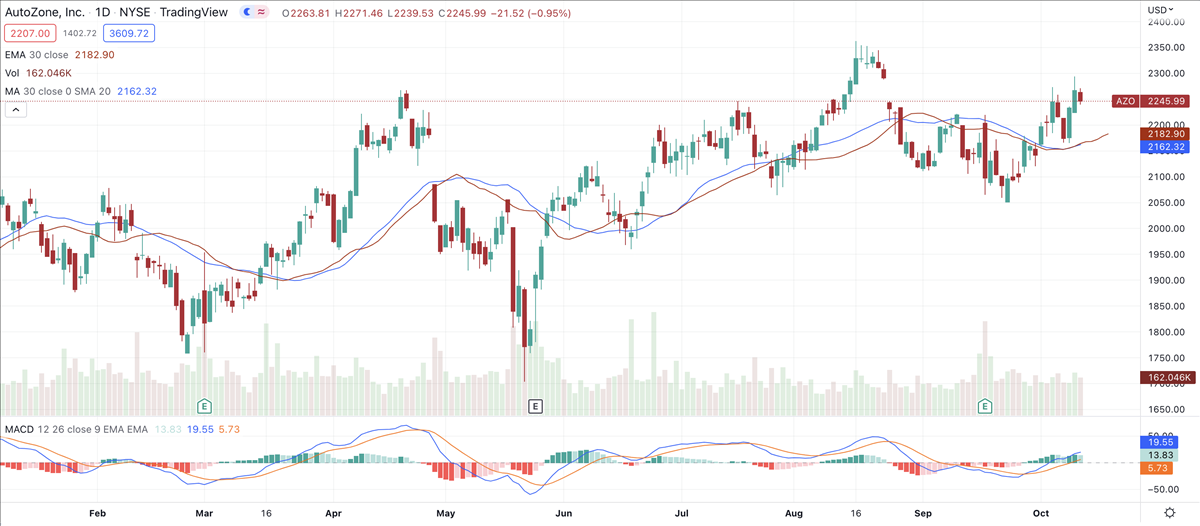
While the expectations and results and recent price performances of the two companies are roughly comparable, what sets them apart?
According to MarketBeat data on institutional ownership, the big investors have put in about the same amount into O’Reilly and AutoZone in the past 12 months. Because both are S&P 500 index components, funds tracking that benchmark have to align their holdings with index weighting. In addition, stocks that are substantially the same when it comes to their business models and other core metrics can be interchangeable when it comes to actively managed funds.
The two companies also have similar market capitalizations.
While AutoZone is more reticent about offering guidance, you can extrapolate that its customers are facing the same challenges as O’Reilly’s, so O’Reilly’s guidance isn’t necessarily a warning sign.
In the end, it may boil down to the chart pattern, and the timing of each stock’s breakout when the market returns to a rally, or at least when more buys present themselves.
In addition, if you are looking for exposure to the auto parts retailing industry, you have other options, such as fellow S&P component Advance Auto Parts (NYSE:AAP). This stock has lagged O’Reilly and AutoZone in terms of profitability, but that may be changing as the company focuses on efficiency.
In addition, Advance’s price performance lags industry peers, as it shows a year-to-date decline while the others are holding up well in a broad market downturn. While the old advice to “buy low, sell high” is certainly a truism, it’s often a better strategy to focus on stocks showing strength while others languish, at least in the near term.
Author
Jacob Wolinsky
ValueWalk
Jacob Wolinsky is the founder of ValueWalk, a popular investment site. Prior to founding ValueWalk, Jacob worked as an equity analyst for value research firm and as a freelance writer. He lives in Passaic New Jersey with his wife and four children.