|

NZD/USD slips below 0.6000 as risk appetite crumples

  • The NZD/USD has dropped back beneath 0.6000 as markets turn back into the US Dollar.
  • The Kiwi's recovery pattern is beginning to calcify into consolidation.
  • NZ PPI to close out the Kiwi's data for the week, US Housing Starts in the barrel for Friday.

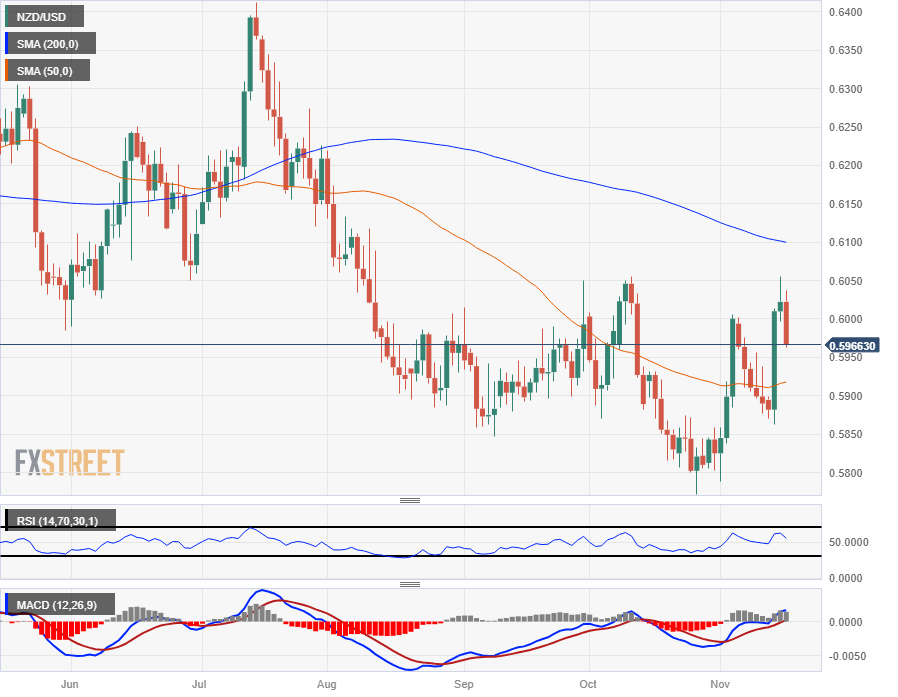
The NZD/USD is slipping back on Thursday and is set for its worst trading day in a month, down over 1.2% from the day's high of 0.6037.

A broad miss for US economic data soured market risk appetite, pushing the US Dollar (USD) higher against riskier assets like the Kiwi (NZD). US Initial Jobless Claims for the week into November 10th increased to 231K, higher than the 220K expectation and stepping over the previous week's 218K showing (revised upwards from 217K).

US Industrial Production also missed the mark, with October's production declining by 0.6%, falling back from September's meager 0.1% growth (revised downward from 0.3%) and blowing right past the market's forecast of -0.3%.

New Zealand's Producer Price Index (PPI) will land in the early Friday session when NZ markets open ahead of the pack. NZ PPI in the third quarter last came in at -0.2% for Input and 0.2% for Output.

NZD/USD Technical Outlook

The Kiwi's pullback below the 0.6000 handle leaves the NZD/USD exposed to further downside, with the pair at risk of getting pulled back through the 50-day Simple Moving Average (SMA) and into the 0.5900 handle, with the last swing low sitting near 0.5860.

On the topside, This week's peak at 0.6050 represents a technical resistance level due to repeated rejections from the region since falling into the sub-0.6100 zone in August. Long-term technical resistance will be capping off any upside runs at the 200-day SMA near 0.6100.

NZD/USD Daily Chart
NZD/USD Technical Levels

NZD/USD

Overview
Today last price0.5966
Today Daily Change-0.0056
Today Daily Change %-0.93
Today daily open0.6022
 
Trends
Daily SMA200.5886
Daily SMA500.5916
Daily SMA1000.6002
Daily SMA2000.6101
 
Levels
Previous Daily High0.6055
Previous Daily Low0.5996
Previous Weekly High0.6002
Previous Weekly Low0.5877
Previous Monthly High0.6056
Previous Monthly Low0.5772
Daily Fibonacci 38.2%0.6033
Daily Fibonacci 61.8%0.6019
Daily Pivot Point S10.5994
Daily Pivot Point S20.5966
Daily Pivot Point S30.5935
Daily Pivot Point R10.6053
Daily Pivot Point R20.6083
Daily Pivot Point R30.6112

Author

Joshua Gibson

Joshua joins the FXStreet team as an Economics and Finance double major from Vancouver Island University with twelve years' experience as an independent trader focusing on technical analysis.


More from Joshua Gibson
Share:

Editor's Picks

AUD/USD bulls regain control above 0.6950 amid USD retreat

AUD/USD regains traction and extends the previous day's bounce from the weekly low, aiming for 0.7000 in Asia on Friday. The overnight pullback in US bond yields keeps the US Dollar below an 18-month high, which in turn offers some support to the pair. Meanwhile, hawkish RBA expectations also keep the major underpinned.

USD/JPY holds gains near 158.00 after Japan's weak Household Spending data

USD/JPY clings to gains around 158.00 after data showed on Friday that Japan's Household Spending fell for the ninth straight month, undermining the Japanese Yen. Meanwhile, the US Dollar remains depressed as the overnight fall in US bond yields counters a hawkish Fed and geopolitical uncertainties, could cap any downside in the pair.

Gold remains range-bound below $4,200

Gold has given up some ground after an initial bullish attempt to reach weekly highs, returning to below the $4,200 mark per troy ounce on Friday. The US Dollar’s strong upside momentum, combined with rising US Treasury yields across the curve, seems to keep further gains in the yellow metal under scrutiny.

Has Bitcoin really escaped the macro forces it was built to fight?
Over 17 years ago, Satoshi Nakamoto designed Bitcoin (BTC) on the back of a global financial crisis as an alternative to the global monetary system outside the control of central banks, governments and traditional intermediaries. This raises a key question: has Bitcoin really become independent of the macroeconomic forces it was built to challenge?
The Euro is not the sick man of Europe. France's bond market is
EUR/USD remains under pressure, near the 17-month low of 1.1161 reached on Monday. The pair has lost more than 7% since its yearly peak, as concerns over France's public finances increasingly weigh on the single currency. But behind the weakness of the Euro (EUR), the problem does not necessarily lie with the European economy as a whole.
Has Bitcoin really escaped the macro forces it was built to fight?
Over 17 years ago, Satoshi Nakamoto designed Bitcoin (BTC) on the back of a global financial crisis as an alternative to the global monetary system outside the control of central banks, governments and traditional intermediaries. This raises a key question: has Bitcoin really become independent of the macroeconomic forces it was built to challenge?














