|

NZD/USD climbs above 0.6100 after the US unemployment rate rose

  • NZD/USD edges up following a mixed US Nonfarm Payrolls report.
  • The Unemployment Rate in the United States edged up, easing pressure on the Federal Reserve to act.
  • NZD/USD Price Analysis: It is still downward biased but could test 0.6200.

NZD/USD advances sharply following the release of mixed labor market data in the United States (US). Wall Street opened in the red, reflecting a sour sentiment, while the US Dollar (USD) weakened across the FX board. At the time of writing, the NZD/USD advances 0.76% and trades at 0.6142.

Post US NFP money market futures begin to price in a less hawkish Fed

The highlight of the day, the US Nonfarm Payrolls report for February, showed the economy adding 311,000 jobs, exceeding estimates. January’s data was revised down from 517,000 to 504,000. The Unemployment Rate was above estimates of 3.4%, at 3.6%, signaling that the labor market is easing. Average Hourly Earnings grew 4.6%, and the focus shifted toward the US Consumer Price Index (CPI) next Tuesday.

The data weakened the US Dollar, as shown by the NZD/USD climbing from 0.6117 to 0.6140s. Investors’ initial assessment of the report sees the US Federal Reserve (Fed) hiking rates by 25 bps in March., contrarily to a 50 bps increment. Meanwhile, the swaps markets foresee the first rate cut by the year’s end.

During the week, Fed Chief Jerome Powell stated that rates would peak higher, and if data warranted a faster pace of tightening, the US central bank is ready to act. Now that the first tranche of US data is under the belt, Powell and Co. will be focused on next week’s CPI. Traders should remember that the Fed blackout would begin on Friday at 23:59 hrs.

On the New Zealand front, the economic calendar featured Business PMI in New Zealand, which came at 52 above the previous month’s reading of 50.8, rising for two consecutive months after bottoming around 47.4 in November 2022. Manufacturing Sales in NZ plunged 9.9% YoY, its most significant decline since mid-2020.

NZD/USD Technical analysis

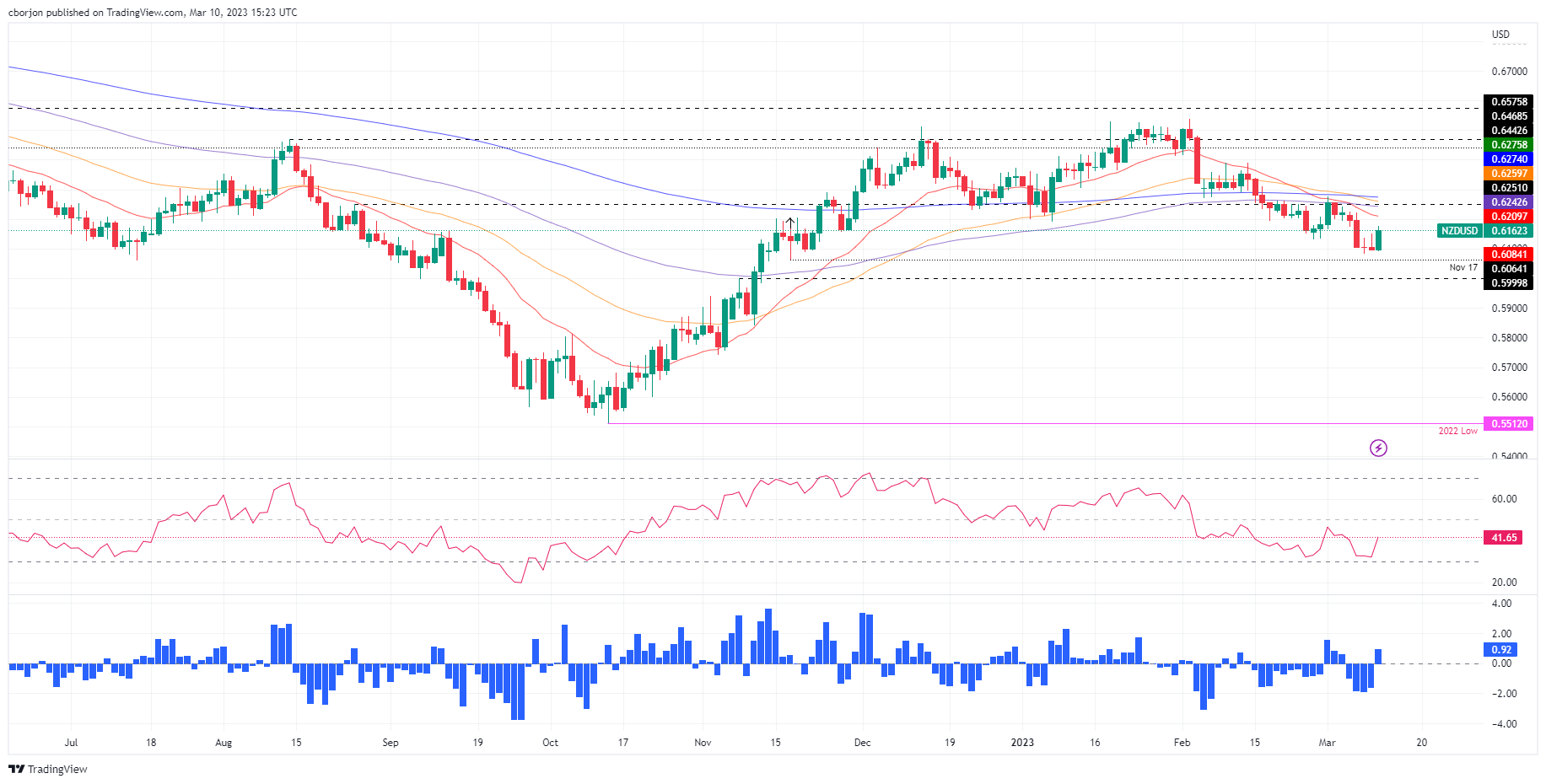
NZD/USD daily chart suggests the downtrend stays intact after a death cross emerged on March 7. That exacerbated the major’s fall to YTD lows of 0.6084. Nevertheless, the uptick in the unemployment rate in the US spurred a jump in the NZD/USD towards the 0.6150s area. If the NZD/USD reclaims the 20-day EMA at 0.6209, that will pave the way toward the 100-day EMA at 0.6242. Otherwise, the NZD/USD could be headed back to 0.6100 before testing the YTD lows.
NZD/USD

Overview
Today last price0.6164
Today Daily Change0.0061
Today Daily Change %1.00
Today daily open0.6103
 
Trends
Daily SMA200.6222
Daily SMA500.6324
Daily SMA1000.6236
Daily SMA2000.617
 
Levels
Previous Daily High0.6152
Previous Daily Low0.6096
Previous Weekly High0.6277
Previous Weekly Low0.6131
Previous Monthly High0.6538
Previous Monthly Low0.6131
Daily Fibonacci 38.2%0.6117
Daily Fibonacci 61.8%0.6131
Daily Pivot Point S10.6082
Daily Pivot Point S20.6061
Daily Pivot Point S30.6026
Daily Pivot Point R10.6138
Daily Pivot Point R20.6173
Daily Pivot Point R30.6194

Author

Christian Borjon Valencia

Markets analyst, news editor, and trading instructor with over 14 years of experience across FX, commodities, US equity indices, and global macro markets.


More from Christian Borjon Valencia
Share:

Editor's Picks

AUD/USD sits near monthly high, around 0.7035 on hawkish RBA

AUD/USD trades around 0.7030-0.7035 in the Asian session on Thursday, near its monthly top, as recent hawkish comments from RBA officials continue to underpin the Australian Dollar. The US Dollar, meanwhile, struggles to lure buyers amid further declines in US bond yields, adding support to the pair. However, Fed rate-hike bets and geopolitical uncertainty help limit losses for the safe-haven buck, warranting caution for Aussie bulls.

USD/JPY remains confined in a familiar range; holds steady above 158.00

USD/JPY extends its consolidative price action through Thursday's Asian session, trading just above 158.00 amid diverging forces. Uncertainty over the timing of the next BoJ rate hike keeps Japanese Yen bulls on the defensive. The US Dollar, meanwhile, languishes near multi-week low amid declining US bond yields. Furthermore, looming intervention risks limit JPY losses and cap the pair. Traders also seem hesitant ahead of the Fed and BoJ meetings next week.

Gold hangs near one-week low; eyes $4,100 break amid Fed hike bets

Gold attracts fresh sellers in Thursday’s Asian session, sliding closer to a one-week low touched the previous day. Firming expectations for an imminent Fed rate hike, bolstered by oil-driven inflation risks, weigh on the non-yielding bullion. Meanwhile, declining US bond yields counter geopolitical uncertainty, keeping US Dollar bulls on the defensive. This helps XAU/USD defend $4,100.

Dogecoin Labs launches, resistance looms
Dogecoin (DOGE) Labs launched Wednesday in partnership with the Dogecoin Foundation, bringing together several product teams and technologies to expand the use of the memecoin (DOGE) across payments, decentralized finance (DeFi) and consumer applications. The launch will consolidate MyDoge, DogeOS and Such App under one business, led by Jordan Jefferson, founder of MyDoge and DogeOS.
What the midterm elections mean for Treasury yields, the Dollar and Gold
Democrats are priced to take the House, so November 3 comes down to the Senate and how much Washington can borrow without the other party. Treasury yields will show the answer first, then the Dollar and Gold. On November 3, Americans vote for all 435 House seats and 35 Senate seats. For bond prices, the result comes down to one thing: how much the government will borrow over the next two years.
The US Dollar fell. Gold didn't rally. That tells you everything
Gold (XAU/USD) is struggling to capitalize on a weaker US Dollar (USD), after repeatedly failing to establish itself above the $4,200 level. The precious metal remains confined to a relatively narrow trading range despite a combination of developments that would normally support higher prices.