Nvidia Stock Forecast: NVDA drops to $421 as market turns south
- Nvidia appears to be readying for a pullback at the moment.
- NVDA is still trading in overbought territory on the RSI.
- Fed Chair Powell’s testimony has depressed markets this week.
- Barclay’s named Nvidia its top AI pick on Thursday.

Three days into this four-session trading week, Nvidia (NVDA) appears to be headed for a pullback. While last week the leading maker of advanced GPUs for the artificial intelligence industry advanced 10.1%, this week has seen an overall 0.8% gain from a mixed bag of price action. Despite a decent gain on Tuesday, Nvidia traded lower on Wednesday and Thursday as the tech-heavy NASDAQ Composite slid 0.43% on the week.
NVDA stock is down 2% in Friday's first half hour, while the NASDAQ Composite declines 1.15%.
Nvidia stock news: With Powell testimony, markets expect ‘higher for longer’ rate regime
The overall market has been somewhat depressed this week after Jay Powell, the Chair of the Federal Reserve, testified before the two houses of Congress this week on keeping interest rates elevated for the foreseeable future.
On Wednesday, Powell addressed a committee of the House of Representatives, and then on Thursday it was a banking committee at the Senate. Both occasions saw Powell stick to his guns on keeping rates high through the end of the year. The market sold off on both days as Powell reiterated his belief that the central bank would raise interest rates on two more occasions this year – this despite the market largely expecting the bank to either halt rate hikes altogether or apply a single hike sometime in the second half of 2023.
The “higher for longer” interest rate regime that most expect to remain heading into 2024 should put downward pressure on growth stocks since the risk-free rate will remain high. Nvidia is chiefly valued around 40x sales, because Wall Street expects revenues to explode due to AI-based investment over the course of this decade. Higher rates, however, make future profits somewhat less valuable compared with a lower rate environment.
Nvidia stock news: Barclays makes NVDA top AI pick
On Thursday, Barclays bank analysts said Nvidia was their top pick for the AI revolution over Microsoft (MSFT), which owns a majority share of ChatGPT-creator OpenAI. In a note to clients, Barclays wrote that while Microsoft’s expectation calls for AI to lead to a 1% gain in its Azure cloud business, Nvidia expects revenue to jump from $7.2 billion in the most recent quarter reported in May to $11 billion in the current quarter, the results of which will be reported in late August.
“We believe that most of the near-term economic value attached to AI will accrue to a handful of key names in the foundational hardware segments of the AI value chain,” wrote Barclays.
Indeed, analysts are already estimating that largely due to AI investment from hyperscalers, Nvidia revenue will top $42.8 billion this fiscal year and reach nearly $52.5 billion the following year.
Nvidia stock forecast
Nvidia stock has made a rounding shape over the past five sessions that are similar to a bearish tower top, although the pattern is not a perfect rendition. The most popular reason to see a bearish setup for NVDA stock is the Relative Strength Index (RSI). It is true that the RSI has mostly been overbought (trading above the 70 level) since May 18, but at some point the stock needs to trade lower and let the RSI sink to normal, neutral levels – 50 at the least.
NVDA stock is below $428 in the premarket. A break of $420 should see Nvidia stock pull back to $400 at least. That price level is a good round psychological level for traders, but it may not hold.
If it fails to hold, then the $373 to $378 demand zone should provide the necessary support. This region held up from May 25 to June 8. With the overall market looking ready for a pullback – the NASDAQ 100 is also overbought on the daily RSI – it wouldn’t be unusual for a certain portion of traders to take profits.
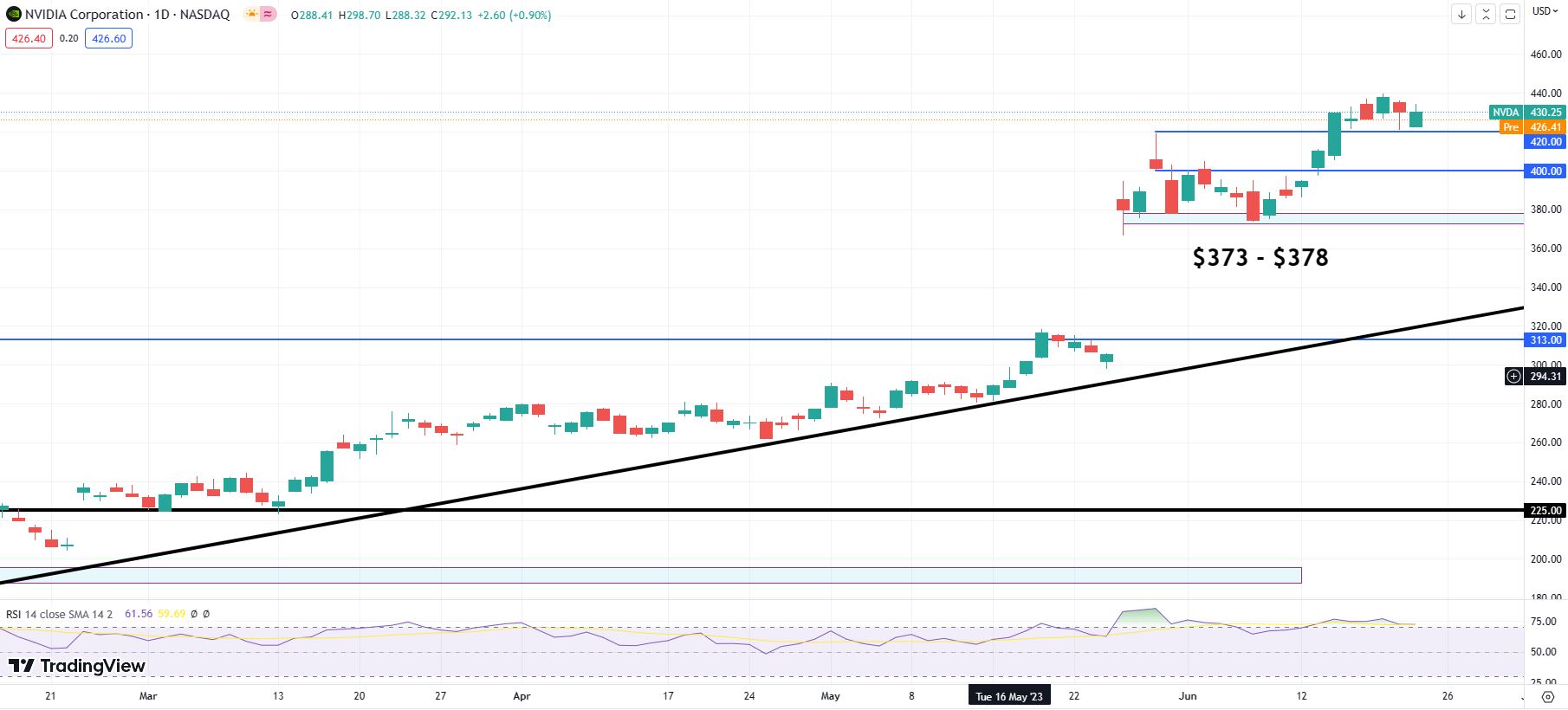
NVDA daily chart
Author

Clay Webster
FXStreet
Clay Webster grew up in the US outside Buffalo, New York and Lancaster, Pennsylvania. He began investing after college following the 2008 financial crisis.