Mullen Automotive Stock Forecast: MULN surges 18% on Wednesday after 30% crash
- MULN stock rose nearly 5% in Wednesday’s premarket.
- Mullen shares plunged 30% on Tuesday.
- CEO David Michery sold more than 2 million shares for close to $0.26.
- MULN stock is down 99.6% over the past year.

Mullen Automotive (MULN) stock jumped 18% at the start of trading on Wednesday's regular session, rising from $0.16 to $0.19. This was impressive since the stock lost 29.9% of its value on Tuesday. Despite a letter on June 15 that attempted to calm shareholder worries, CEO and founder David Michery sold more than 2 million shares of common stock last Friday, June 21, which appears to have triggered Tuesday’s plummet in the share price.
Mullen stock news: Michery sells shares after MULN plummets 90%
CEO David Michery sold 2,090,979 shares of the electric vehicle company on June 16, according to a filing with the Securities & Exchange Commission (SEC). These shares were exercised on a day when the MULN price closed at $0.2616. This means Michery took home at least $547,000.
Michery actually had another 541,813 shares expire worthless due to his 2022 performance stock award compensation that required the MULN share price to hold above a certain level. However, as Michery himself admitted in a letter to shareholders on June 15, Mullen stock has lost 90% of its value just since March 31 of this year.
The heavy implosion of the share price was largely due to the extreme level of dilution going on. Mullen has been funding its pre-revenue operations by selling common stock and warrants at a blistering speed. Just the previous week, Mullen announced 586 million shares of common stock and warrants for common stock in order to fund its production ramp-up. This meant dilution of more than a third in the span of a few days.
In his letter to shareholders, Michery wrote: “We want to respond to the many emails and calls regarding the decrease in our share price. Since March 31, 2023, our stock has declined 90% from $3.25 per share. On June 13, 2023, the Company’s common stock closed at $0.32 per share. The Company currently trades at a discount to its current cash position of $135 million or $0.38 per share.
“Despite the decline in stock price, management believes we are in position to meet the previously announced objectives for moving first into the production and then sale of our Class 3 commercial vehicles during the quarter ending Sept. 30, 2023.”
Following that letter to shareholders last Thursday, Michery’s immediate sale of more than 2 million shares on Friday produced a run on the stock this Tuesday. The company is now valued at a market cap of $39 million and looks to be headed toward bankruptcy if nothing changes. Of course, Mullen has survived for more than a decade by finding a steady stream of willing investors, so let’s just see if Michery can wriggle out of this situation.
EV stocks FAQs
What are electric vehicles?
Electric vehicles or EVs are automobiles that use rechargable batteries and electric motors to accelerate rather than internal combustion engines (ICEs). They have been around for more that 100 years, but battery technology research & development was meager for much of the 20th century. Lithium-ion battery technology became advanced enough to produce EVs at scale in the late 1990s and 2000s, and sales have been steadily increasing since then Tesla’s Roadster was unveiled in 2008. EVs are viewed as a means of reducing carbon emissions since battery electric vehicles (BEVs) themselves produce zero emissions. Other vehicles called plug-in hybrid electric vehicles (PHEVs) utilize both battery electric power and ICEs as a backup.
What is the market share held by EVs?
EVs are growing from a small base, but they rose from 9% of global new auto sales in 2021 to 14% of the total in 2022. This was a 65% YoY growth rate, and the industry delivered 10.2 million EVs worldwide in 2022. Projections show this number climbing above 16 million in 2023. Across the world, market shares differ greatly among nations. Nearly 88% of Norwegian new car sales in 2022 were EVs. On the other hand, the United States, where much of the modern innovation in EVs was forged, had less than 8% of new vehicle sales go to EVs in 2022. The largest EV market in the world, China, saw 30% of the market go to EVs that year.
Who is the father of the EV?
We know you’re thinking Elon Musk, but he’s probably more like the father of the mass-market, contemporary EV. All the way back in 1827, a Hungarian priest named Anyos Jedlik invented the electric motor and used it the following year to power a vehicle of sorts. French scientist Gaston Planté invented the lead-acid battery in 1859, and German engineer Andreas Flocken built the first true electric car for the public in 1888. EVs made up about 38% of all vehicles sold in the US around 1900. They began losing market share rapidly after 1910 when gasoline-powered vehicles grew much more affordable. They largely died off until new research programs in the 1990s led to gradual private sector investment in the 2000s.
Who are the biggest makers of electric vehicles?
China’s BYD is by far the largest manufacturer of EVs in the world. In 2022 it sold 1.8 million EVs and in the second half of the year made up 20% of the global market. The asterisk given to BYD is that the vast majority of these vehicles are hybrids. Tesla’s 12% market share is often treated as more significant than BYD, because it only sells BEVs and is the most famous EV brand in the world. Volkswagen, BMW and Wuling then round out the top five. As a new sector with heavy investment though, many startups have flooded the market. These include China’s Nio, Li Auto and Xpeng; a Swedish-Chinese manufacturer called Polestar; and Lucid and Rivian from the US.
Mullen stock chart
What to even say? MULN stock is down 99.6% over the past year. The company’s shareholder meeting scheduled for early August is expected to offer shareholders the ability to vote on another reverse stock split. Mullen’s last stock split on May 4, less than two months ago, gave shareholders one share for every 25 they previously owned. The new one is expected to give one share for every 10.
The daily chart below compares Mullen’s stock price to a number of other EV upstarts that have experienced extreme sell-offs over the past year. Rivian (RIVN), Lucid (LCID), Nio (NIO) and Polestar (PSNY) are all trading between 45% and 65% lower, but Mullen is the only one down more than 99%. That’s really something.
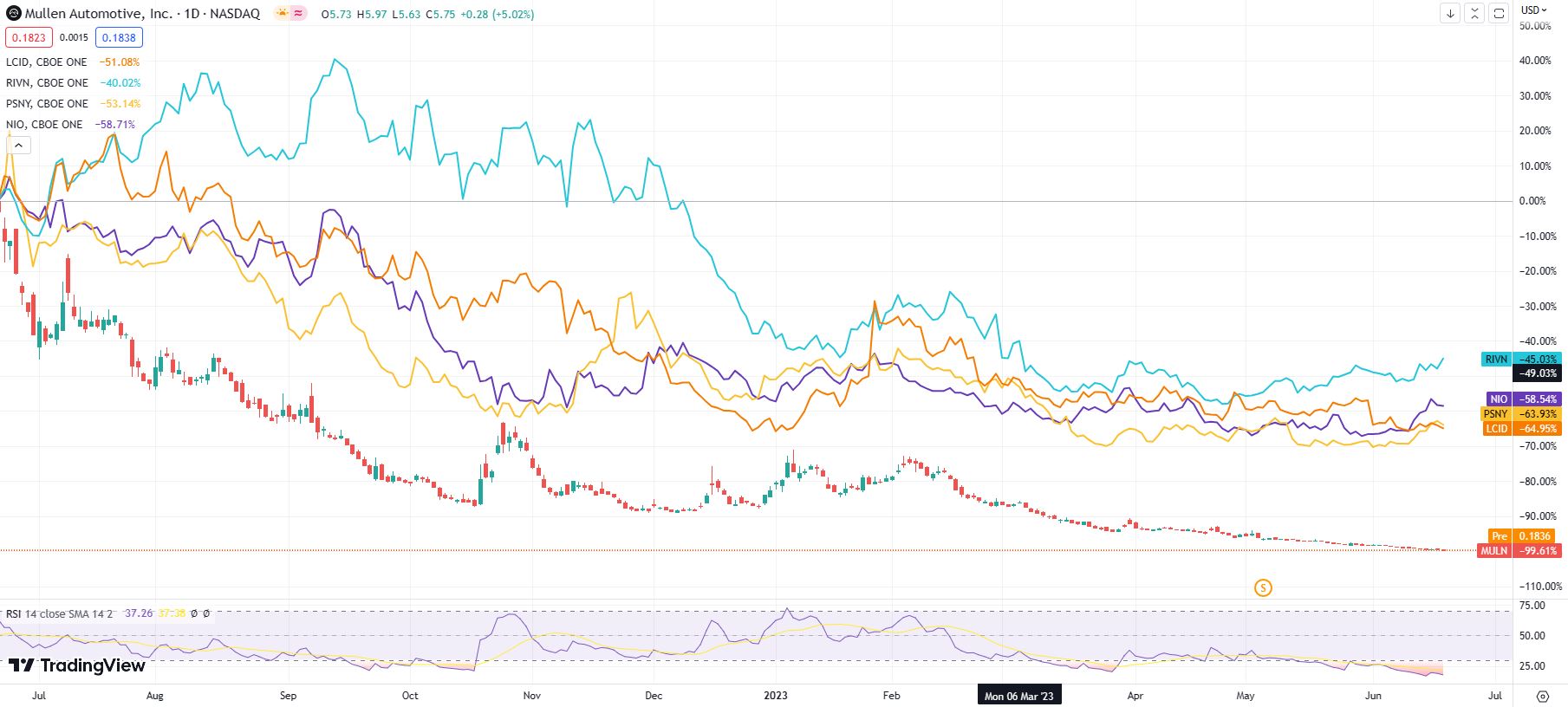
MULN 1-year chart
Author

Clay Webster
FXStreet
Clay Webster grew up in the US outside Buffalo, New York and Lancaster, Pennsylvania. He began investing after college following the 2008 financial crisis.