Nio Stock Forecast: NIO unable to rise above $10, as Chinese equity pessimism returns
- Goldman Sachs has cut its outlook for 2023 Chinese GDP growth to 5.4%.
- Nio cut model prices by $4,200 earlier in June.
- May deliveries from the electric-vehicle company dropped 12% YoY.
- NIO stock drops 3% in Tuesday premarket.
Nio (NIO) stock is on the backfoot on Tuesday after Goldman Sachs released an update to its economic outlook for China on Monday that forecasts 5.4% growth in 2023. Goldman’s prior forecast had predicted 6% growth.
This news sent most Chinese American Depository Shares (ADRs) lower early Tuesday, including Nio. The stock is down 2% at $9.20 in Tuesday’s early trading, while the broader market also looks pessimistic. NASDAQ 100, S&P 500 and Dow futures are all dropping around 1% at the time of writing.
Nio stock news: Chinese economy upsets again
A narrative has begun to set in across Wall Street. It follows a generally pessimistic approach to Chinese equities. If it’s not related to the Chinese government’s crackdown on tech companies, then pundits point out that Chinese growth is faltering in the post-pandemic world. If it’s not related to the US belief that China is imminently prepared to invade Taiwan – and thus experience repercussions from US or EU sanctions – then they say that China’s unwillingness to allow US regulators to view audits from ADR-linked companies makes them uninvestable. They just can’t seem to win.
Goldman’s new downgrade of Chinese economic growth signals yet another fault line in the deteriorating relationship between US investors and the once beloved Chinese equity market. Chinese youth unemployment rose to a record high last week, and retail sales, industrial growth, and fixed asset investment figures all showed a flagging level of growth over the past month.
In unrelated but important news, Alibaba’s (BABA) long-time CEO on Tuesday left his position. Daniel Zhang will be leaving the company to head up Alibaba’s new cloud computing spinoff. This news was previously reported, but BABA stock still sold off 2% on the news that Joseph Tsai will take over as chairman. The cloud computing segment is viewed as the most profitable part of Alibaba.
Nio delivered 6,155 electric vehicles in May – a 12.4% decrease from the year-ago quarter. In response, management cut prices by an average of $4,200. To make matters worse, Nio’s gross margin in the first quarter dropped to 1%. Just one year ago, this figure was close to 14%.
EV stocks FAQs
What are electric vehicles?
Electric vehicles or EVs are automobiles that use rechargable batteries and electric motors to accelerate rather than internal combustion engines (ICEs). They have been around for more that 100 years, but battery technology research & development was meager for much of the 20th century. Lithium-ion battery technology became advanced enough to produce EVs at scale in the late 1990s and 2000s, and sales have been steadily increasing since then Tesla’s Roadster was unveiled in 2008. EVs are viewed as a means of reducing carbon emissions since battery electric vehicles (BEVs) themselves produce zero emissions. Other vehicles called plug-in hybrid electric vehicles (PHEVs) utilize both battery electric power and ICEs as a backup.
What is the market share held by EVs?
EVs are growing from a small base, but they rose from 9% of global new auto sales in 2021 to 14% of the total in 2022. This was a 65% YoY growth rate, and the industry delivered 10.2 million EVs worldwide in 2022. Projections show this number climbing above 16 million in 2023. Across the world, market shares differ greatly among nations. Nearly 88% of Norwegian new car sales in 2022 were EVs. On the other hand, the United States, where much of the modern innovation in EVs was forged, had less than 8% of new vehicle sales go to EVs in 2022. The largest EV market in the world, China, saw 30% of the market go to EVs that year.
Who is the father of the EV?
We know you’re thinking Elon Musk, but he’s probably more like the father of the mass-market, contemporary EV. All the way back in 1827, a Hungarian priest named Anyos Jedlik invented the electric motor and used it the following year to power a vehicle of sorts. French scientist Gaston Planté invented the lead-acid battery in 1859, and German engineer Andreas Flocken built the first true electric car for the public in 1888. EVs made up about 38% of all vehicles sold in the US around 1900. They began losing market share rapidly after 1910 when gasoline-powered vehicles grew much more affordable. They largely died off until new research programs in the 1990s led to gradual private sector investment in the 2000s.
Who are the biggest makers of electric vehicles?
China’s BYD is by far the largest manufacturer of EVs in the world. In 2022 it sold 1.8 million EVs and in the second half of the year made up 20% of the global market. The asterisk given to BYD is that the vast majority of these vehicles are hybrids. Tesla’s 12% market share is often treated as more significant than BYD, because it only sells BEVs and is the most famous EV brand in the world. Volkswagen, BMW and Wuling then round out the top five. As a new sector with heavy investment though, many startups have flooded the market. These include China’s Nio, Li Auto and Xpeng; a Swedish-Chinese manufacturer called Polestar; and Lucid and Rivian from the US.
Nio stock forecast
Nio stock broke above its five-month descending trendline last week. Additionally, bulls grew excited when NIO stock conquered the $9.50 resistance level. On Friday, however, this all changed. Nio stock descended below the $9.50 level, and bulls are uncertain whether they can regain some semblance of power.
The 9-day and 21-day moving averages are both merging near $8.25, and that is most likely the best idea for a future support level. Otherwise, NIO could descend to the $7.50 region near for a retouch of the former resistance trendline.
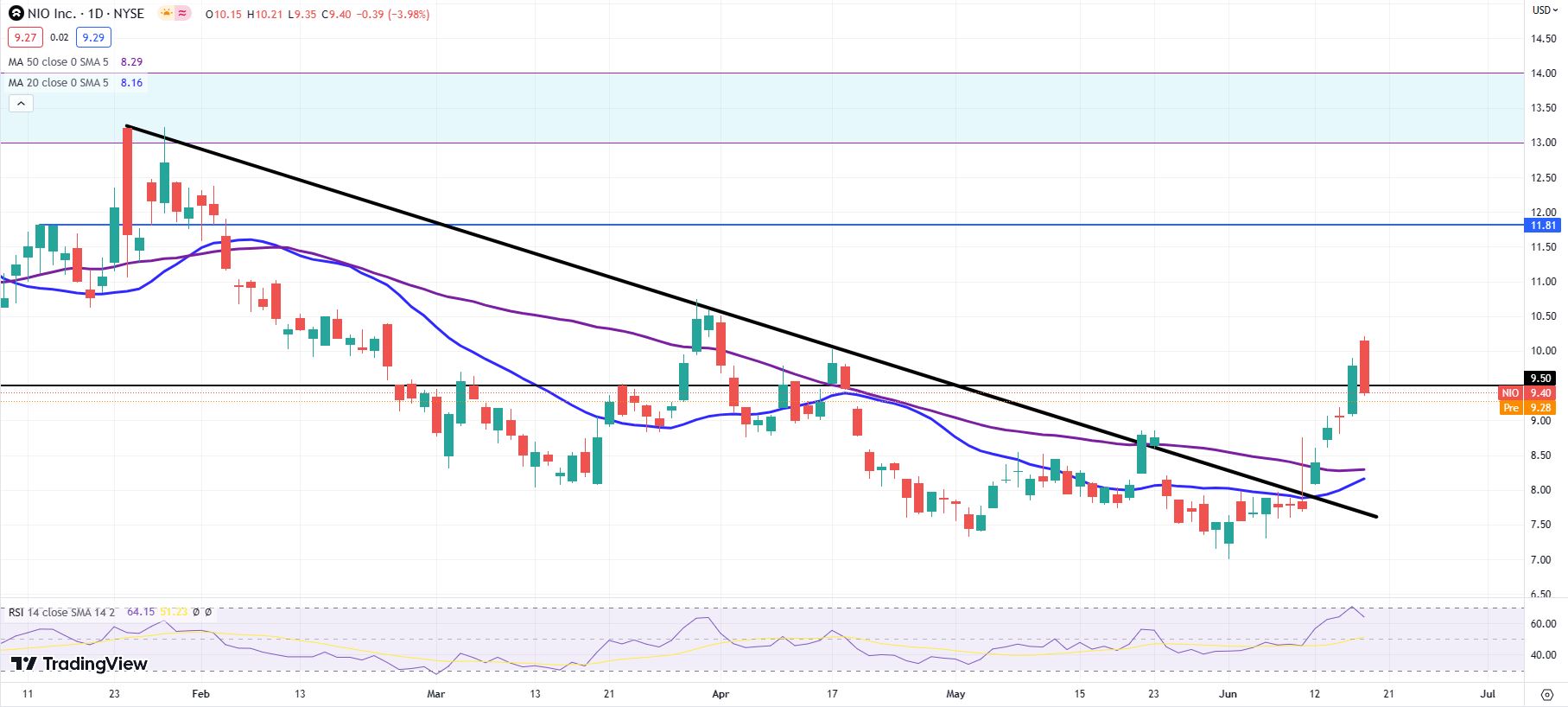
NIO daily chart
Author

Clay Webster
FXStreet
Clay Webster grew up in the US outside Buffalo, New York and Lancaster, Pennsylvania. He began investing after college following the 2008 financial crisis.
















