|

NIO Stock Price: Nio Inc rises as Deutsche Bank makes it a fresh pick for 2022

  • NYSE:NIO gained 2.24% during Thursday’s trading session.
  • Deutsche Bank adds Nio’s stock to 2022’s fresh money list.
  • Nio is looking to join forces with BYD to create a new mass market brand.

NYSE: NIO entered the Christmas break on a high note as a slew of good news pushed the stock back over the $30 price level. Shares of Nio gained 2.24% and closed the final trading session of the week at $30.52. It was a third straight day of gains for all three major indices, as Santa Claus did in fact visit Wall Street before Christmas. The NASDAQ continued its resurgence, gaining 0.85% to pace the broader markets. Meanwhile the Dow Jones added 196 basis points and the S&P 500 climbed by 0.62% to close the week. 


Stay up to speed with hot stocks' news!


Despite Nio’s recent volatility, a noted bull has once again put his support behind the Chinese EV maker. Deutsche Bank analyst Edison Yu has added Nio to the fresh money list for 2022, citing that much of the concerns investors have in Nio are already baked into the stock price. Yu notes that 2022 could be a banner year for Nio with the company doubling its production capacity, releasing several new models, and expanding further outside of China. Yu is also looking long-term with Nio, as he pointed out the 25 country expansion by 2025 as another key that makes Nio’s current stock price an attractive one. 

NIO stock news
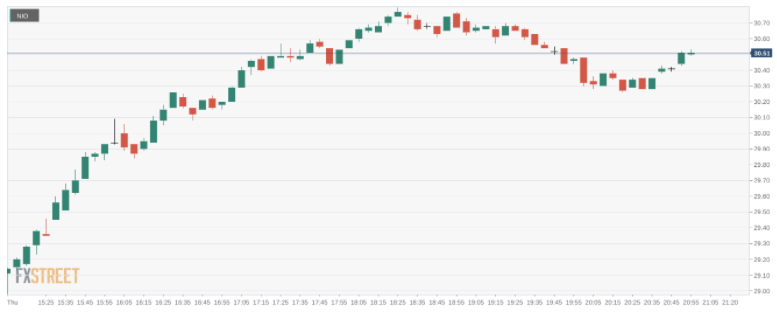
NIO Stock

Nio has also announced that it is in discussions with Warren Buffett-backed BYD to launch a brand new mass market brand in China. This new brand would provide an affordable electric vehicle for the masses, and give Nio a foothold outside of the luxury electric vehicle market. No further details about a timeline have been revealed, but it does mesh with Nio’s announcement of launching three vehicle models in 2022.


Like this article? Help us with some feedback by answering this survey:

Author

More from Stocks Reporter
Share:

Editor's Picks

AUD/USD bounces back toward 0.6950 on fresh USD supply

AUD/USD bounces back toward 0.6950 in the Asian session on Friday. The US Dollar retreats from 17-month highs as traders take profits off the table ahead of the all-important US Nonfarm Payrolls report. Meanwhile, the Australian Dollar draws support from reviving expectations of a November interest rate hike amid elevated global yields and inflation risks.


USD/JPY struggles near 158.00 as USD retreats ahead of NFP

USD/JPY is struggling for fresh impetus near 158.00, moving away from the top end of its weekly range in the Asian session on Friday, after hotter-than-expected Tokyo CPI and amid a broad US Dollar retreat. Traders reposition themselves ahead of US Nonfarm Payrolls.

Gold fades the earlier optimism; back below $4,200

Gold could not sustain the post-NFP bull run past the $4,200 mark per troy ounce, receding toward the $4,180 region at the end of the week. The precious metal’s inconclusive price action comes amid fresh selling pressure hurting the US Dollar as investors assess the latest NFP data.

Crypto Today: Bitcoin, Ethereum and XRP gains reinforce bullish outlook

Cryptocurrency prices are broadly recovering on Friday, led by Bitcoin moving above $86,000. Ethereum has reaffirmed its bullish outlook, rising above $2,700 while the immediate area at $2,800 caps upside. Meanwhile, Ripple hovers near $1.54.

Week ahead – Fed minutes in the spotlight amid bond market rout

Energy crisis and soaring bond yields to stay in driver’s seat in quiet week. Fed minutes eyed after drop in October rate hike bets. ISM services PMI and Treasury auctions to be watched too. Canadian employment, Japanese wages and ECB minutes also on tap.

The Euro is near a one-year low: Inflation could trigger its rebound, not its fall

EUR/USD has fallen to its lowest level since May 2025. The pair hit 1.1312 on Wednesday and trades well below the January peak of 1.2082. The decline reflects a powerful combination of US Dollar strength, geopolitical uncertainty and renewed concerns about Europe's exposure to higher energy prices.

















