Mexican Peso slumps as US Dollar rises on US data
- Mexican Peso slips from multi-year lows, reacting to optimistic US growth figures and labor market resilience.
- Strong US GDP growth in Q4 2023 and a robust labor market boosted the US Dollar, a headwind for the Mexican currency.
- Fed’s Waller remains hawkish, adhering to the “higher for longer” mantra.

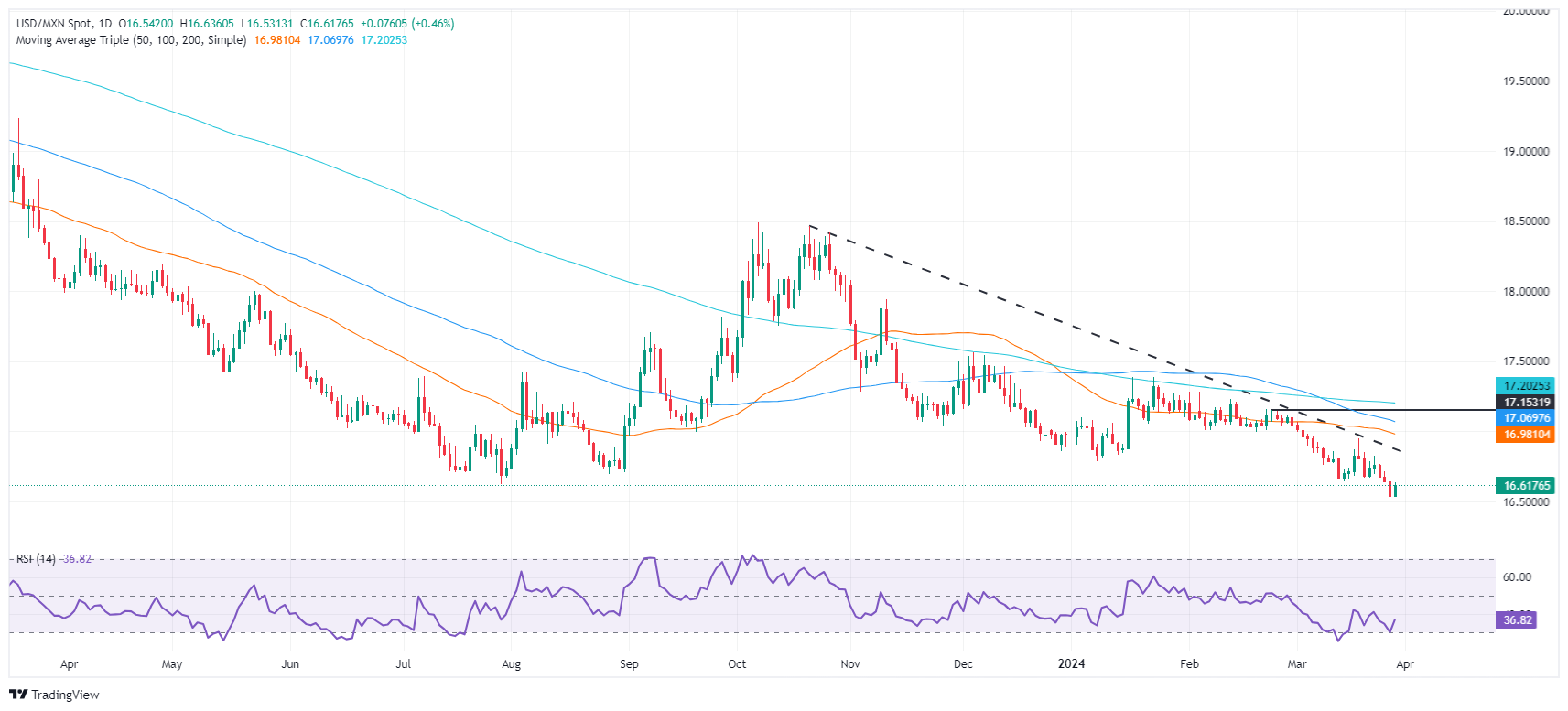
The Mexican Peso was on the defensive against the US Dollar on Thursday, with buyers capitalizing on the exotic pair's dip toward an over eight-year low of 16.51. Hawkish comments by Federal Reserve (Fed) Governor Christopher Waller and an absent Mexican economic docket sponsored a leg up in the USD/MXN. At the time of writing, the pair trades at 16.62, up 0.50%.
In addition to Fed speeches, US economic data has been the main driver of price action. The US Bureau of Economic Analysis (BEA) revealed that the US economy grew above estimates in the last quarter of 2023, as measured by the Gross Domestic Product (GDP). At the same time, a report by the US Bureau of Labor Statistics (BLS) portrayed a tight labor market, with fewer Americans applying for unemployment benefits.
Further data showed an improvement in the housing market as Pending Home Sales recovered in February from January.
Daily digest market movers: Mexican Peso weighed by hawkish comments of Fed’s Waller
- On Monday, Banxico Governor Victoria Rodriguez Ceja remained dovish via an interview with El Financiero. Governor Rodriguez commented that the battle against inflation hasn’t been concluded, though adding that it would discuss further rate cuts to the main reference rate in upcoming meetings. “When macroeconomic conditions and the inflationary outlook allow us to make additional adjustments to the reference rate to the one we already have, I consider that they would be gradual.”
- Banxico revealed that international reserves grew to $216.9 billion, adding $411 million in US Dollars through March 22.
- Mexico’s Balance of Trade in February printed a deficit of $-0.5 billion, lower than the $-4.31 billion in January but missing expectations of $-0.2 billion. Other data showed that the Unemployment Rate in February dropped from 2.9% to 2.5%, which is below the consensus of 2.8%.
- Mexico’s Indicator of General Economic Activity flashed signs of contraction in January, justifying Banxico’s 25-basis-point rate cut on March 21.
- Fed Governor Christopher Waller delivered hawkish remarks on Wednesday, said that rates need to be higher for longer than expected and that more inflation progress is needed before supporting a rate cut. He sees the beginning of the easing cycle in 2024, though he suggests that back-to-back months of inflation data heading to 2% are needed.
- The GDP in the US rose by 3.4%, exceeding the preliminary reading of 3.2%, an indication of a strong economy. The Core Personal Consumption Expenditure (PCE) for Q4 2023 hit the Fed’s target of 2% QoQ.
- Initial Jobless Claims for the week ending March 23 rose to 210K, below market expectations of 215K and lower than the previous week. The data shows that the labor market remains tight, which could deter the Fed from cutting rates.
- The University of Michigan Consumer Sentiment index rose to its highest level since July 2021, climbing to 79.4, exceeding estimates of 76.5. Pending Home Sales recovered in February, increasing 1.6% MoM after plunging -4.7% in January and above the consensus of 1.5%.
Technical analysis: Mexican Peso is on the backfoot as USD/MXN edges toward the 16.60 region
The USD/MXN posted a reversal after dropping to a multi-year low of 16.51, with buyers emerging at around those levels, lifting the exchange rate to the 16.60 region. Nevertheless, they’re facing strong resistance at the previous year's low of 16.62, which turned resistance. A breach of the latter will expose January’s monthly low of 16.78, followed by the March 19 high at 16.94. Up next would be the 50-day Simple Moving Average (SMA) at 16.97.
On the other hand, if the pair dives below 16.51, look for a test of October’s 2015 low of 16.32, ahead of the 16.00 psychological figure.
USD/MXN Price Action – Daily Chart
Mexican Peso FAQs
The Mexican Peso (MXN) is the most traded currency among its Latin American peers. Its value is broadly determined by the performance of the Mexican economy, the country’s central bank’s policy, the amount of foreign investment in the country and even the levels of remittances sent by Mexicans who live abroad, particularly in the United States. Geopolitical trends can also move MXN: for example, the process of nearshoring – or the decision by some firms to relocate manufacturing capacity and supply chains closer to their home countries – is also seen as a catalyst for the Mexican currency as the country is considered a key manufacturing hub in the American continent. Another catalyst for MXN is Oil prices as Mexico is a key exporter of the commodity.
The main objective of Mexico’s central bank, also known as Banxico, is to maintain inflation at low and stable levels (at or close to its target of 3%, the midpoint in a tolerance band of between 2% and 4%). To this end, the bank sets an appropriate level of interest rates. When inflation is too high, Banxico will attempt to tame it by raising interest rates, making it more expensive for households and businesses to borrow money, thus cooling demand and the overall economy. Higher interest rates are generally positive for the Mexican Peso (MXN) as they lead to higher yields, making the country a more attractive place for investors. On the contrary, lower interest rates tend to weaken MXN.
Macroeconomic data releases are key to assess the state of the economy and can have an impact on the Mexican Peso (MXN) valuation. A strong Mexican economy, based on high economic growth, low unemployment and high confidence is good for MXN. Not only does it attract more foreign investment but it may encourage the Bank of Mexico (Banxico) to increase interest rates, particularly if this strength comes together with elevated inflation. However, if economic data is weak, MXN is likely to depreciate.
As an emerging-market currency, the Mexican Peso (MXN) tends to strive during risk-on periods, or when investors perceive that broader market risks are low and thus are eager to engage with investments that carry a higher risk. Conversely, MXN tends to weaken at times of market turbulence or economic uncertainty as investors tend to sell higher-risk assets and flee to the more-stable safe havens.
Author

Christian Borjon Valencia
FXStreet
Markets analyst, news editor, and trading instructor with over 14 years of experience across FX, commodities, US equity indices, and global macro markets.