Mexican Peso edges lower after three consecutive up days
- The Mexican Peso edges lower in key pairs on Monday after three up days in a row.
- USD/MXN’s daily chart paints three down days in a row, a pattern called “Three Black Crows”.

The Mexican Peso (MXN) edges lower on Monday, after a week in which the Peso rose strongly, gaining about 3.9% on average versus the US Dollar (USD), the Euro (EUR) and the Pound Sterling (GBP).
Much higher probabilities of the US Federal Reserve (Fed) cutting interest rates by a larger-than-standard 0.50% at their meeting on Wednesday drove the appreciation in the Mexican currency against the USD last week.
From probabilities of only around 15% midweek, after the release of the US August Consumer Price Index (CPI), the market-based probabilities of a 0.50% cut by the Fed have now risen to about 59%, according to the CME FedWatch tool.
A larger cut to base interest rates in the US would expand the already wide interest rate differential with Mexico, where interest rates set by the Bank of Mexico (Banxico) are 10.75% versus the Fed’s 5.25%-5.50%. This encourages capital flows into the Mexican Peso because they can earn more interest.
Generally, downbeat expectations regarding the economic outlook for the United Kingdom (UK) and the Eurozone led MXN’s gains against the EUR and the GBP. Weak GDP growth data in the UK and a downward revision to GDP forecasts by the European Central Bank (ECB) acted as catalysts.
Mexican Peso stabilizes as political risk stabilizes
The Mexican Peso stabilizes on thre back of a less negative assessment of its political outlook.
The currency lost over 10% in June following the general election at which the left-leaning Morena coalition won a supermajority. Investors feared the impact of reforms the party wanted to push through affecting the judicial system and industry regulators, which, they argued, risked reducing foreign investment into the country.
Rating agency Moody’s warned of a potential downgrade resulting from the reforms, and leading investment banks like Morgan Stanley and Bank of America also voiced concerns.
The first tranche of reforms, which affect the judiciary were voted through by the Senate last week and outgoing President, Andres Manuel Lopez Obrador signed an official decree to make them law on Sunday after the "Cry for Independence" celebration.
Rating agency Fitch has put forward a more neutral, if still slightly negatively biased view, of the country’s creditworthiness inspite of the new reforms, in a recent note, reported Christian Borjon Valencia, an Analyst at FXStreet, on Friday.
“The rating outlook is stable, which means that we are seeing a balance between strengths and weaknesses. Before observing a direct downgrade of the sovereign rating, what could be expected from us is a change in the outlook, either from stable to positive or from stable to negative, the latter probably occurring,” said Gerardo Carrillo, Regional Director for LATAM at Fitch Ratings.
Further, Banxico’s Director of Economic Research, Alejandrina Salcedo, “stated that a robust environment in the rule of law can help generate conditions that encourage investment,” and “respecting the rule of law and public safety ‘would provide greater certainty, boost the flow of investment in all regions, and contribute to capitalizing on the opportunities offered by the relocation process,’” writes Borjon Valencia.
At the time of writing, one US Dollar (USD) buys 19.34 Mexican Pesos, EUR/MXN trades at 21.52, and GBP/MXN at 25.53.
Technical Analysis: USD/MXN prints bearish Three Black Crows
USD/MXN has broken out of a rising mini-channel within a wider rising channel and fallen for three days in a row. This has now formed a bearish Three Black Crows Japanese candlestick pattern on the daily chart (shaded rectangle), which indicates the probability that prices will fall even lower in the short term.
USD/MXN Daily Chart
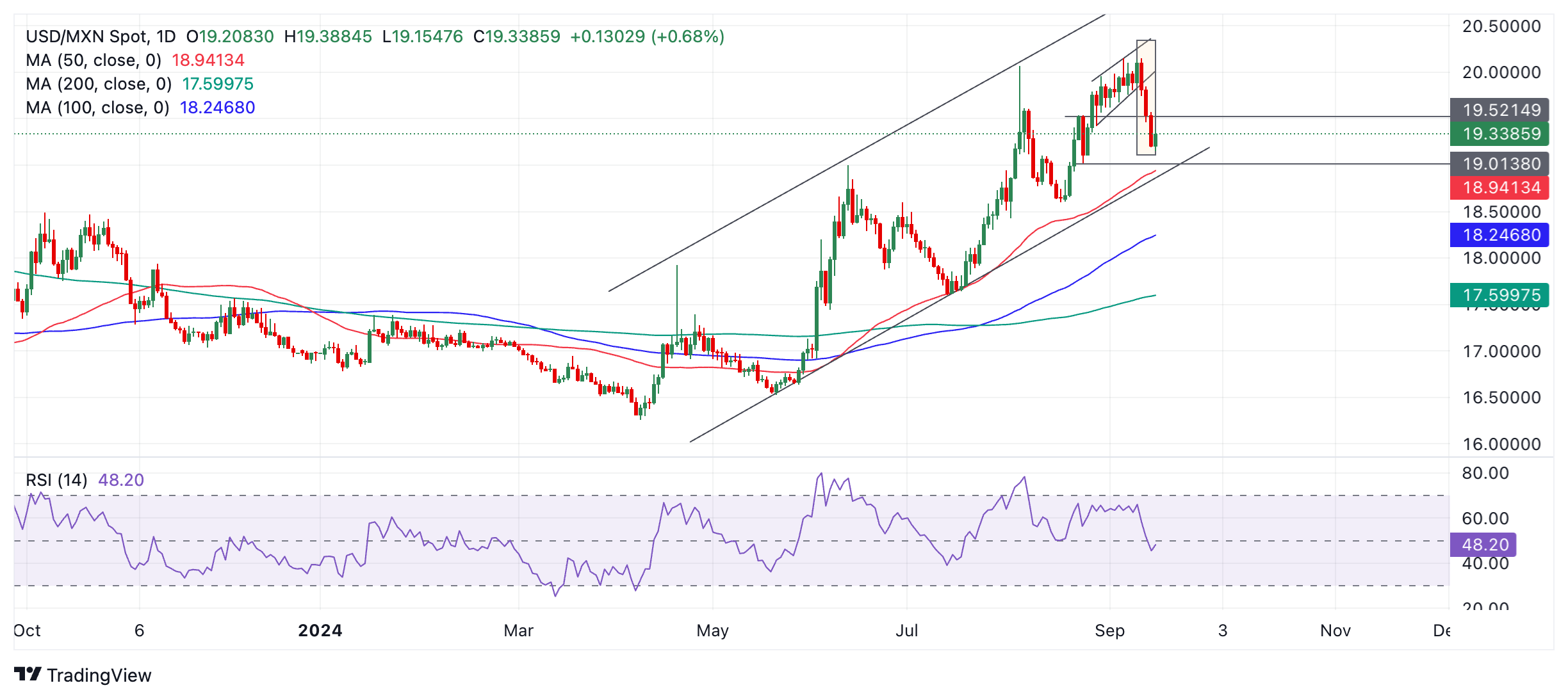
The odds now favor the pair falling to the next downside support level at 19.01 (August 23 low), followed perhaps by further weakness to the 50-day Simple Moving Average (SMA) at 18.94 and the lower trendline of the larger channel a few pips below. At that level, the price will probably find firm support to stabilize and perhaps recover.
Even though the short-term trend is bearish, the medium and long-term trends are still bullish, suggesting the possibility that the pair could recover eventually and continue to trade higher.
Banxico FAQs
The Bank of Mexico, also known as Banxico, is the country’s central bank. Its mission is to preserve the value of Mexico’s currency, the Mexican Peso (MXN), and to set the monetary policy. To this end, its main objective is to maintain low and stable inflation within target levels – at or close to its target of 3%, the midpoint in a tolerance band of between 2% and 4%.
The main tool of the Banxico to guide monetary policy is by setting interest rates. When inflation is above target, the bank will attempt to tame it by raising rates, making it more expensive for households and businesses to borrow money and thus cooling the economy. Higher interest rates are generally positive for the Mexican Peso (MXN) as they lead to higher yields, making the country a more attractive place for investors. On the contrary, lower interest rates tend to weaken MXN. The rate differential with the USD, or how the Banxico is expected to set interest rates compared with the US Federal Reserve (Fed), is a key factor.
Banxico meets eight times a year, and its monetary policy is greatly influenced by decisions of the US Federal Reserve (Fed). Therefore, the central bank’s decision-making committee usually gathers a week after the Fed. In doing so, Banxico reacts and sometimes anticipates monetary policy measures set by the Federal Reserve. For example, after the Covid-19 pandemic, before the Fed raised rates, Banxico did it first in an attempt to diminish the chances of a substantial depreciation of the Mexican Peso (MXN) and to prevent capital outflows that could destabilize the country.
Author

Joaquin Monfort
FXStreet
Joaquin Monfort is a financial writer and analyst with over 10 years experience writing about financial markets and alt data. He holds a degree in Anthropology from London University and a Diploma in Technical analysis.