Mexican Peso declines in key pairs on inflation outlook
- The Mexican Peso falls against major peers as inflation outlook in US, Europe and UK remains stickier than expected.
- This will probably lead to interest rates remaining higher for longer providing support to MXN’s counterparts.
- USD/MXN’s short-term trend looks increasingly sideways as it yo-yos in a range.

The Mexican Peso (MXN) trades lower in most pairs on Friday as signs of entrenched inflation in most developed economies push back expectations for interest-rate cuts with bullish implications for their currencies.
USD/MXN is trading up almost two-tenths of a percent at 17.24, EUR/MXN is up over three-tenths at 18.53 and GBP/MXN is up a similar amount at 21.60, at the time of publication during the European session.
Mexican Peso falls versus peers
The Mexican Peso plummeted over half a percentage point against the US Dollar (USD) on Thursday after US first quarter GDP data showed an unexpected rise in inflation despite below-par growth.
US Gross Domestic Product (GDP) annualized slowed to 1.6% in Q1, missing expectations of 2.5% and below the previous quarter’s 3.6%, however, the US Dollar gained after the Personal Consumption Expenditures Prices component, which measures the change in prices of goods, came in a lot higher compared with previous quarter.
The data led markets to dial back their expectation of when the Federal Reserve (Fed) will start cutting interest rates, with the probability of a cut at the July meeting falling from 50% on the previous day to 34% afterwards, according to analysts at Deutsche Bank.
The expectation of interest rates staying higher for longer appreciated the Greenback and USD/MXN spiked up to 17.39 following the GDP data, because higher interest rates attract more foreign capital inflows.
USD/MXN traders now await the US March core Personal Consumption Expenditures Price Index (PCE) out at 12:30 GMT, which is the US Federal Reserve’s (Fed) preferred gauge of inflation, for more detail on inflationary pressures.
In Europe, rising Bund yields, which are above 2.60%, help the Single Currency rebound in most pairs. The move comes on the back of more hawkish rhetoric from the President of the Bundesbank and European Central Bank (ECB) governing council member Joachim Nagel, who suggested the ECB’s promised June rate cut may be a “one and done”.
Commentary from ECB policymaker Isabel Schnabel further endorsed the view as she highlighted services sector wage inflation as a sticking point.
In the UK, despite an underforming economy, inflation remains high and Bank of England (BoE) officials continue to strike a hawkish tone, supporting the Pound Sterling.
The Banxico, meanwhile, adopts a data-dependent approach in its outlook for interest rates, and whilst the central bank cut rates by 0.25% in March, a further cut is not seen coming in May.
The mid-month Mexican inflation data for March released earlier this week failed to clarify the situation, coming out mixed and showing a rise in headline but downtick in core.
According to the Citibanamex Survey, most analysts expect Banxico to hold rates unchanged at the May meeting. The median foresees a rate cut in June, while they estimate the main reference rate to end at 10.00%, up from 9.63% previously.
Technical Analysis: USD/MXN enters sideways trend
USD/MXN shows increased volatility and may be entering a sideways trend over the short-term horizon.
USD/MXN 4-hour Chart
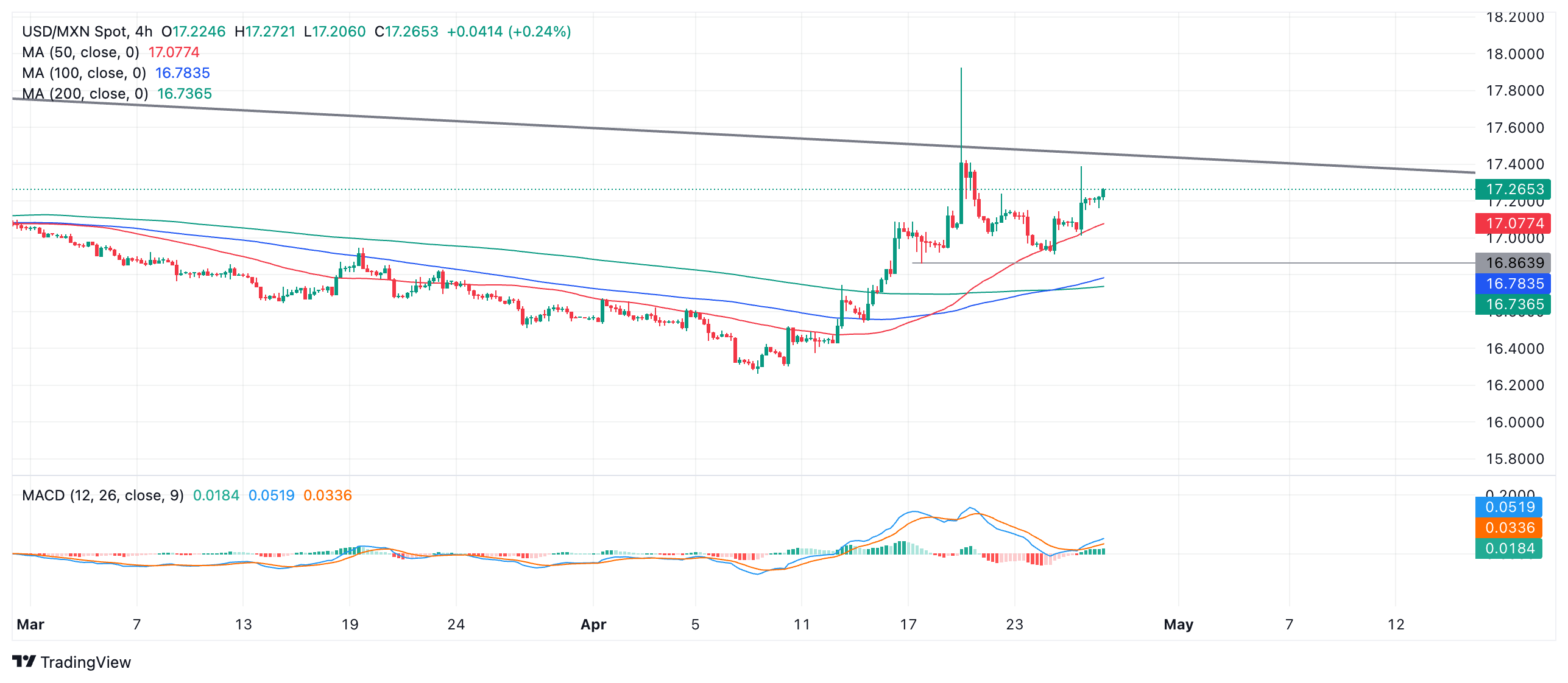
USD/MXN appears to be rising up towards the top of the range at 17.40. If it reaches that level it will probably pivot and start falling back down within the range to the floor in the 16.80s.
A decisive break below 16.86 would be required to confirm a breakout of the range and further downside to the next target at 16.50 and then the April 9 low at 16.26.
On the other side, a decisive break above the major trendline for the long-term downtrend at roughly 17.40 would be required to change the trend back to bullish, and activate an upside target at around 18.15.
A decisive break would be one characterized by a longer-than-average green daily candlestick that pierces above the trendline and closes near its high, or three green candlesticks in a row that pierce above the level.
Author

Joaquin Monfort
FXStreet
Joaquin Monfort is a financial writer and analyst with over 10 years experience writing about financial markets and alt data. He holds a degree in Anthropology from London University and a Diploma in Technical analysis.

















