Mexican Peso breaks higher after Banxico keeps key rate unchanged
- The Mexican Peso rallies following Thursday’s Bank of Mexico policy meeting.
- Banxico decided to keep interest rates unchanged but upwardly revised its inflation forecasts.
- USD/MXN broke below the floor of a short-term range following the news and is tipped to decline further.

The Mexican Peso (MXN) breaks higher in its most heavily traded pairs in the aftermath of the Bank of Mexico (Banxico) policy meeting on Thursday, at which the board unanimously voted to keep interest rates unchanged and substantially revised up its inflation forecasts in the light of stubbornly high price pressures.
The Banxico is now not seen cutting interest rates in the near future – a positive for its currency since higher rates attract more foreign capital inflows.
USD/MXN is exchanging hands at 16.74, EUR/MXN at 18.04 and GBP/MXN at 20.97, at the time of publication.
Mexican Peso appreciates after Banxico meeting, inflation revision
The Mexican Peso strengthened by between roughly a quarter and three quarters of a percent in its most heavily traded pairs on Thursday, after the Bank of Mexico held its May policy meeting and decided unanimously to keep the policy rate unchanged at 11.00%. This strength broadly holds up into Friday’s European trading session, with the MXN retreating only marginally.
The Banxico revised up its inflation forecasts over the next year and a half, indicating it expected inflation to be stickier than previously anticipated. It forecast inflation to now fall more slowly to its 3.0% target, which it did not foresee reaching until Q4 of 2025.
Previously Banxico had expected inflation to fall more swiftly, reaching 3.1% in Q2 of 2025, and remaining at that level for the rest of the year (see table below). Banxico made similar revisions for core inflation.

In its accompanying statement, Banxico said, “..considering that inflationary shocks are
foreseen to take longer to dissipate, the forecasts for headline and core inflation have been revised upwards for the next six quarters. In particular, services inflation is foreseen to show more persistence, as compared to what had been previously anticipated.”
Technical Analysis: USD/MXN breaks below floor of short-term range
USD/MXN – the cost of one US Dollar in Mexican Pesos – has decisively broken below the bottom of a short-term range at 16.86 and is now expected to continue falling towards the target for the breakout.
USD/MXN 4-hour Chart
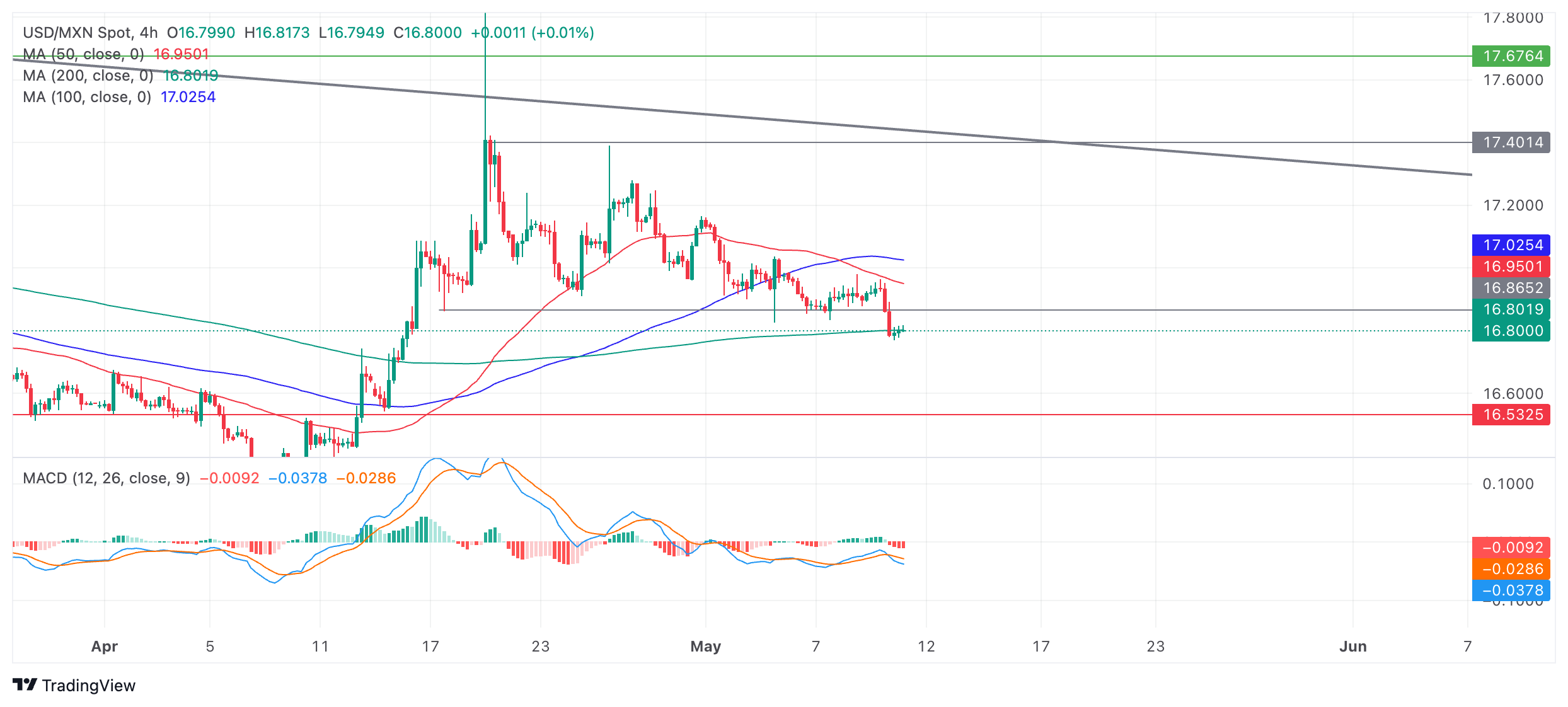
The break below the range floor generates an initial, conservative target at 16.54. This is the 0.681 Fibonacci ratio of the height of the range extrapolated lower, and it is followed by 16.34, the full height of the range extrapolated lower.
The short-term trend is now probably bearish following the breakdown from the range, which given the old adage that the “trend is your friend”, suggests the odds favor more downside.
The Moving Average Convergence Divergence (MACD) momentum indicator has crossed below its signal line, further indicating bearishness. However, the momentum accompanying the breakdown move itself was not particularly strong.
Given the medium and long-term trends are bearish, the odds further favor more downside for the pair in line with those trends.
Banxico FAQs
The Bank of Mexico, also known as Banxico, is the country’s central bank. Its mission is to preserve the value of Mexico’s currency, the Mexican Peso (MXN), and to set the monetary policy. To this end, its main objective is to maintain low and stable inflation within target levels – at or close to its target of 3%, the midpoint in a tolerance band of between 2% and 4%.
The main tool of the Banxico to guide monetary policy is by setting interest rates. When inflation is above target, the bank will attempt to tame it by raising rates, making it more expensive for households and businesses to borrow money and thus cooling the economy. Higher interest rates are generally positive for the Mexican Peso (MXN) as they lead to higher yields, making the country a more attractive place for investors. On the contrary, lower interest rates tend to weaken MXN. The rate differential with the USD, or how the Banxico is expected to set interest rates compared with the US Federal Reserve (Fed), is a key factor.
Banxico meets eight times a year, and its monetary policy is greatly influenced by decisions of the US Federal Reserve (Fed). Therefore, the central bank’s decision-making committee usually gathers a week after the Fed. In doing so, Banxico reacts and sometimes anticipates monetary policy measures set by the Federal Reserve. For example, after the Covid-19 pandemic, before the Fed raised rates, Banxico did it first in an attempt to diminish the chances of a substantial depreciation of the Mexican Peso (MXN) and to prevent capital outflows that could destabilize the country.
Author
Joaquin Monfort
FXStreet
Joaquin Monfort is a financial writer and analyst with over 10 years experience writing about financial markets and alt data. He holds a degree in Anthropology from London University and a Diploma in Technical analysis.