Gold remains deppressed ahead of the Fed monetary policy decision
- Gold finds support at $2,630 but remains capped ahead of the Fed’s decision.
- The market is bracing for a Fed “hawkish cut” that might boost the US Dollar and weigh on Gold.
- XAU/USD remains under pressure, with upside attempts capped below $2,665.

Gold (XAU/USD) is practically flat on Wednesday after bouncing up from a one-week low the previous day. The precious metal remains on the defensive as the market braces for the outcome of the last Federal Reserve’s (Fed) meeting of the year.
The Fed is widely expected to cut interest rates by 25 basis points (bps), but the economic and rate hike projections will likely reveal a hawkish turn on the central bank’s forward guidance.
Recent US data shows that economic activity remains robust, consumption is buoyant, and inflationary pressures are high. Beyond that, US President-elect Donald Trump’s policies are expected to fuel price pressure higher.
This has forced investors to scale back monetary easing expectations, which is fuelling a sharp rebound in US Treasury yields and weighing on the yellow metal.
Gold remains vulnerable amid fears of a hawkish Fed
- US Retail Sales released on Tuesday revealed a 0.7% increment in November, up from an upwardly revised 0.5% rise in October and beating expectations of a 0.5% increase.
- Consumption amounts to more than 60% of the US GDP, and these figures endorse the view of US economic exceptionalism in the context of a global economic slowdown.
- US data released earlier this week showed an unexpected improvement in services activity, pointing to healthy economic growth in the fourth quarter.
- Futures markets are almost fully pricing a 25 bps interest rate cut on Wednesday, according to the CME Group’s FedWatch Tool, but less than a 30% chance of more than two quarter-percentage cuts in 2025.
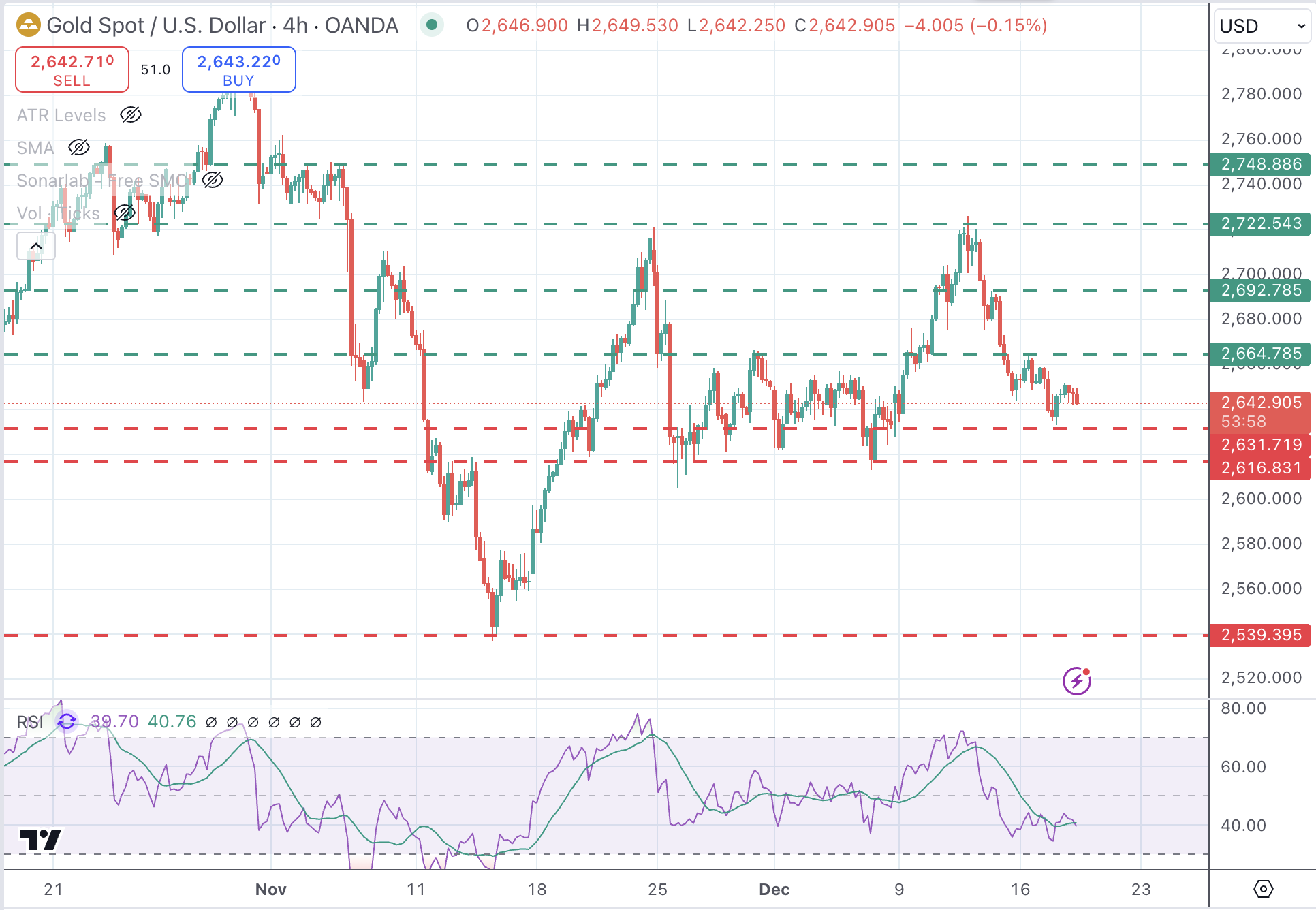
Technical analysis: XAU/USD consolidates losses with upside attempts limited below $2,665
Gold has found some support at $2,630 and is consolidating recent losses, with investors looking from the sidelines ahead of the Fed decision. The short-term bearish trend, however, remains intact, with resistance at $2,665 capping upside attempts.
From a wider perspective, a potential double top at $2,720 suggests that a deeper correction is on the cards.
Immediate support is at $2,630 (December 17 low), while the $2,615-$2,605 area (November 25 and 26 lows) is the neckline of the previously mentioned double top. Below there, the next target would be November’s trough, at $2,540. On the upside, resistances are at the mentioned $2,665 (December 16 high) and 2,690 (December 13 high).
XAU/USD 4-Hour Chart
Interest rates FAQs
Interest rates are charged by financial institutions on loans to borrowers and are paid as interest to savers and depositors. They are influenced by base lending rates, which are set by central banks in response to changes in the economy. Central banks normally have a mandate to ensure price stability, which in most cases means targeting a core inflation rate of around 2%. If inflation falls below target the central bank may cut base lending rates, with a view to stimulating lending and boosting the economy. If inflation rises substantially above 2% it normally results in the central bank raising base lending rates in an attempt to lower inflation.
Higher interest rates generally help strengthen a country’s currency as they make it a more attractive place for global investors to park their money.
Higher interest rates overall weigh on the price of Gold because they increase the opportunity cost of holding Gold instead of investing in an interest-bearing asset or placing cash in the bank. If interest rates are high that usually pushes up the price of the US Dollar (USD), and since Gold is priced in Dollars, this has the effect of lowering the price of Gold.
The Fed funds rate is the overnight rate at which US banks lend to each other. It is the oft-quoted headline rate set by the Federal Reserve at its FOMC meetings. It is set as a range, for example 4.75%-5.00%, though the upper limit (in that case 5.00%) is the quoted figure. Market expectations for future Fed funds rate are tracked by the CME FedWatch tool, which shapes how many financial markets behave in anticipation of future Federal Reserve monetary policy decisions.
Economic Indicator
Fed Interest Rate Decision
The Federal Reserve (Fed) deliberates on monetary policy and makes a decision on interest rates at eight pre-scheduled meetings per year. It has two mandates: to keep inflation at 2%, and to maintain full employment. Its main tool for achieving this is by setting interest rates – both at which it lends to banks and banks lend to each other. If it decides to hike rates, the US Dollar (USD) tends to strengthen as it attracts more foreign capital inflows. If it cuts rates, it tends to weaken the USD as capital drains out to countries offering higher returns. If rates are left unchanged, attention turns to the tone of the Federal Open Market Committee (FOMC) statement, and whether it is hawkish (expectant of higher future interest rates), or dovish (expectant of lower future rates).
Read more.Next release: Wed Dec 18, 2024 19:00
Frequency: Irregular
Consensus: 4.5%
Previous: 4.75%
Source: Federal Reserve
Author

Guillermo Alcala
FXStreet
Graduated in Communication Sciences at the Universidad del Pais Vasco and Universiteit van Amsterdam, Guillermo has been working as financial news editor and copywriter in diverse Forex-related firms, like FXStreet and Kantox.