|

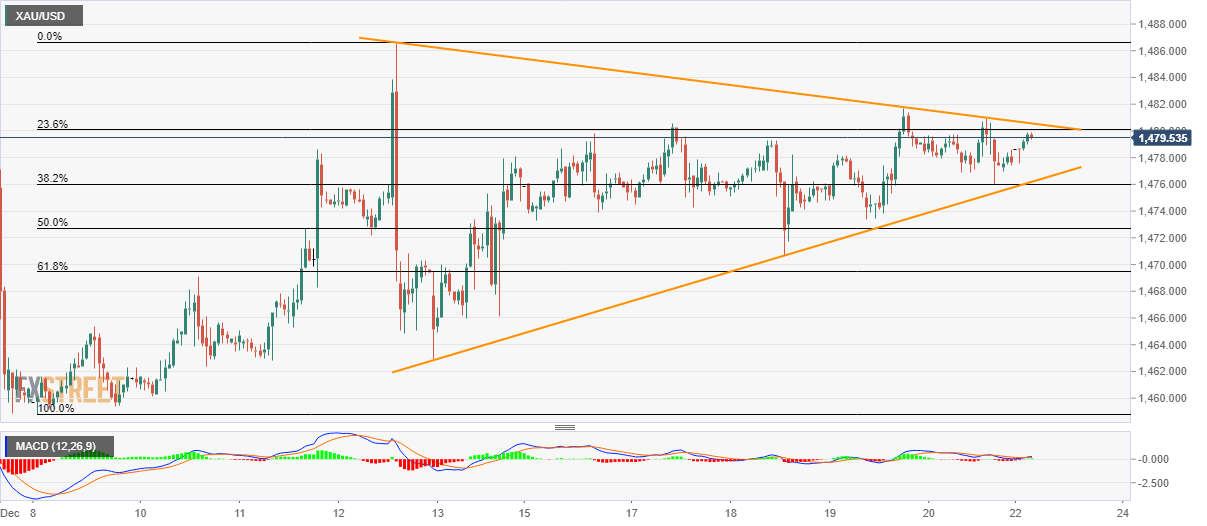
Gold Technical Analysis: Funnelling down to short-term triangle break

  • Gold extends recent bounces off 38.2% Fibonacci retracement.
  • A sustained upside break of the triangle can challenge the monthly high.
  • The last week’s low can please sellers after the triangle’s downside break.

Gold prices take the bids to $1,479.75 by the press time of early Monday. The bullion is heading towards the break of short-term symmetrical triangle amid a bullish signal from 12-bar Moving Average Convergence and Divergence (MACD).

However, a sustained break of $1,480.60 is what buyers will look for ahead of targeting the monthly top near $1,487.

Should prices manage to stay strong beyond $1,487, November 06 high near $1,494 can act as an intermediate halt to $1,500 round-figure.

Meanwhile, the yellow metal’s downside break below the triangle’s support of $1,476 will fetch it to last week’s low close to $1,471,

In a case where sellers dominate below $1,471, 61.8% Fibonacci retracement of the latest upside, at $1,469, can check Bears ahead of pleasing them with December 13 low near $1,463.

Gold hourly chart
Trend: Sideways

XAU/USD

Overview
Today last price1479.72
Today Daily Change2.06
Today Daily Change %0.14%
Today daily open1477.66
 
Trends
Daily SMA201468.83
Daily SMA501477.4
Daily SMA1001492.04
Daily SMA2001413.99
 
Levels
Previous Daily High1480.96
Previous Daily Low1476
Previous Weekly High1481.7
Previous Weekly Low1470.7
Previous Monthly High1515.38
Previous Monthly Low1445.8
Daily Fibonacci 38.2%1477.89
Daily Fibonacci 61.8%1479.07
Daily Pivot Point S11475.45
Daily Pivot Point S21473.25
Daily Pivot Point S31470.49
Daily Pivot Point R11480.41
Daily Pivot Point R21483.17
Daily Pivot Point R31485.37

Author

Anil Panchal

Anil Panchal

FXStreet

Anil Panchal has nearly 15 years of experience in tracking financial markets. With a keen interest in macroeconomics, Anil aptly tracks global news/updates and stays well-informed about the global financial moves and their implications.


More from Anil Panchal
Share:

Editor's Picks

AUD/USD turns south toward 0.6900 as USD firms up

AUD/USD sees fresh selling and drops toward 0.6900 in late Asian trading on Monday, as renewed US Dollar strength weighs on the pair amid lingering Middle East and Russia-Ukraine geopolitical tensions. Focus remains on Oil prices, Treasury bond yields, and RBA expectations for fresh trading impetus in the major.

USD/JPY retakes 158.00 amid hawkish BoJ bets, firmer USD

USD/JPY erases losses and retakes 158.00 in the Asian session on Monday, trading within a one-week-old range. Geopolitical uncertainty continues to underpin the US Dollar, despite fading Fed rate hike hopes, supporting the pair's rebound. However, further upside could be capped by hawkish BoJ expectations and looming intervention risks that could support the Japanese Yen.

Gold trades flat as stronger US Dollar offsets easing Fed rate-hike bets

Gold trades little changed on Monday after giving back most of its early gains. The metal remains caught between easing Fed interest-rate hike bets and a stronger US Dollar (USD), while US Treasury yields also remain elevated near multi-year highs.

Crypto Today: Bitcoin rally slows while Ethereum and XRP extend recovery amid slowing ETF inflows

Bitcoin is narrowly consolidating while trading above $86,000 at the time of writing on Monday. Altcoins, on the other hand, show a positive outlook, with Ethereum edging higher above $2,700 while Ripple steadies above $1.52.

Eurozone inflation just hit 3.8%, its highest in three years. This chart shows why the ECB can’t simply hike its way out

The ECB would normally have a relatively straightforward answer to inflation running almost twice its target: raise interest rates. But these are not normal circumstances. This time, the bond market is already doing part of the tightening for it, leaving the ECB facing an increasingly difficult dilemma.

Eurozone inflation just hit 3.8%, its highest in three years. This chart shows why the ECB can’t simply hike its way out

The ECB would normally have a relatively straightforward answer to inflation running almost twice its target: raise interest rates. But these are not normal circumstances. This time, the bond market is already doing part of the tightening for it, leaving the ECB facing an increasingly difficult dilemma.














