Gold jumps above $4,440 as geopolitical flare, Fed cut bets mount
- Gold surges to a record high of $4,442 as tensions in Venezuela and the Middle East fuel strong safe-haven demand.
- Softer US Dollar and falling US Treasury yields support bullion as markets price 59 bps of Fed easing in 2026.
- Fed remains divided, with dovish Miran offset by Hammack warning inflation data may be distorted.

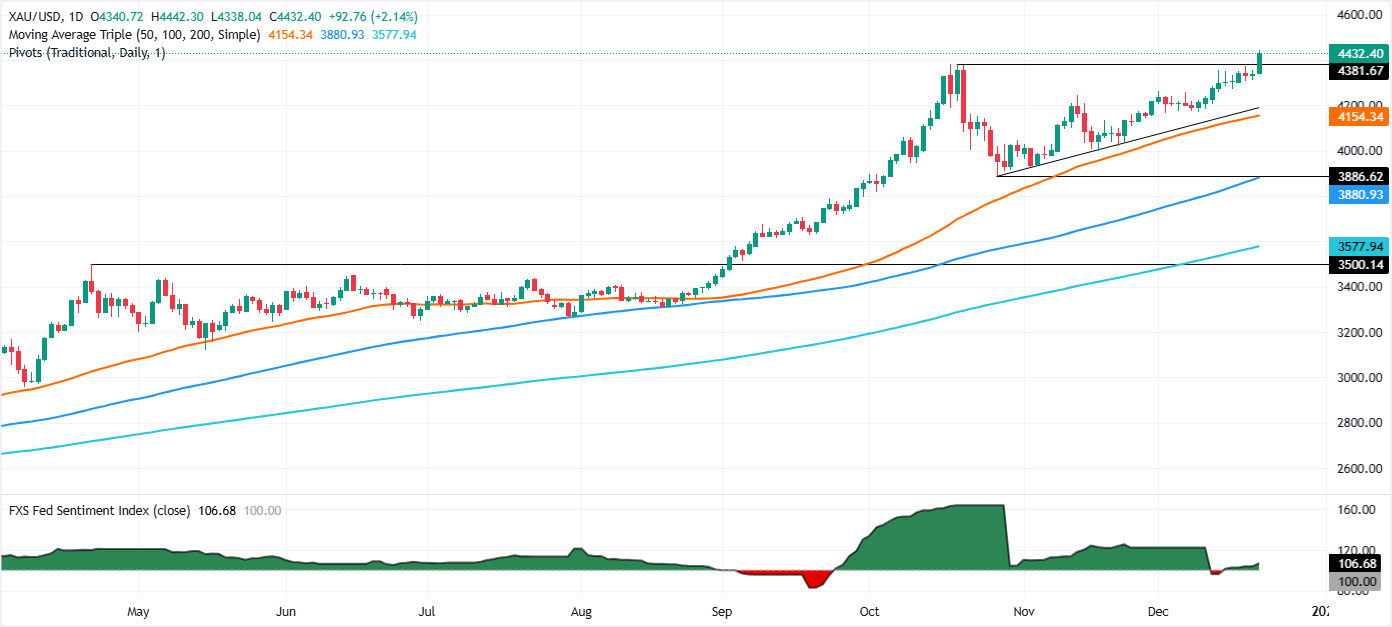
Gold (XAU/USD) rallies over 2% on Monday, reaching a record high of $4,442 amid rising geopolitical tensions and expectations that the Federal Reserve (Fed) will continue to reduce interest rates next year, pushing US Treasury yields lower. At the time of writing, XAU/USD trades at $4,435 after jumping off daily lows of $4,338.
Bullion jumps over 2% as Middle East and Venezuela tensions rise, while markets price deeper Fed cuts for 2026
Tensions in the Caribbean had risen after US President Donald Trump announced last week a “blockade” of oil tankers leaving or entering Venezuela. Speculation of US military ground operations in the country remains high as Trump pressures the President Nicolas Maduro administration. Additionally, renewed tensions between Iran-Israel drove the yellow metal higher.
US Dollar weakness is also sponsoring Bullion’s advance as the Greenback tumbles 0.40%, according to the US Dollar Index (DXY). The DXY, which tracks the performance of the buck’s value against six other currencies, is trading below its opening price at 98.32.
Meanwhile, money markets have priced in 59 basis points of easing by the US central bank for 2026, according to Capital Edge rate probability data.
A scarce economic docket in the US left traders adrift to Fed officials crossing the wires. Fed Governor Stephen Miran reaffirmed his dovish stance, opposite to Cleveland’s Fed President Beth Hammack, who revealed that November’s Consumer Price Index (CPI) data showed irregularities, an indication that the dip in inflation could be short-lived.
Ahead, the US economic docket will be busy on Tuesday due to a shortened week by Christmas holidays. Traders will digest the ADP Employment Change 4-week average, growth figures for Q3 on its preliminary release, October’s Durable Goods Orders and Industrial Production prints for October and November.
Daily digest market movers: Gold climbs despite high US yields
- Gold price rallies despite both US yields and the US Dollar are posting solid gains. The US 10-year Treasury note yield is up two basis points at 4.171%. US real yields, which correlate inversely with Gold prices, surge nearly two and a half basis points to 1.91%.
- Cleveland Fed President Beth Hammack struck a hawkish tone, warning that November’s CPI may have understated annual price pressures due to data irregularities. She added that the neutral interest rate could be higher than commonly assumed, arguing for caution on further easing.
- Separately, Fed Governor Stephen Miran also pointed to irregularities in CPI data linked to the government shutdown. He said recent data align with his assessment of current economic conditions and reiterated that additional policy rate reductions are likely in the future.
- Last Thursday, US inflation for November eased to 2.7% year-on-year, down from the prior 3% reading. However, economists cautioned that the data should be interpreted with care, as the 43-day US government shutdown may have distorted parts of the economic reporting.
Technical analysis: Gold shines bright, on its way towards $4,500
Gold price uptrend remains intact, with the yellow metal poised to challenge $4,500 in the near term. Momentum favors bulls as depicted by the Relative Strength Index (RSI), which turned overbought, depicting the force of the uptrend, an indication that a leg-up might be underway.
If XAU/USD clears $4,500, the next resistance would be $4,550 and $4,600. Conversely, a drop below $4,400 will expose the previous all-time milestone at $4,381, ahead of challenging $4,350 and $4,300.
Gold FAQs
Gold has played a key role in human’s history as it has been widely used as a store of value and medium of exchange. Currently, apart from its shine and usage for jewelry, the precious metal is widely seen as a safe-haven asset, meaning that it is considered a good investment during turbulent times. Gold is also widely seen as a hedge against inflation and against depreciating currencies as it doesn’t rely on any specific issuer or government.
Central banks are the biggest Gold holders. In their aim to support their currencies in turbulent times, central banks tend to diversify their reserves and buy Gold to improve the perceived strength of the economy and the currency. High Gold reserves can be a source of trust for a country’s solvency. Central banks added 1,136 tonnes of Gold worth around $70 billion to their reserves in 2022, according to data from the World Gold Council. This is the highest yearly purchase since records began. Central banks from emerging economies such as China, India and Turkey are quickly increasing their Gold reserves.
Gold has an inverse correlation with the US Dollar and US Treasuries, which are both major reserve and safe-haven assets. When the Dollar depreciates, Gold tends to rise, enabling investors and central banks to diversify their assets in turbulent times. Gold is also inversely correlated with risk assets. A rally in the stock market tends to weaken Gold price, while sell-offs in riskier markets tend to favor the precious metal.
The price can move due to a wide range of factors. Geopolitical instability or fears of a deep recession can quickly make Gold price escalate due to its safe-haven status. As a yield-less asset, Gold tends to rise with lower interest rates, while higher cost of money usually weighs down on the yellow metal. Still, most moves depend on how the US Dollar (USD) behaves as the asset is priced in dollars (XAU/USD). A strong Dollar tends to keep the price of Gold controlled, whereas a weaker Dollar is likely to push Gold prices up.
Author

Christian Borjon Valencia
FXStreet
Markets analyst, news editor, and trading instructor with over 14 years of experience across FX, commodities, US equity indices, and global macro markets.