Dow Jones Industrial Average climbs over 200 points ahead of holiday
- The Dow Jones rose around 250 points to start a holiday-shortened week.
- Equities are broadly bullish heading into the tail-end of 2025.
- US ADP labor changes and US GDP data in the pipe this week.

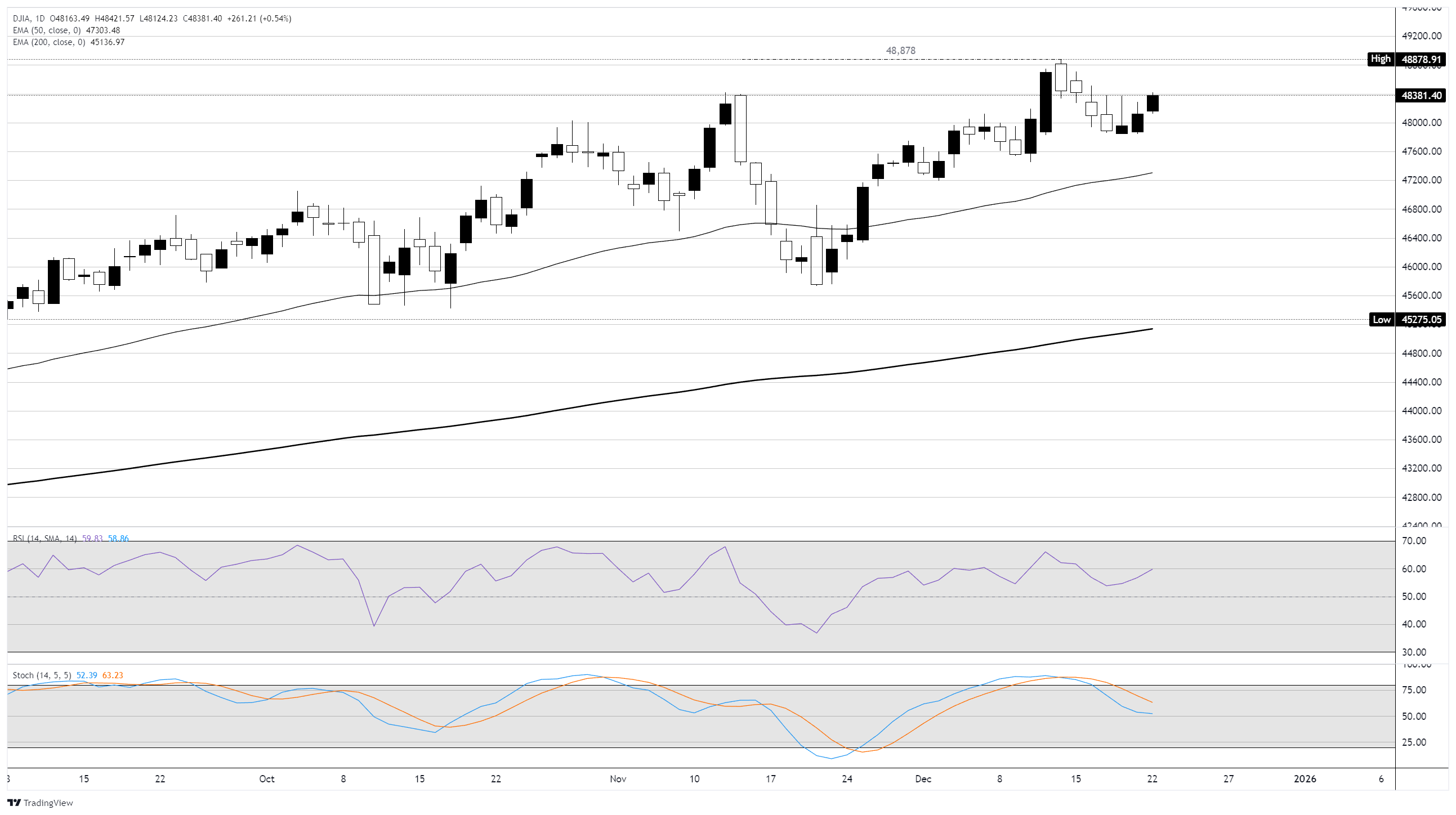
The Dow Jones Industrial Average (DJIA) gained ground on Monday, heading into the Christmas holiday schedule on the front foot as equity markets tilt into the bullish side to wrap up the trading year. Stocks tied to the AI trade rose, with big boosts coming from both the financial and materials sectors.
Stocks rally to wrap up 2025
Equity markets are twisting into the high side to wrap up the remainder of the 2025 trading window in hopes of sparking a last-minute Santa Clause rally, but time is running out with stock markets slated to be shuttered early this week. The New York Stock Exchange (NYSE) will be closing early at 1800 GMT (1300 EST) on Wednesday. Volatility could rise heading through the holidays, but overall market momentum is likely to remain muted into the new year as investors sideline themselves.
Following the Federal Reserve’s (Fed) third straight interest rate cut earlier this month, ‘real economy’ stocks are taking a step higher, with the construction materials sector climbing nearly 1.5% on Monday. The banking segment also rose 1.3% as financials take a step higher on hopes for further interest rate easing.
Data reactions remain muted following shutdown data gap
Overall market reaction to the latest inflation figures remains muted, despite a headline easing in key inflation figures. Looking deeper into the latest Consumer Price Index (CPI) report, market trepidation at the numbers is a given: The US government’s long-winded shutdown early in the fourth quarter suspended data collection at federal agencies, sparking a void in key inflation datapoints. Specifically, rents and shelter cost inflation clocked in at 0.0% for the latest reporting period, a functional impossibility as US housing remains in what most analysts refer to as an ‘affordability crisis’.
Despite eagerly leaning into further rate-cut expectations, investors are holding off on making any decisions on the back of the latest CPI inflation report, which is broadly chalked up as a wash for many analysts thanks to the shutdown data void. Policymakers at the Fed will likely view the latest inflation figures with the same level of skepticism.
US ADP Employment change and Gross Domestic Product (GDP) growth figures are due on Tuesday and will serve as the final spurt of US economic data before the holiday shutdown. The ADP 4-week average last clocked in at a relatively disappointing 16.25K, implying that ongoing weakness in the US labor market is likely to continue. On the growth front, Annualized US GDP for the third quarter is expected to slow to 3.2% from 3.8%, flying in the face of Trump administration staff who have been suggesting that American growth could accelerate to 4-5% heading into the end of the year.
Dow Jones daily chart
Dow Jones FAQs
The Dow Jones Industrial Average, one of the oldest stock market indices in the world, is compiled of the 30 most traded stocks in the US. The index is price-weighted rather than weighted by capitalization. It is calculated by summing the prices of the constituent stocks and dividing them by a factor, currently 0.152. The index was founded by Charles Dow, who also founded the Wall Street Journal. In later years it has been criticized for not being broadly representative enough because it only tracks 30 conglomerates, unlike broader indices such as the S&P 500.
Many different factors drive the Dow Jones Industrial Average (DJIA). The aggregate performance of the component companies revealed in quarterly company earnings reports is the main one. US and global macroeconomic data also contributes as it impacts on investor sentiment. The level of interest rates, set by the Federal Reserve (Fed), also influences the DJIA as it affects the cost of credit, on which many corporations are heavily reliant. Therefore, inflation can be a major driver as well as other metrics which impact the Fed decisions.
Dow Theory is a method for identifying the primary trend of the stock market developed by Charles Dow. A key step is to compare the direction of the Dow Jones Industrial Average (DJIA) and the Dow Jones Transportation Average (DJTA) and only follow trends where both are moving in the same direction. Volume is a confirmatory criteria. The theory uses elements of peak and trough analysis. Dow’s theory posits three trend phases: accumulation, when smart money starts buying or selling; public participation, when the wider public joins in; and distribution, when the smart money exits.
There are a number of ways to trade the DJIA. One is to use ETFs which allow investors to trade the DJIA as a single security, rather than having to buy shares in all 30 constituent companies. A leading example is the SPDR Dow Jones Industrial Average ETF (DIA). DJIA futures contracts enable traders to speculate on the future value of the index and Options provide the right, but not the obligation, to buy or sell the index at a predetermined price in the future. Mutual funds enable investors to buy a share of a diversified portfolio of DJIA stocks thus providing exposure to the overall index.
Author

Joshua Gibson
FXStreet
Joshua joins the FXStreet team as an Economics and Finance double major from Vancouver Island University with twelve years' experience as an independent trader focusing on technical analysis.

















