Gold dips amid reduced geopolitical tensions
- Gold retracts sharply from recent highs, influenced by reduced geopolitical risks and a strengthening US Dollar.
- Fed officials, including Chairman Powell, maintain a hawkish stance on interest rates, pressuring Gold prices.
- Market sentiment shifts as expectations for Federal Reserve rate cuts are adjusted to a later timeline.

Gold prices plummet sharply and retrace last week's gains, down more than 2.50% as the Middle East's woes abate. The pullback in the price of gold metal could be attributed to profit-taking, as mentioned by Jim Wyckoff of Kitco News, alongside some modest strength in the US Dollar.
XAU/USD trades at $2,329 after hitting a daily high of $2,392, sponsored by last Friday’s increasing tensions between Israel and Iran. Also, market participants are beginning to price out that the Federal Reserve (Fed) would cut rates later than expected, further weighing on Gold prices.
Tehran downplayed Israel’s retaliation drone strike on April 19 in what was perceived as an escalation of the conflict.
Elsewhere, Federal Reserve officials struck hawkish remarks led by Chairman Jerome Powell, who commented that the lack of progress on the disinflation process warrants keeping interest rates higher for longer. Echoing his comments was Chicago Fed, Austan Goolsbee, one of the most dovish members of the FOMC, who said that progress on inflation has “stalled.”
Daily Digest Market Movers: Gold retreats as US manufacturing activity accelerates
- Chicago Fed National Activity Index increased to 0.15 in March from 0.09 in February. The index’s three-month moving average increased from -0.28 in February to -0.19 in March.
- The US 10-year Treasury benchmark rate is down one basis point in the week at 4.611%.
- US Dollar Index (DXY), which tracks the buck’s performance against a basket of six other currencies, is up 0.01% to 106.13.
- Further, Fed speakers crossed the wires. Atlanta Fed’s Raphael Bostic noted that inflation is too high, adding that the Fed won’t be able to reduce rates. New York Fed President John Williams stated that the Fed is data-dependent and emphasized that monetary policy is in a good place, so he wasn’t in a rush to cut rates
- This week, the economic docket in the United States (US) will feature the release of the Fed’s preferred gauge for inflation, the March Personal Consumption Expenditure (PCE) Price Index. A softer reading than expected could prompt Gold traders to buy the yellow metal and aim to refresh all-time highs. Otherwise, a rise in prices could underpin US Treasury yields and the Greenback, a headwind for the non-yielding metal.
- The PCE is expected to edge higher, while the Core PCE is expected to decrease from 2.8% to 2.6% YoY.
- Data from the Chicago Board of Trade (CBOT) suggests that traders expect the fed funds rate to finish 2024 at 4.99%.
Technical Analysis: Gold plunges as sellers eye $2,300
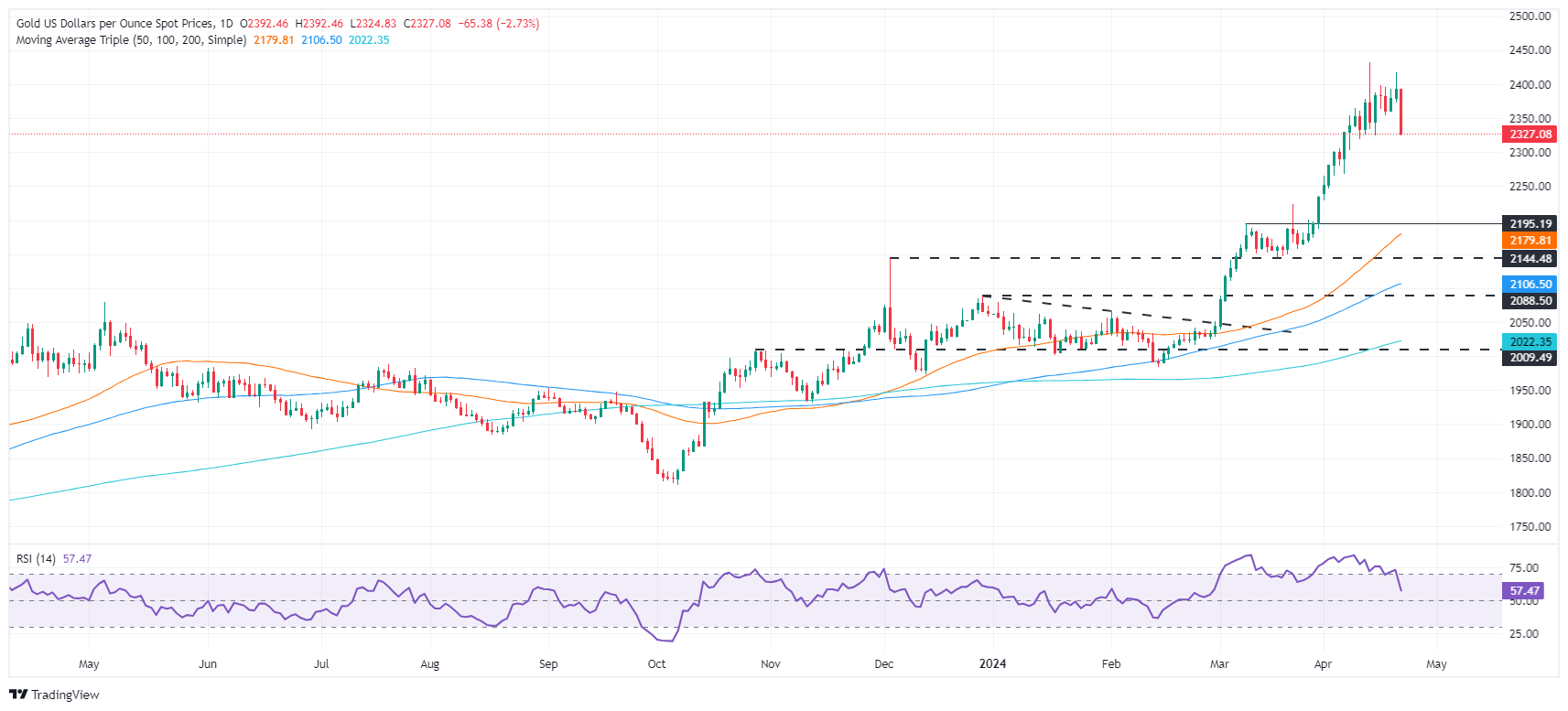
Gold price nosedived and formed a ‘bearish engulfing’ chart pattern, which opened the door for a retracement. If XAU/USD prices dip below the April 15 daily low of $2,324, that would pave the way to test $2,300. A breach of the latter will expose the March 21 high at $2,222.
On the other hand, XAU/USD's first resistance would be $2,400, followed by Friday’s high of $2,417. A breach of the latter will expose the all-time high of $2,431.
Gold FAQs
Gold has played a key role in human’s history as it has been widely used as a store of value and medium of exchange. Currently, apart from its shine and usage for jewelry, the precious metal is widely seen as a safe-haven asset, meaning that it is considered a good investment during turbulent times. Gold is also widely seen as a hedge against inflation and against depreciating currencies as it doesn’t rely on any specific issuer or government.
Central banks are the biggest Gold holders. In their aim to support their currencies in turbulent times, central banks tend to diversify their reserves and buy Gold to improve the perceived strength of the economy and the currency. High Gold reserves can be a source of trust for a country’s solvency. Central banks added 1,136 tonnes of Gold worth around $70 billion to their reserves in 2022, according to data from the World Gold Council. This is the highest yearly purchase since records began. Central banks from emerging economies such as China, India and Turkey are quickly increasing their Gold reserves.
Gold has an inverse correlation with the US Dollar and US Treasuries, which are both major reserve and safe-haven assets. When the Dollar depreciates, Gold tends to rise, enabling investors and central banks to diversify their assets in turbulent times. Gold is also inversely correlated with risk assets. A rally in the stock market tends to weaken Gold price, while sell-offs in riskier markets tend to favor the precious metal.
The price can move due to a wide range of factors. Geopolitical instability or fears of a deep recession can quickly make Gold price escalate due to its safe-haven status. As a yield-less asset, Gold tends to rise with lower interest rates, while higher cost of money usually weighs down on the yellow metal. Still, most moves depend on how the US Dollar (USD) behaves as the asset is priced in dollars (XAU/USD). A strong Dollar tends to keep the price of Gold controlled, whereas a weaker Dollar is likely to push Gold prices up.
Author

Christian Borjon Valencia
FXStreet
Markets analyst, news editor, and trading instructor with over 14 years of experience across FX, commodities, US equity indices, and global macro markets.