Gold surges but ends session shy of $2,400 amid risk aversion, Fed’s Bostic comments
- Gold remains lifted by geopolitical risks amid sharp rise in US Treasury yields.
- Federal Reserve officials emphasize ongoing inflation concerns, hinting at maintaining higher interest rates for longer.
- Strong US labor market data reinforces robust economic backdrop.

Gold prices advanced late in the North American session on Thursday, underpinned by heightened geopolitical risks involving Iran and Israel. Federal Reserve (Fed) officials delivered hawkish messages, triggering a jump in US Treasury yields, which boosted the Greenback.
XAU/USD trades at $2,384, with gains of more than 1%, after hitting a daily low of $2,361. Major central bank speakers are grabbing the spotlight, pushing aside the release of economic data from the United States (US), which paints an optimistic outlook for the labor market.
On Thursday, Fed policymakers crossed the wires. Atlanta Fed’s Raphael Bostic noted that inflation is too high, and the US central bank still has a way to go to tame it. He added the Fed won’t be able to reduce rates. Earlier, New York Fed President John Williams stated that the Fed is data-dependent and emphasized that monetary policy is in a good place, so he wasn’t in a rush to cut rates. His baseline doesn’t consider hiking rates but added that the Fed will hike if needed.
Following Bostic’s remarks and strong data that showed US Initial Jobless Claims remained unchanged compared to the previous reading, the golden metal continued to climb.
Daily digest market movers: Gold shrugs off higher yields, strong US data
- The US Department of Labor revealed that Initial Jobless Claims for the week ending April 13 fell to 212K, below the predicted 215K. Continuing Jobless Claims for the week of April 6 slightly rose to 1.812 million from 1.810 million but were still below the expected 1.818 million.
- The Philadelphia Fed Manufacturing Index increased significantly, jumping to 15.5, far surpassing minimal forecasts of 1.5. US Existing Home Sales declined by 4.3% MoM, falling from 4.38 million to 4.19 million, which was also below the anticipated 4.2 million.
- In the meantime, the CME FedWatch Tool shows the first rate cut could happen in September, with odds for a quarter percentage point cut standing at 66%, down from yesterday’s 71%.
- Despite decent US economic data, market participants seem to be focused on geopolitical risks.
- Tensions in the Middle East subsided after Israeli officials commented that they considered striking Iran on Monday but decided to wait, according to Axios. Jake Sullivan, the White House National Security Advisor, said the US decided to impose new sanctions on Iran in the upcoming days.
- US Dollar Index (DXY), which tracks the buck’s performance against a basket of six other currencies, loses 0.15% to 105.96.
- Gross Domestic Product (GDP) estimates for Q1 2024 show that the US economy is expected to grow 2.9%, up from 2.8% estimated on April 15, according to the Atlanta GDPNow model.
Technical analysis: Gold rises despite RSI in overbought levels
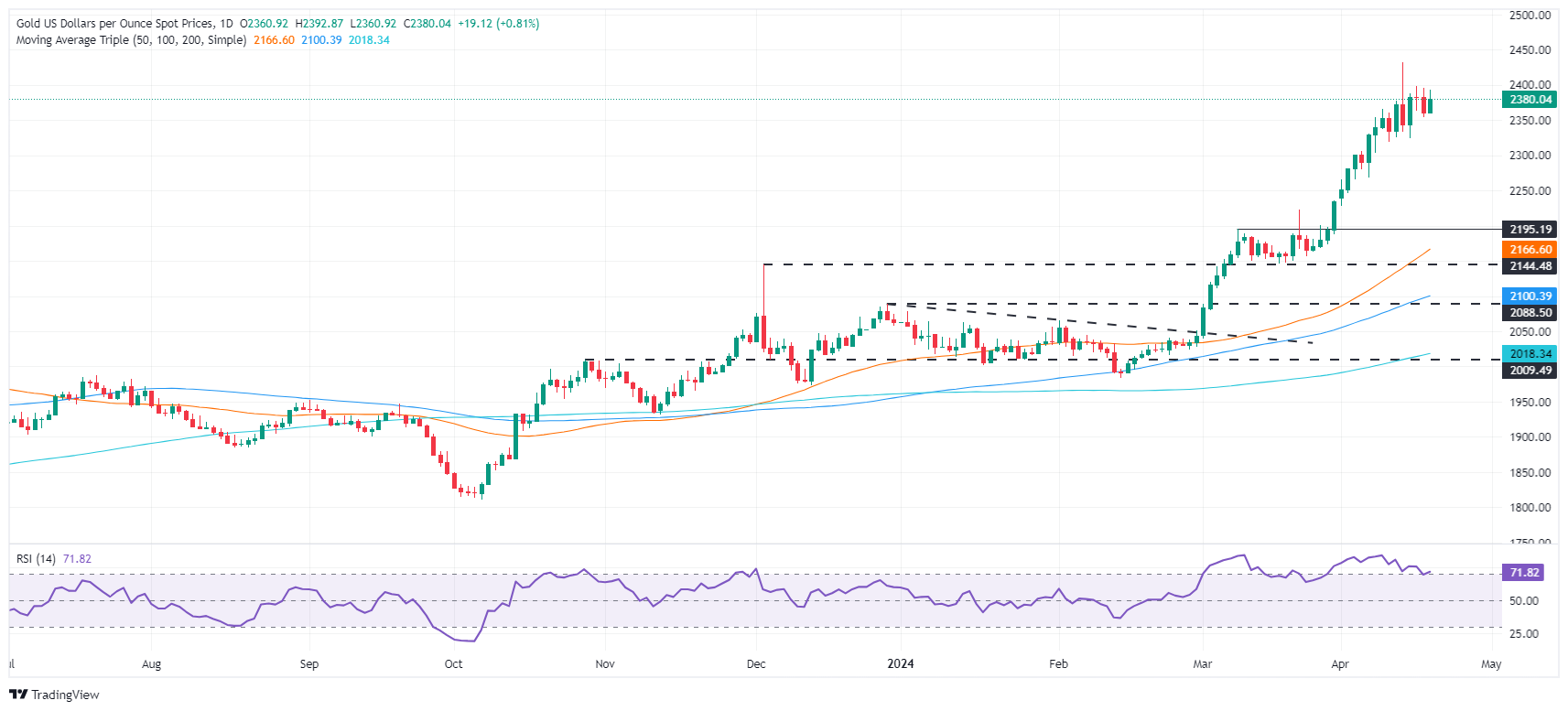
The Gold price remains bullishly biased, and price action of the last couple of trading days appears to form a Bullish Harami chart pattern that reassembles an inside day. That suggests the non-yielding metal could resume its uptrend, even though the Relative Strength Index (RSI) is at overbought levels. That said, buyers need to challenge the $2,400 figure. Once cleared, that could pave the way to test the year-to-date (YTD) high at $2,431.78, ahead of $2,500.
On the other hand, if XAU/USD is headed for a correction, the first support would be the $2,350 mark, followed by the April 15 daily low of $2,324. Once surpassed, Gold might test $2,300.
Gold FAQs
Gold has played a key role in human’s history as it has been widely used as a store of value and medium of exchange. Currently, apart from its shine and usage for jewelry, the precious metal is widely seen as a safe-haven asset, meaning that it is considered a good investment during turbulent times. Gold is also widely seen as a hedge against inflation and against depreciating currencies as it doesn’t rely on any specific issuer or government.
Central banks are the biggest Gold holders. In their aim to support their currencies in turbulent times, central banks tend to diversify their reserves and buy Gold to improve the perceived strength of the economy and the currency. High Gold reserves can be a source of trust for a country’s solvency. Central banks added 1,136 tonnes of Gold worth around $70 billion to their reserves in 2022, according to data from the World Gold Council. This is the highest yearly purchase since records began. Central banks from emerging economies such as China, India and Turkey are quickly increasing their Gold reserves.
Gold has an inverse correlation with the US Dollar and US Treasuries, which are both major reserve and safe-haven assets. When the Dollar depreciates, Gold tends to rise, enabling investors and central banks to diversify their assets in turbulent times. Gold is also inversely correlated with risk assets. A rally in the stock market tends to weaken Gold price, while sell-offs in riskier markets tend to favor the precious metal.
The price can move due to a wide range of factors. Geopolitical instability or fears of a deep recession can quickly make Gold price escalate due to its safe-haven status. As a yield-less asset, Gold tends to rise with lower interest rates, while higher cost of money usually weighs down on the yellow metal. Still, most moves depend on how the US Dollar (USD) behaves as the asset is priced in dollars (XAU/USD). A strong Dollar tends to keep the price of Gold controlled, whereas a weaker Dollar is likely to push Gold prices up.
Author

Christian Borjon Valencia
FXStreet
Markets analyst, news editor, and trading instructor with over 14 years of experience across FX, commodities, US equity indices, and global macro markets.