Gold soars as US economic woes and inflation fears grip investors
- Gold prices climb following US Q1 GDP results falling below expectations.
- Sharp increase in Q1 inflation to 3.7% tempers expectations for immediate Fed rate cuts and underpins higher Treasury yields.
- Fed officials maintain cautious stance on monetary policy, echoing concerns over persistent inflation pressure.

Gold prices advanced modestly during Thursday’s North American session, gaining more than 0.5% following the release of crucial economic data from the United States (US). GDP figures for the first quarter of 2024 missed estimates, increasing speculation that the US Federal Reserve (Fed) could lower borrowing costs. However, inflation for the same period jumped sharply, which would delay interest rate cuts by the Fed.
XAU/USD trades at $2,330 after bouncing off daily lows of $2,305 amid higher US Treasury yields, courtesy of the reacceleration of inflation. As expected by analysts, the US economy would slow down in 2024, but it missed the mark by a full percentage point in the first quarter. That would keep the “soft landing” narrative in place, but underlying inflation for Q1 2024 rose by 3.7% QoQ, above estimates and crushing the 2% registered in the last quarter of 2023.
This justified Fed officials' change of stance last week. Chairman Jerome Powell gave the green light when he commented, "Recent data shows lack of further progress on inflation this year.”
Those words were echoed by a slew of policymakers, most significantly by the ultra-dovish Chicago Fed President, Austan Goolsbee, who said, “Fed's current restrictive monetary policy is appropriate.”
Daily digest market movers: Gold price climbs amid highs US yields, soft USD
- Gold advance continues even though US Treasury yields advance. The US 10-year note yield is up six basis points (bps) at 4.706%, while US real yields, which closely correlate inversely with the golden metal, are also up by the same amount, at 2.296%.
- A softer Greenback also underpins the yellow metal. The US Dollar Index (DXY) is down 0.22% at 105.59.
- US GDP for Q1 2024 expanded by 1.6% QoQ, below estimates of 2.5%, and trailed Q4 2023’s 3.4%. The core Personal Consumption Expenditure Price Index (PCE) for the same period rose 3.7%, crushing estimates of a 3.4% increase and up from 2% in the previous reading.
- In addition, the US labor market remains strong. Initial Jobless Claims for the week ending April 20 missed estimates of 214K, coming at 207K, less than the previous reading.
- Upcoming Q1 GDP data and core PCE inflation figures will provide key insights into the possible timing of the Fed's interest rate reductions. The core PCE, the Fed’s preferred measure of inflation, is expected to maintain a steady monthly growth of 0.3%. Additionally, the annual core PCE rate is anticipated to decrease to 2.6% from 2.8% in February.
- Data from the Chicago Board of Trade (CBOT) suggests that traders expect the fed funds rate to finish 2024 at 5.035%, up from 4.98% on Wednesday.
Technical analysis: Gold price hovers near $2,330 as buyers take a breather
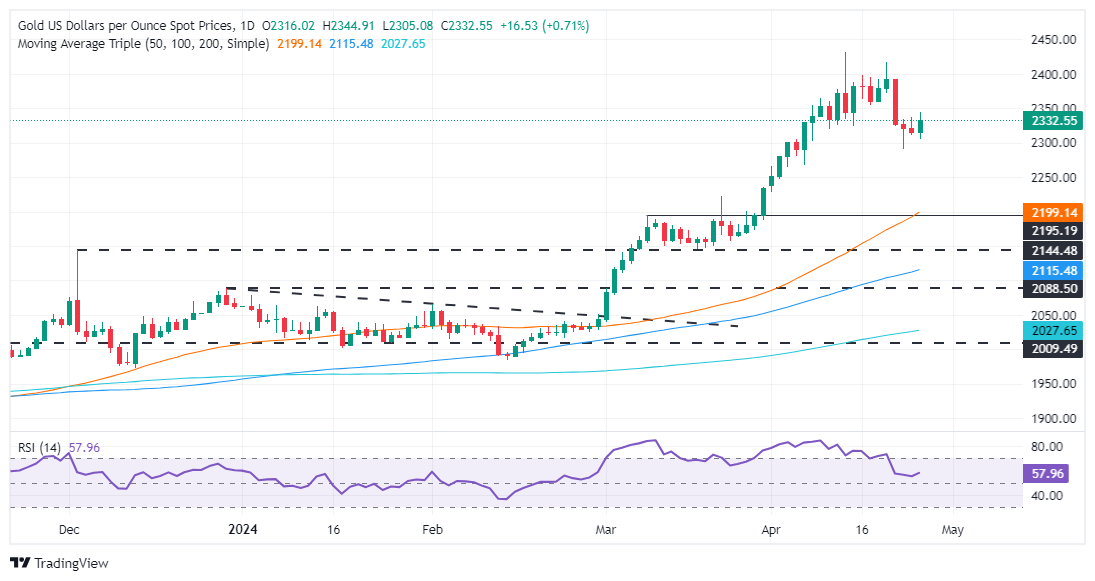
Gold price edges up, but it’s facing resistance at $2,337, the April 24 high. A breach of the latter will expose the psychological $2,350 figure, followed by the $2,400 mark. Subsequent gains lie once that supply zone is cleared, followed by the April 19 high at $2,417, followed by the all-time high of $2,431.
On the flip side, if the XAU/USD price dips below the April 15 daily low of $2,324, that would pave the way to test $2,300. A breach of the latter would expose the April 23 low of $2,229, followed by the March 21 high at $2,222.
Gold FAQs
Gold has played a key role in human’s history as it has been widely used as a store of value and medium of exchange. Currently, apart from its shine and usage for jewelry, the precious metal is widely seen as a safe-haven asset, meaning that it is considered a good investment during turbulent times. Gold is also widely seen as a hedge against inflation and against depreciating currencies as it doesn’t rely on any specific issuer or government.
Central banks are the biggest Gold holders. In their aim to support their currencies in turbulent times, central banks tend to diversify their reserves and buy Gold to improve the perceived strength of the economy and the currency. High Gold reserves can be a source of trust for a country’s solvency. Central banks added 1,136 tonnes of Gold worth around $70 billion to their reserves in 2022, according to data from the World Gold Council. This is the highest yearly purchase since records began. Central banks from emerging economies such as China, India and Turkey are quickly increasing their Gold reserves.
Gold has an inverse correlation with the US Dollar and US Treasuries, which are both major reserve and safe-haven assets. When the Dollar depreciates, Gold tends to rise, enabling investors and central banks to diversify their assets in turbulent times. Gold is also inversely correlated with risk assets. A rally in the stock market tends to weaken Gold price, while sell-offs in riskier markets tend to favor the precious metal.
The price can move due to a wide range of factors. Geopolitical instability or fears of a deep recession can quickly make Gold price escalate due to its safe-haven status. As a yield-less asset, Gold tends to rise with lower interest rates, while higher cost of money usually weighs down on the yellow metal. Still, most moves depend on how the US Dollar (USD) behaves as the asset is priced in dollars (XAU/USD). A strong Dollar tends to keep the price of Gold controlled, whereas a weaker Dollar is likely to push Gold prices up.
Author
Christian Borjon Valencia
FXStreet
Christian Borjon began his career as a retail trader in 2010, mainly focused on technical analysis and strategies around it. He started as a swing trader, as he used to work in another industry unrelated to the financial markets.