Gold ascends but remains shy of testing $2,400 amid hawkish Fed remarks
- Gold climbs, reacting to Fed Chair Powell's hawkish comments and mixed US data.
- Tensions in the Middle East escalate, influencing Gold's status as a safe-haven asset.
- Market expectations reduce the likelihood of multiple Fed rate cuts this year.

Gold prices edged higher late in Tuesday’s North American session, gaining 0.22% following a hawkish tilt by Federal Reserve Chair Jerome Powell. Economic data from the United States (US) was mixed, though Monday’s Retail Sales report and Powell’s remarks kept US Treasury yields higher, capping the yellow metal’s advance.
XAU/USD trades at $2,388 after hitting a daily low of $2,363. Risk appetite has deteriorated amid the heightened tensions in the Middle East. Following Iran’s attack on Israel over the weekend, the latter is set to retaliate even though the White House warned that it would not participate.
Given the backdrop, Gold is set to continue advancing, if not because Fed Chair Jerome Powell said that the US economy has performed quite strongly while acknowledging that recent data shows a lack of further progress on inflation.
Following those remarks, traders reduced expectations for the Federal Reserve to cut rates more than once this year, according to Reuters. The CME FedWatch Tools shows the first rate cut could happen in September, with odds for a quarter of a percentage point standing at 71.38%.
Daily digest market movers: Gold traders ignore higher US yields, strong production output data
- In March, US Building Permits saw a decrease of 4.3%, dropping to 1.458 million, which was below the expected 1.514 million and February's figure of 1.523 million. Additionally, Housing Starts experienced a significant drop of 14.7%, falling from 1.549 million to 1.321 million, well under the forecast of 1.48 million.
- The Federal Reserve reported that March’s Industrial Production was stable, meeting both estimates and the previous month’s growth rate of 0.4% MoM.
- Despite mixed economic indicators, market participants remain focused on strong March US Retail Sales data released on Monday. Particularly noteworthy was the control group's performance—essential for GDP calculations—which significantly exceeded both forecasts and the previous month's results.
- Despite decent US economic data, market participants seem to be focused on geopolitical risks. Sources cited by The Jerusalem Post revealed that Israel has reportedly finalized plans for a counterstrike against Iran.
- Gold’s price remains high even though US Treasury yields are climbing more than 5 basis points (bps) in the belly and long end of the yield curve.
- US Dollar Index (DXY), which tracks the buck’s performance against a basket of six other currencies, gains 0.11% to 106.29, levels last seen in November 2023.
- Gross Domestic Product (GDP) estimates for Q1 2024 show that the US economy is expected to grow 2.9%, up from 2.8% estimated on April 15, according to the Atlanta GDPNow model.
Technical analysis: Gold buyers remain in charge despite RSI being in overbought levels
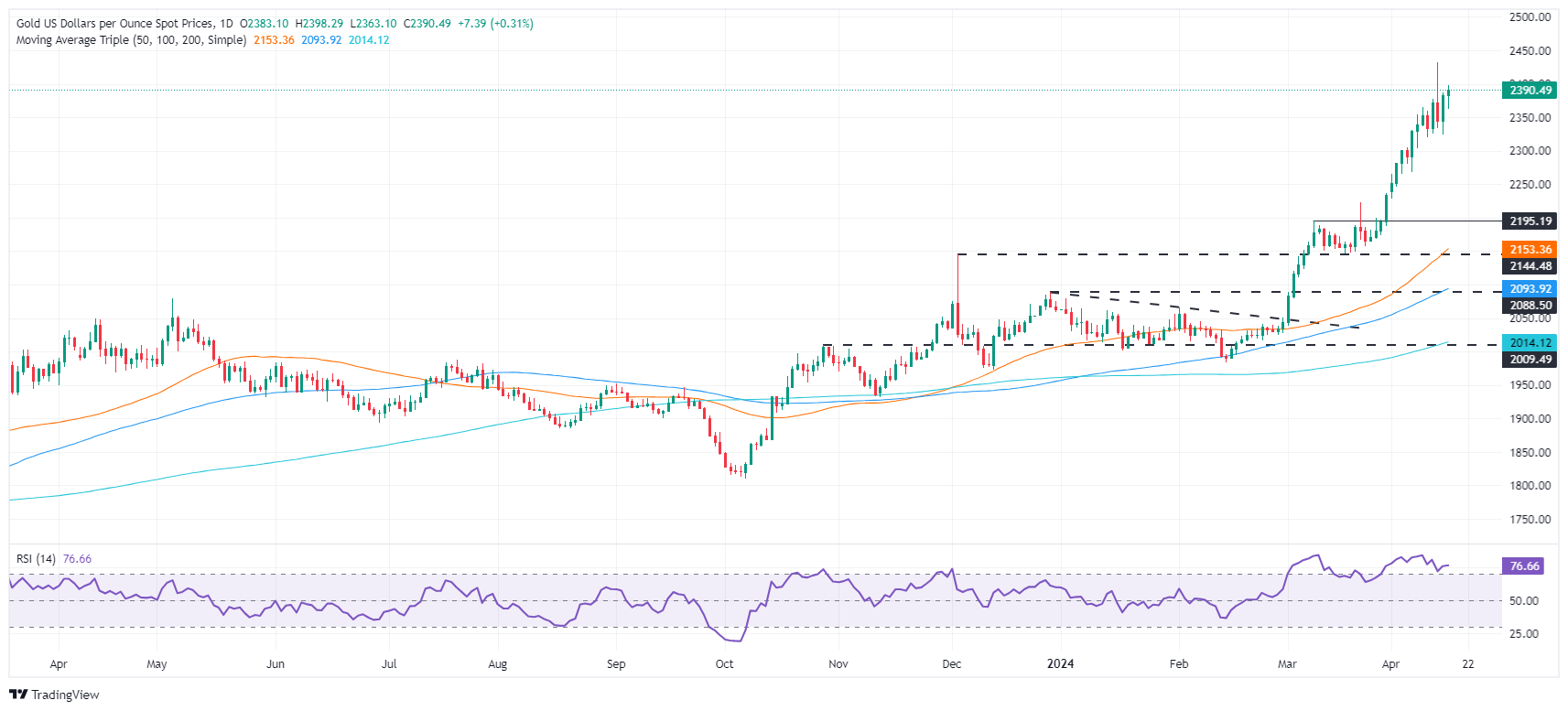
Gold is upwardly biased, though the uptrend seems overextended, increasing the risks of a pullback. Nevertheless, according to Dow Theory, the trend is more likely to continue than reverse. That said, after dipping on Friday, the Relative Strength Index (RSI) is aiming upward again, with buyers stepping in, opening the door to challenge the $2,400 figure. A breach of the latter will expose the all-time high at $2,431, followed by $2,450.
On the flip side, a daily close below the April 12 close of $2,343 could open the door to push Gold’s price toward the $2,300 mark. Once cleared, the next support would be the April 5 swing low of $2,267.
Gold FAQs
Gold has played a key role in human’s history as it has been widely used as a store of value and medium of exchange. Currently, apart from its shine and usage for jewelry, the precious metal is widely seen as a safe-haven asset, meaning that it is considered a good investment during turbulent times. Gold is also widely seen as a hedge against inflation and against depreciating currencies as it doesn’t rely on any specific issuer or government.
Central banks are the biggest Gold holders. In their aim to support their currencies in turbulent times, central banks tend to diversify their reserves and buy Gold to improve the perceived strength of the economy and the currency. High Gold reserves can be a source of trust for a country’s solvency. Central banks added 1,136 tonnes of Gold worth around $70 billion to their reserves in 2022, according to data from the World Gold Council. This is the highest yearly purchase since records began. Central banks from emerging economies such as China, India and Turkey are quickly increasing their Gold reserves.
Gold has an inverse correlation with the US Dollar and US Treasuries, which are both major reserve and safe-haven assets. When the Dollar depreciates, Gold tends to rise, enabling investors and central banks to diversify their assets in turbulent times. Gold is also inversely correlated with risk assets. A rally in the stock market tends to weaken Gold price, while sell-offs in riskier markets tend to favor the precious metal.
The price can move due to a wide range of factors. Geopolitical instability or fears of a deep recession can quickly make Gold price escalate due to its safe-haven status. As a yield-less asset, Gold tends to rise with lower interest rates, while higher cost of money usually weighs down on the yellow metal. Still, most moves depend on how the US Dollar (USD) behaves as the asset is priced in dollars (XAU/USD). A strong Dollar tends to keep the price of Gold controlled, whereas a weaker Dollar is likely to push Gold prices up.
Author

Christian Borjon Valencia
FXStreet
Markets analyst, news editor, and trading instructor with over 14 years of experience across FX, commodities, US equity indices, and global macro markets.