Gold price declines as market sentiment improves
- Gold price declines on positive risk appetite, denting safe-haven demand.
- Gold rose strongly on Wednesday after the Federal Reserve adopted an overall easing bias in its May meeting.
- The precious metal was propelled higher after Federal Reserve Chairman Jerome Powell described more rate hikes as “unlikely”.

The Gold price (XAU/USD) is trading in the $2,290s on Thursday after falling almost a percentage point on reduced safe-haven demand. Market sentiment is overall positive as Asian stocks on balance closed higher and Oil prices hover at seven-week lows.
Gold price rallies after Federal Reserve meeting
Gold price surged over $30 an ounce after the US Federal Reserve (Fed) adopted an overall easing bias at its May policy meeting on Wednesday.
Gold bulls bid up the price after the Fed decided to leave interest rates unchanged and to slow the pace of reduction of its US Treasury holdings, a mildly dovish move as it unwinds quantitative tightening.
Yet the Fed also added a hawkish phrase to its statement to reflect the continued stubbornness of US inflation, saying that, “in recent months, there has been a lack of further progress toward the Committee’s 2 percent inflation objective.”
Concerns, however, that the Fed might actually consider raising interest rates – something that would be detrimental to non-yielding Gold – were allayed after the Federal Reserve Chairman Jerome Powell described such a move as “unlikely”.
In his prepared remarks, Powell dropped any reference to reducing interest rates this year, and sidestepped questions about whether the Fed would still be cutting rates in 2024, in the Q&A. Yet, although the overall take-away was that rates were not coming down any time soon, additional rate-hikes were not on the table either.
Technical Analysis: Gold price possibly unfolding Measured Move
Gold price (XAU/USD) has fulfilled the minimum requirement for completing its bearish Measured Move price pattern after hitting the Fibonacci 0.681 price objective for the final C wave at $2,286. This could mean prices will now track higher.
XAU/USD 4-hour Chart
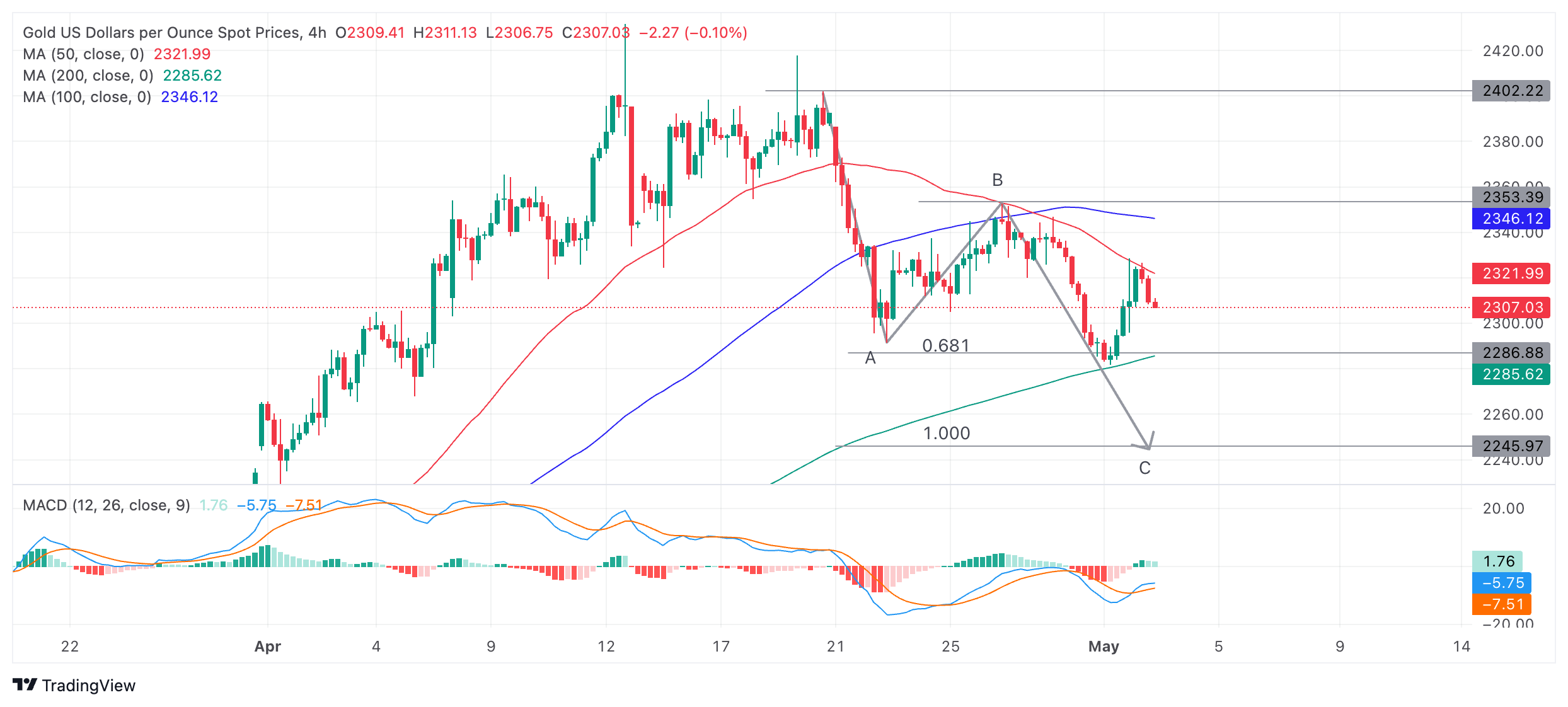
Measured Move patterns are composed of three waves that trace out a zig-zag. The end of the final C wave can be estimated based on the length of wave A. It is usually either equal in length to A or a Fibonacci 0.681 ratio of A.
Directionally, Gold is in a bit of a no-man’s land: a break below the 0.681 Fibonacci target lows at $2,285 would be needed to confirm more downside to a target at $2,245 (1.000 or where A=C).
Alternatively, a break above the cluster of Moving Averages and the peak of wave B at around $2,350 would potentially usher in a new more bullish environment. This could then see a retest of the $2,400 highs.
Additionally, the trend for Gold price is up both in the medium and long-term, overall supporting the outlook.
Gold FAQs
Gold has played a key role in human’s history as it has been widely used as a store of value and medium of exchange. Currently, apart from its shine and usage for jewelry, the precious metal is widely seen as a safe-haven asset, meaning that it is considered a good investment during turbulent times. Gold is also widely seen as a hedge against inflation and against depreciating currencies as it doesn’t rely on any specific issuer or government.
Central banks are the biggest Gold holders. In their aim to support their currencies in turbulent times, central banks tend to diversify their reserves and buy Gold to improve the perceived strength of the economy and the currency. High Gold reserves can be a source of trust for a country’s solvency. Central banks added 1,136 tonnes of Gold worth around $70 billion to their reserves in 2022, according to data from the World Gold Council. This is the highest yearly purchase since records began. Central banks from emerging economies such as China, India and Turkey are quickly increasing their Gold reserves.
Gold has an inverse correlation with the US Dollar and US Treasuries, which are both major reserve and safe-haven assets. When the Dollar depreciates, Gold tends to rise, enabling investors and central banks to diversify their assets in turbulent times. Gold is also inversely correlated with risk assets. A rally in the stock market tends to weaken Gold price, while sell-offs in riskier markets tend to favor the precious metal.
The price can move due to a wide range of factors. Geopolitical instability or fears of a deep recession can quickly make Gold price escalate due to its safe-haven status. As a yield-less asset, Gold tends to rise with lower interest rates, while higher cost of money usually weighs down on the yellow metal. Still, most moves depend on how the US Dollar (USD) behaves as the asset is priced in dollars (XAU/USD). A strong Dollar tends to keep the price of Gold controlled, whereas a weaker Dollar is likely to push Gold prices up.
Author

Joaquin Monfort
FXStreet
Joaquin Monfort is a financial writer and analyst with over 10 years experience writing about financial markets and alt data. He holds a degree in Anthropology from London University and a Diploma in Technical analysis.

















