|

Gold Price Forecast: XAU/USD trapped in a $14 range as bulls prepare an assault of $1900

  • Gold aims for a 2.06% gain on the week, courtesy of geopolitical jitters amid Fed speaking ignored by market players.
  • The conflict in Eastern Europe gives signs of no de-escalation as Russian President Putin decided to oversee nuclear drills in the weekend.
  • XAU/USD Technical Outlook: Despite finishing the week on the wrong foot, still upward biased, as XAU bulls prepare to probe $1900.

Gold (XAU/USD) slides as the New York session winds down and fails to cling to the $1,900 mark pierced on Thursday, so far in the week up 2.02%. At the time of writing, XAU/USD is trading at $1,897. A risk-off market mood kept the safe-haven gold bid through the majority of the week, with four days of gains and one day in the red.

Russia/Ukraine update

In the meantime, the Russia Ukraine narrative keeps grabbing the headlines. In the last couple of hours, tensions have remained unchanged. Ukraine’s intelligence reported that Russian special forces placed numerous explosive devices around local infrastructure in separatist-held territories in Donetsk. Meanwhile, the Russian Communist leader Zyuganov said that Russian President Vladimir Putin would announce a decision on Donbas on February 20.

Furthermore, late in the day, a Senior US admin official said that Russian President Putin’s decision to oversee nuclear drills on Saturday is “escalatory.” In contrast, other US officials privately urged Ukraine President Zelensky to stay put, as concerns of a possible incursion rise, as reported by CNN’s reporter.

That said, what happened to gold? During Friday’s session, the yellow metal consolidated around the $1,886-$1,900 area, amongst exchanges of statements in news media between Russia, Ukraine, and NATO countries, keeping uncertainty around the current situation in Ukraine.

The US 10-year Treasury yield fell five basis points sits at 1.925% in the bond market. At the same time, the US Dollar Index, a gauge of the greenback’s value against a basket of its rivals, edges up 0.31%, at 96.10, reflecting the increased demand for the US dollar amid geopolitical concerns.

XAU/USD Price Forecast: Technical outlook

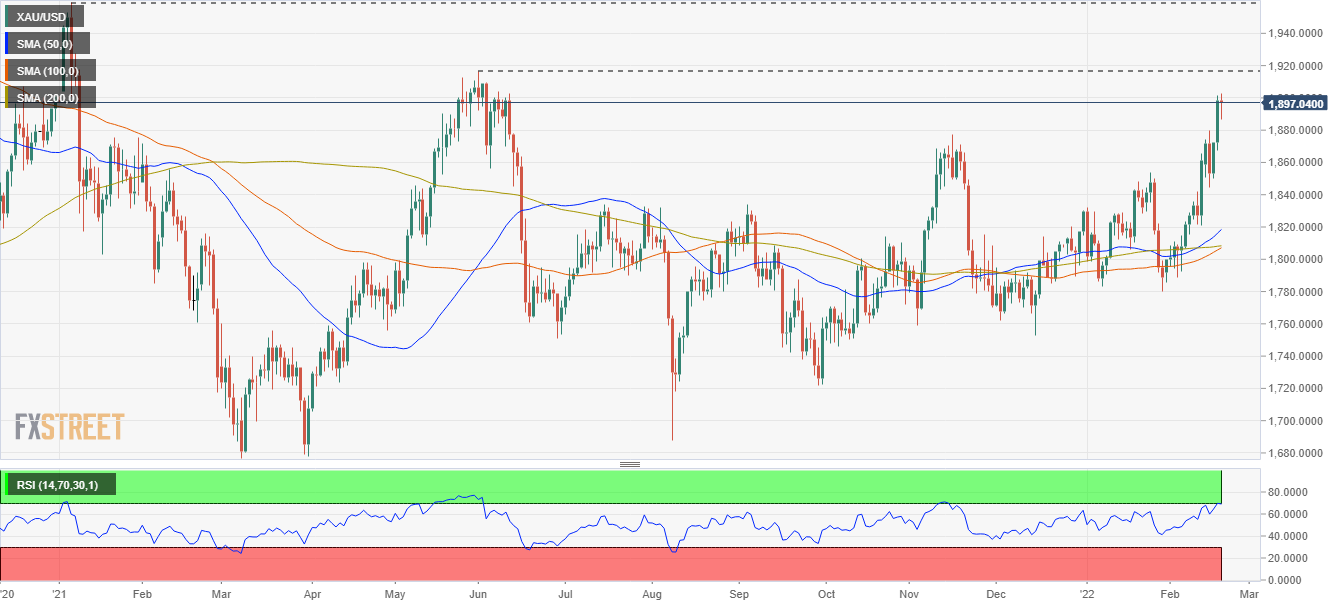
On Thursday, the non-yielding metal pierced the $1,900 mark for the first time since last June. However, XAU bulls’ failure to record a daily close left the yellow metal subject of a mean reversion move.

On Friday, XAU/USD consolidated in a $14.00 range. Should gold close within the range, a move towards February 15 daily high, resistance/support at $1,879 is on the cards, as XAU bulls prepare for an assault of $1,900. If that scenario plays out, XAU/USD first resistance is $1,900. The breach of it opens the door towards $1,916, which, once cleared, will expose January 2021 highs at $1,959.
XAU/USD

Overview
Today last price1897.04
Today Daily Change-1.64
Today Daily Change %-0.09
Today daily open1898.68
 
Trends
Daily SMA201830.57
Daily SMA501816.2
Daily SMA1001805.76
Daily SMA2001808.09
 
Levels
Previous Daily High1901.18
Previous Daily Low1867.52
Previous Weekly High1865.51
Previous Weekly Low1806.9
Previous Monthly High1853.91
Previous Monthly Low1780.32
Daily Fibonacci 38.2%1888.32
Daily Fibonacci 61.8%1880.38
Daily Pivot Point S11877.07
Daily Pivot Point S21855.47
Daily Pivot Point S31843.41
Daily Pivot Point R11910.73
Daily Pivot Point R21922.79
Daily Pivot Point R31944.39

Author

Christian Borjon Valencia

Markets analyst, news editor, and trading instructor with over 14 years of experience across FX, commodities, US equity indices, and global macro markets.


More from Christian Borjon Valencia
Share:

Editor's Picks

AUD/USD eyes 0.7000 as USD remains on the back foot amid softer bond yields

AUD/USD fills a modest bearish gap on Monday, approaching 0.7000 during the Asian session amid holiday-thinned liquidity. The US Dollar remains on the back foot as US bond yields pull back from multi-year highs, supporting the pair. However, the Fed's hawkish outlook and the US-Iran standoff should limit USD losses. Moreover, diminishing odds of another RBA rate hike in November might cap the Aussie.

USD/JPY remains confined in a familiar range around 158.00

USD/JPY extends its range-bound price action at the start of a new week, trading around 158.00 as bulls remain on high alert amid speculation that authorities would step in to prop up the Japanese Yen. Furthermore, softer US bond yields keep US Dollar bulls on the back foot and cap the currency pair. However, geopolitical uncertainties could limit losses for the safe-haven buck amid thin liquidity due to a holiday in Japan and the US.

Gold advances to over one-week top, above $4,200 on softer bond yields/USD

Gold moves above $4,200 on Monday, hitting an over one-week high during the Asian session as softer US bond yields keep US Dollar bulls on the defensive. However, the US-Iran standoff over the Strait of Hormuz, along with a hawkish Fed, could limit USD losses. This could cap non-yielding bullion as traders look to US inflation figures and Fed Chair Kevin Warsh's speech for a fresh impetus during the latter part of this week.

Week ahead: US CPI, France’s budget crisis and Q3 earnings to set the market tone
The US dollar held relatively strong this week, despite the disappointing US jobs report on October 2, which further decreased the probability of a back-to-back rate hike by the Fed at the upcoming gathering on October 28.
Middle East War updates: New attack launched on Saudi airport
Here’s a brief recap of the key developments in the Middle East war that occurred over the weekend, which are expected to have a significant impact on markets in the upcoming week. In the world of financial jargon the two widely used terms “risk-on” and “risk off'' refer to the level of risk that investors are willing to stomach during the period referenced.
Has Bitcoin really escaped the macro forces it was built to fight?
Over 17 years ago, Satoshi Nakamoto designed Bitcoin (BTC) on the back of a global financial crisis as an alternative to the global monetary system outside the control of central banks, governments and traditional intermediaries. This raises a key question: has Bitcoin really become independent of the macroeconomic forces it was built to challenge?















