Gold Price Forecast: XAU/USD steadies around $1,920, eyes more downside amid obscurity over Fed’s policy
- Gold remains on the back foot around fortnight low, after three-day downtrend.
- Market sentiment is turning positive amid a rebound in global equities.
- Treasury yields seesaw around mid-2019 peak, S&P 500 Futures differs from upbeat Wall Street close during sluggish Asian session.
- Fed March Preview: Gold needs a dovish Fed to regain traction

Update: Gold (XAU/USD) is hovering around Tuesday’s low at $1,907.13 as investors are anxious ahead of the announcement of the interest rate decision by the Federal Reserve (Fed). Usually, a continuous price action near the previous trading session’s low denotes the build-up of significant offers and more weakness going forward. Although it is very much clear that Fed Chair Jerome Powell and his colleagues are left with no other option than feature an interest rate hike to curtail the soaring inflation, the catalyst to which investors are getting curious is the extent of hawkish stance to be taken by the Fed.
Meanwhile, the 10-year US Treasury yields have sensed barricades near 2.15% amid rising uncertainty over the Fed’s monetary policy. The US dollar index (DXY) is trailing the yields and has struggled to sustain above 99.00. Moreover, positive cues from the Asian markets have squeezed the safe-haven appeal.
Apart from the Fed’s monetary policy announcement, US Retail Sales will also be released on Wednesday. A preliminary estimate at 0.4% is indicating underperformance in lieu of the previous print at 3.8%.
End of Update
Gold (XAU/USD) portrays the fourth consecutive daily loss near $1,917 while poking the monthly low, despite being inactive during Wednesday’s Asian session. The yellow metal’s losses could be linked to the firmer US Treasury yields and the market’s anxiety ahead of the top-tier events.
That said, the US 10-year Treasury yields ended Tuesday unchanged despite rising to mid-2019 levels during the initial day, down one basis point (bp) to 2.149% at the latest. On the same line, the five-year bond coupon also eases from the highest levels since May 2019 marked the previous day. Further, S&P 500 Futures print mild losses despite the positive performance of Wall Street.
Talking about the key catalysts, Russia-Ukraine tussles continue but a halt in further deterioration seems to cut the fears of late. global markets initially cheered hopes of the Ukraine-Russia peace, as signaled by Ukraine President Volodymyr Zelenskyy’s adviser, before Russian President Vladimir Putin said Kyiv is not serious about finding a mutually acceptable solution. Following that, Mykhailo Podoliyak, one of the representatives of Ukraine at Russian-Ukrainian negotiations cites room for compromise. It’s worth noting that the UK added more sanctions on Russia whereas Japan is up for removing Moscow from favored trade status. In return, Moscow banned Canadian PM from entering their country and levied sanctions on US President Joe Biden.
Further, China turned out as a fresh risk for the markets with a surge in the local covid numbers and lockdowns in multiple cities, the latest one being near to the capital Beijing.
It’s worth noting that the US Producer Price Index (PPI) matched YoY expectations of 10% growth whereas NY Empire State Manufacturing Index printed the biggest downside since May 2020, adding to the market’s pre-Fed anxiety. Also testing Fed hawks is the recently easing US inflation expectations from the record top, as signaled by the 10-year breakeven inflation rate per the St. Louis Federal Reserve (FRED) data.
Moving on, gold traders will pay close attention to how the Fed battles inflation fears, which in turn will pave way for the short-term trend. Also important will be China’s covid headlines and Russia-Ukraine news as the risk-off mood may cushion the metal against the hard-hitting if the Fed manages to praise the USD bulls.
Technical analysis
Gold justifies a clear downside break of a six-week-old rising trend line and the 100-SMA, amid bearish MACD signals, around a two-week low.
Although oversold RSI conditions on the four-hour chart test the gold bears, 50% Fibonacci retracement (Fibo.) of January-March upside and the weekly resistance line challenge any corrective pullback around $1,925 and $1,942 respectively.
Even if the quote manages to rise past-1,942, the 100-SMA and the previous support line, close to $1,948 and $1,954 in that order, will act as additional upside filters before giving control to gold bulls targeting the $2,000 threshold.
Meanwhile, a convergence of the 200-SMA and 61.8% Fibo. near $1,890 is on the XAU/USD seller’s radar ahead of the monthly horizontal support near $1,877.
Gold: Four-hour chart
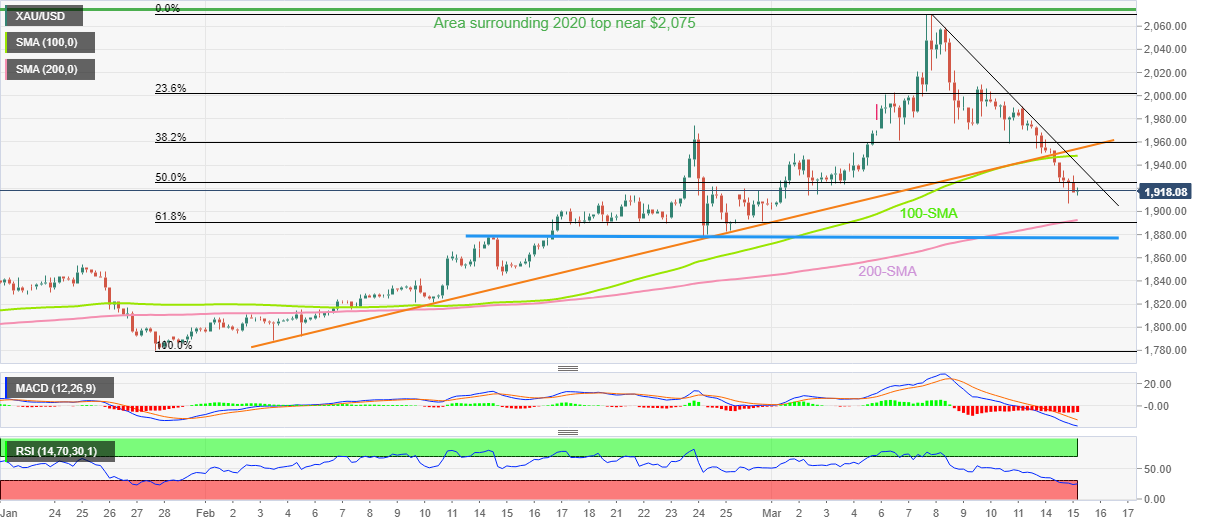
Trend: Bearish
It’s worth noting that the daily chart also highlights $1,877 as the key support, comprising tops marked during November 2021.
Gold: Daily chart
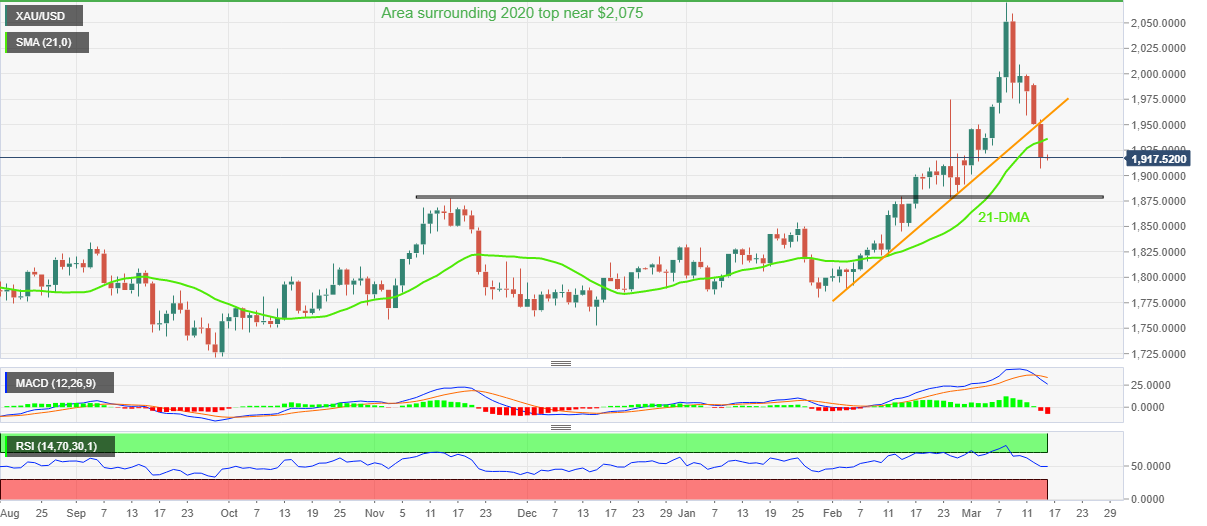
Trend: Further weakness expected
Author

Anil Panchal
FXStreet
Anil Panchal has nearly 15 years of experience in tracking financial markets. With a keen interest in macroeconomics, Anil aptly tracks global news/updates and stays well-informed about the global financial moves and their implications.