Aussie Dollar stuck as the RBA talks tough into a slowdown
- A soft Q1 GDP print sits awkwardly against the RBA's hold-or-hike messaging.
- April's trade surplus flatters what looks like weakening domestic demand.
- The Aussie is rangebound ahead of Friday's NFP and the mid-June RBA decision.
The Australian Dollar is going nowhere in a hurry, and the contradiction at its core explains why. The Reserve Bank of Australia (RBA) keeps dangling the prospect of another hike, yet the economy it governs just expanded 0.3% in the first quarter, a clear step down from the prior pace. A central bank threatening to tighten into a visible slowdown is not a recipe for conviction in either direction, and the tape shows it.
Tough talk meets a 0.3% economy
The growth miss was not marginal. First-quarter Gross Domestic Product (GDP) rose just 0.3% on the quarter and 2.5% YoY, both undershooting expectations and decelerating from late last year. Against that, the RBA has held a line that rules cuts out and keeps hikes on the table, justified by inflation that remains sticky near the top of its target band. That posture made sense while growth held up. It gets harder to defend with every soft print, and the market is right to treat the hawkish guidance with a degree of scepticism.
A surplus that flatters
Thursday's trade figures looked strong at a glance: a swing back to surplus with exports up 7.2% MoM. Look underneath and the picture is less flattering. Imports barely moved, rising close to 0.8% after a double-digit gain the month prior, so the surplus owes more to soft import demand than to booming export volumes. A trade beat built on households and businesses buying less is a symptom of a cooling economy, not evidence of strength, and it quietly reinforces the case the GDP print already made.
Pinned to the average, waiting for a cue
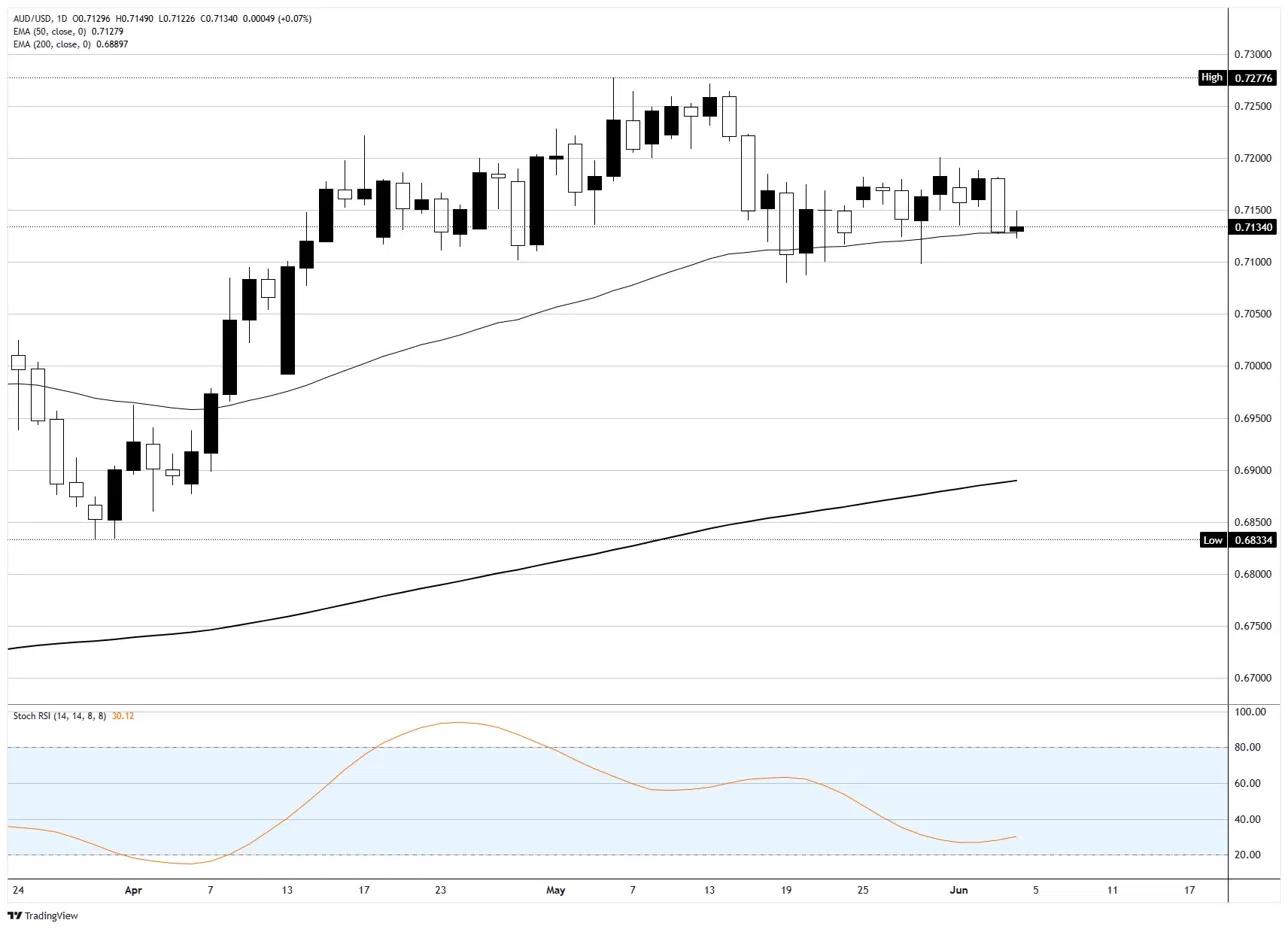
On the daily chart the Aussie is hugging its rising 50-day Exponential Moving Average (EMA), wedged between support around 0.7100 and resistance near 0.7150 after sliding from May highs close to 0.7300. The 200-day EMA sits far below around 0.6900, so the broader uptrend is still intact even as near-term momentum stalls, with the Stochastic Relative Strength Index (Stoch RSI) drifting toward oversold. The chart is not picking a side, which fits a pair waiting on outside catalysts rather than its own story.
The hawkish Fed capping the rebound
That catalyst is more likely to come from Washington than Canberra. Thursday delivered a hawkish chorus from the Federal Reserve (Fed), with Schmid, Barkin and Daly all flagging that rates could rise if inflation stays hot, and markets now lean toward a hike by year-end. A firm dollar built on that repricing keeps the high-beta Aussie capped, which is why even decent local data has struggled to spark a sustained rally.
Friday's payrolls and a busy week after
Nonfarm Payrolls (NFP) headline Friday at 12:30 GMT, consensus near 85K versus 115K prior, with unemployment seen at 4.3%. A strong number reinforces the firm-dollar story and pressures the Aussie, while a soft one is the clearest path to a relief bounce. Next week brings Westpac consumer confidence, Chinese trade and inflation data that matter for Australian export demand, and domestic inflation expectations, all of it feeding into the June 15 to 16 RBA meeting.
How to trade the range
Resistance: 0.7150 first, then the May shelf toward 0.7300; reclaiming 0.7150 on a soft NFP would be the bullish trigger.
Support: 0.7100, below which the 200-day EMA region near 0.6900 is the longer-term backstop.
Bias: neutral to mildly soft while growth disappoints and the Dollar stays bid. The asymmetry favours a squeeze higher on a weak NFP rather than a clean breakdown, given the RBA's reluctance to abandon its hawkish stance just yet.
AUD/USD daily chart
Australian Dollar FAQs
One of the most significant factors for the Australian Dollar (AUD) is the level of interest rates set by the Reserve Bank of Australia (RBA). Because Australia is a resource-rich country another key driver is the price of its biggest export, Iron Ore. The health of the Chinese economy, its largest trading partner, is a factor, as well as inflation in Australia, its growth rate and Trade Balance. Market sentiment – whether investors are taking on more risky assets (risk-on) or seeking safe-havens (risk-off) – is also a factor, with risk-on positive for AUD.
The Reserve Bank of Australia (RBA) influences the Australian Dollar (AUD) by setting the level of interest rates that Australian banks can lend to each other. This influences the level of interest rates in the economy as a whole. The main goal of the RBA is to maintain a stable inflation rate of 2-3% by adjusting interest rates up or down. Relatively high interest rates compared to other major central banks support the AUD, and the opposite for relatively low. The RBA can also use quantitative easing and tightening to influence credit conditions, with the former AUD-negative and the latter AUD-positive.
China is Australia’s largest trading partner so the health of the Chinese economy is a major influence on the value of the Australian Dollar (AUD). When the Chinese economy is doing well it purchases more raw materials, goods and services from Australia, lifting demand for the AUD, and pushing up its value. The opposite is the case when the Chinese economy is not growing as fast as expected. Positive or negative surprises in Chinese growth data, therefore, often have a direct impact on the Australian Dollar and its pairs.
Iron Ore is Australia’s largest export, accounting for $118 billion a year according to data from 2021, with China as its primary destination. The price of Iron Ore, therefore, can be a driver of the Australian Dollar. Generally, if the price of Iron Ore rises, AUD also goes up, as aggregate demand for the currency increases. The opposite is the case if the price of Iron Ore falls. Higher Iron Ore prices also tend to result in a greater likelihood of a positive Trade Balance for Australia, which is also positive of the AUD.
The Trade Balance, which is the difference between what a country earns from its exports versus what it pays for its imports, is another factor that can influence the value of the Australian Dollar. If Australia produces highly sought after exports, then its currency will gain in value purely from the surplus demand created from foreign buyers seeking to purchase its exports versus what it spends to purchase imports. Therefore, a positive net Trade Balance strengthens the AUD, with the opposite effect if the Trade Balance is negative.
Author

Joshua Gibson
FXStreet
Joshua joins the FXStreet team as an Economics and Finance double major from Vancouver Island University with twelve years' experience as an independent trader focusing on technical analysis.