Japanese Yen coiled at the line, leaning on everyone but Japan
- USD/JPY is pinned near its intervention ceiling, capped by Tokyo and supported by the US-Japan rate gap.
- The real drivers are a hawkish Fed and Friday's NFP, not anything happening in Japan.
- The mid-June BoJ and Fed meetings frame a back-to-back policy binary.

The Yen is doing very little, and that stasis is the whole story. USD/JPY sits glued near 160.00 not because Japan has found new strength, but because two outside forces are fighting to a draw over it: a US rate complex that keeps the dollar bid, and a Ministry of Finance (MoF) that refuses to let the line break. Any yen rally from here is borrowed, dependent on a soft US print, a dovish wobble from the Federal Reserve (Fed), or Tokyo's checkbook, none of it Japan's own doing.
A standoff, not a trend
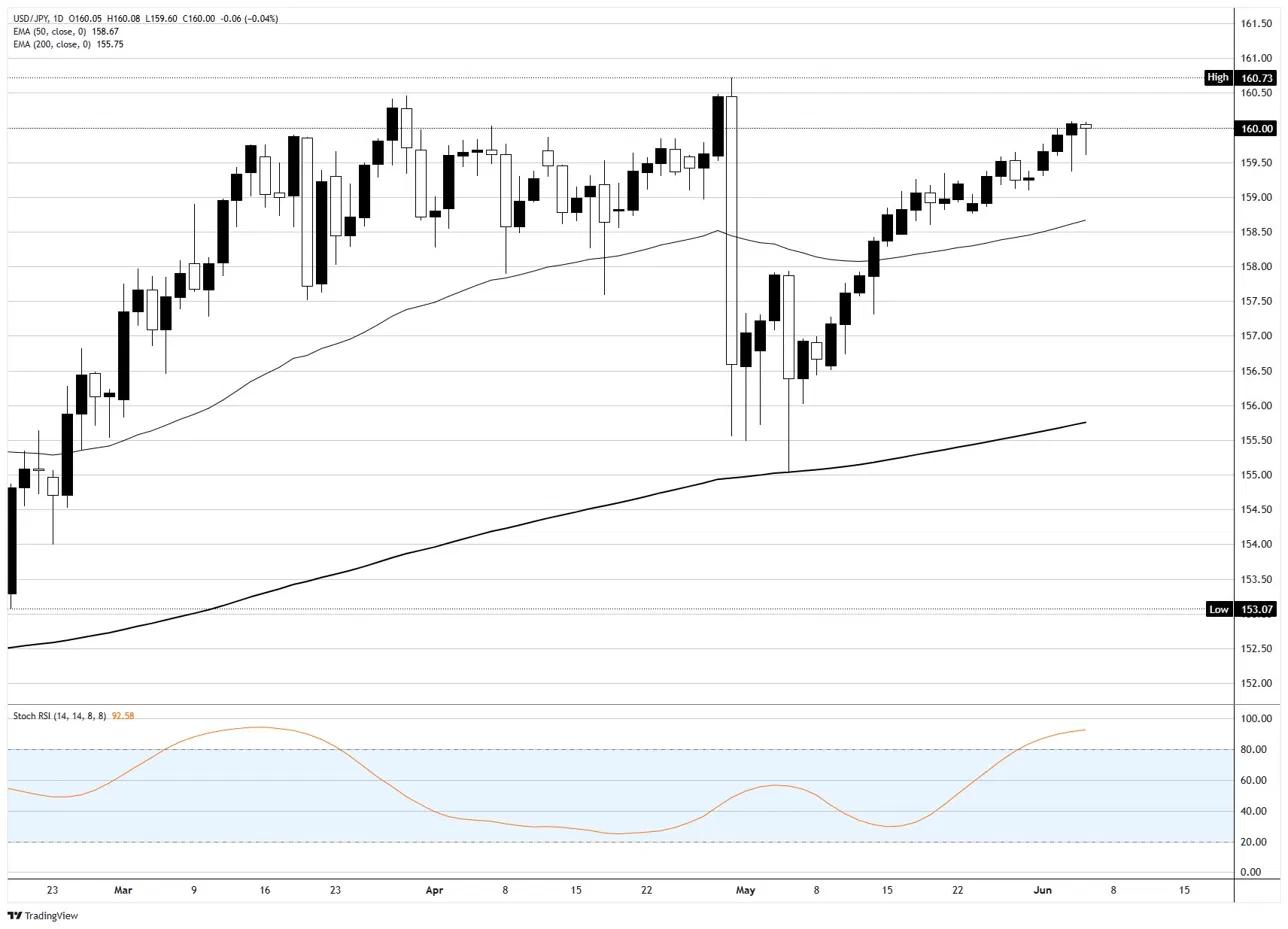
The carry math is unforgiving. With the US policy rate at 3.50% to 3.75% against the Bank of Japan's (BoJ) 0.75%, the gap keeps funding the short-yen trade every day it holds. On the daily chart the pair clings to 160.00, well above its 50-day Exponential Moving Average (EMA) around 158.50 and its 200-day EMA near 155.50, with the Stochastic Relative Strength Index (Stoch RSI) deep in overbought territory. Momentum says stretched, the rate gap says supported, and the result is compression rather than a clean trend.
Tokyo's expensive line in the sand
This is where the MoF earns its reputation. Authorities spent on the order of $70 billion across late April and May leaning against yen weakness, and an earlier intervention close to 160.00 sent the pair tumbling toward 152.00 before it crawled back. The lesson the market took away is that Tokyo cares about the speed of a move more than the level itself. A fast push through 160.00 into Friday's data is precisely the kind of disorderly move that invites a response, which is why the round number behaves like a ceiling even with the fundamentals pointing higher.
The hawkish rotation doing Japan's work
The Yen's best hope is that someone in Washington blinks, and Thursday offered no sign of it. A parade of Fed speakers, with Schmid, Barkin and Daly all on the wires, warned that rates may have to climb if inflation refuses to cool. April's Consumer Price Index (CPI) near 3.8% YoY already chased cut bets out of the picture, and markets now lean toward a hike by year-end rather than an easing. Every basis point of that repricing widens the US-Japan gap and presses the pair harder against Tokyo's line, doing the carry trade's work for it.
What Friday and the weekend throw at it
Nonfarm Payrolls (NFP) lands Friday at 12:30 GMT, consensus near 85K after 115K, with the unemployment rate seen holding at 4.3%. A firm print cements the no-cut, maybe-hike Fed story and shoves USD/JPY into intervention range right as the central banks convene. Closer to home, Japan's Labor Cash Earnings hit late Thursday at 23:30 GMT, seen close to 3.2% YoY, and first-quarter Gross Domestic Product (GDP) arrives Sunday, both feeding the BoJ hike debate ahead of its June 15 to 16 meeting. The Fed follows on June 16 to 17, making the round number the line that defines the whole setup.
How to trade the coil
Topside: a break and hold above 160.00 toward 160.50 is the zone where intervention risk shifts from threat to action, so chasing strength there means fighting the MoF.
Downside: 160.00 losing its grip opens room toward the 50-day EMA around 158.50, then 155.50 on a genuine Dollar unwind.
Bias: Rangebound and headline-driven into Friday. The path of least resistance is still higher on the rate gap, but the asymmetry sits with the downside, where a soft NFP or a ceasefire-driven dollar slip could meet Tokyo's bid and snap the coil hard in the Yen's favour.
USD/JPY daily chart
Japanese Yen FAQs
The Japanese Yen (JPY) is one of the world’s most traded currencies. Its value is broadly determined by the performance of the Japanese economy, but more specifically by the Bank of Japan’s policy, the differential between Japanese and US bond yields, or risk sentiment among traders, among other factors.
One of the Bank of Japan’s mandates is currency control, so its moves are key for the Yen. The BoJ has directly intervened in currency markets sometimes, generally to lower the value of the Yen, although it refrains from doing it often due to political concerns of its main trading partners. The BoJ ultra-loose monetary policy between 2013 and 2024 caused the Yen to depreciate against its main currency peers due to an increasing policy divergence between the Bank of Japan and other main central banks. More recently, the gradually unwinding of this ultra-loose policy has given some support to the Yen.
Over the last decade, the BoJ’s stance of sticking to ultra-loose monetary policy has led to a widening policy divergence with other central banks, particularly with the US Federal Reserve. This supported a widening of the differential between the 10-year US and Japanese bonds, which favored the US Dollar against the Japanese Yen. The BoJ decision in 2024 to gradually abandon the ultra-loose policy, coupled with interest-rate cuts in other major central banks, is narrowing this differential.
The Japanese Yen is often seen as a safe-haven investment. This means that in times of market stress, investors are more likely to put their money in the Japanese currency due to its supposed reliability and stability. Turbulent times are likely to strengthen the Yen’s value against other currencies seen as more risky to invest in.
Author

Joshua Gibson
FXStreet
Joshua joins the FXStreet team as an Economics and Finance double major from Vancouver Island University with twelve years' experience as an independent trader focusing on technical analysis.