Fed March Preview: Gold needs a dovish Fed to regain traction
- Fed to kickstart policy normalization with a 25 bps hike in March.
- Gold has been suffering heavy losses this week amid surging US T-bond yields.
- XAU/USD is likely to remain under bearish pressure unless Fed adopts a dovish policy outlook.

Gold came under strong selling pressure at the start of the week and erased the majority of the gains it registered since the beginning of the Russia-Ukraine war. Heightened optimism for a peace agreement and rising US Treasury bond yields ahead of the US Federal Reserve’s policy announcements have weighed heavily on the yellow metal, dragging it to its lowest level in more than ten days.
The Fed is widely expected to hike its policy rate by 25 basis points at the March policy meeting. Markets have been pricing that move since the beginning of the year. Hence, the Fed’s rate outlook, which will be revealed in the updated Summary of Economic Projections, and Chairman Jerome Powell’s tone on war-related uncertainty should be the thing that triggers a significant market reaction.
December’s dot plot revealed that the Fed was expecting the Core Personal Consumption Expenditures (PCE) price index to average 2.7% in 2022, up from 2.3% in the previous forecast. The US Bureau of Economic Analysis reported on February 25 that the Core PCE jumped to 5.2% on a yearly basis in January from 4.9% in December. Additionally, the annual Consumer Price Index (CPI) in February rose to its highest level in four decades at 7.9% from 7.5% in January.
Inflation continues to run hot in the US and the Russia-Ukraine war is likely to cause it to remain elevated at uncomfortable levels for longer than estimated. Hence, an upward revision to inflation expectations could be seen in the dot plot. Fed officials made it clear that next policy steps will be taken with an intention to control inflation and that they are not really concerned about the growth outlook or the labor market. In fact, Nonfarm Payrolls (NFP) in the US increased by 678,000 in February, surpassing the market forecast of 400,000 by a wide margin, and the real Gross Domestic Product (GDP) grew at an annualized rate of 7% in the fourth quarter of 2021, compared to analysts’ estimate of 5.5%.
Hawkish scenario
Before the Fed went into the blackout period, Fed officials voiced their support for a 25 basis points (bps) rate hike in March and dismissed the need for a 50 bps increase. Although conditions have changed since then with surging energy costs amid the Russia-Ukraine conflict, the Fed is unlikely to surprise the markets with a double-dose hike.
As it currently stands, markets are pricing in a 53% chance of a second 25 basis point rate hike in May. In case the Fed’s policy statement or Powell’s remarks suggest that policymakers are willing to hike the policy rate again at the next policy meeting, US Treasury bond yields could continue to push higher and weigh on XAU/USD.
It would also be seen as a hawkish tone if Powell notes that a 50 bps rate hike will be on the table in the upcoming meetings.
Dovish scenario
In case Fed policymakers shift their attention away from inflation to the growth outlook and voice concerns over increased downside risks, investors could assess this as a dovish tilt. Powell could also adopt a cautious stance and refrain from delivering a clear message on the timing of the second rate hike, which in turn could help gold stage a rebound.
Gold technical outlook
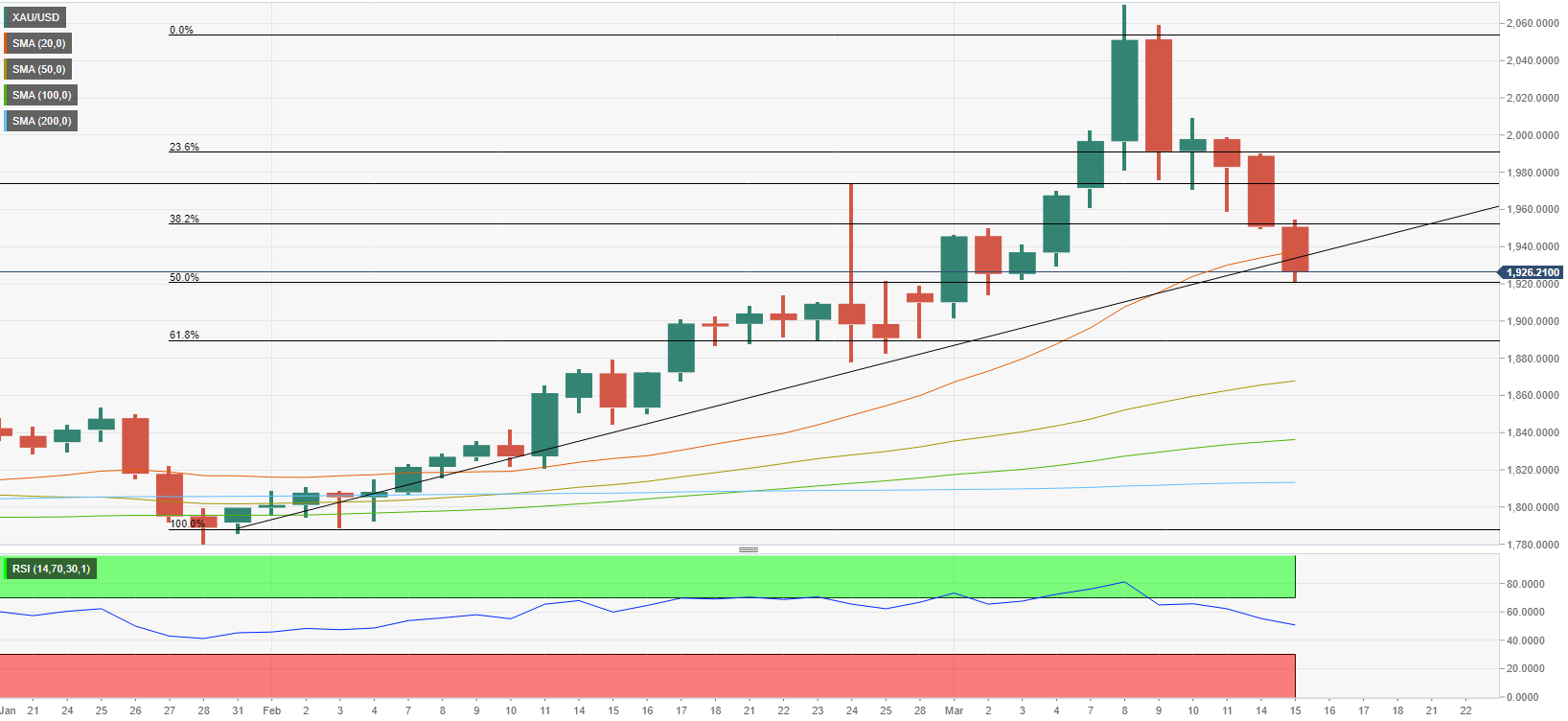
Gold trades below the ascending trend line coming from early February and the Relative Strength Index (RSI) indicator on the daily chart sits near 50, suggesting that sellers look to continue to dominate the precious metal’s action.
$1,920 (Fibonacci 50% retracement of the latest uptrend) aligns as first support. A daily close below that level on a hawkish Fed could open the door for additional losses toward $1,900 (psychological level) and $1,890 (Fibonacci 61.8% retracement).
On the upside, XAU/USD could encounter resistance at $1,940 (20-day SMA) ahead of $1,950 (Fibonacci 38.2% retracement) and $1,970 (static level). Ideally, a dovish shift in the Fed’s policy outlook should be the primary driver for gold to stage a decisive recovery.
Author

Eren Sengezer
FXStreet
As an economist at heart, Eren Sengezer specializes in the assessment of the short-term and long-term impacts of macroeconomic data, central bank policies and political developments on financial assets.
















