Gold slumps as lack of US‑Iran ceasefire progress weigh ahead US jobs data
- Gold price falls in Friday’s early European session.
- There was no sign of progress in ceasefire talks between the US and Iran, weighing on the Gold price.
- Traders brace for the US May employment report, which is due later on Friday.
Gold price (XAU/USD) attracts some sellers to near weekly low during the early European session on Friday. The precious metal remains volatile amid ongoing geopolitical turmoil. Traders will closely monitor the developments surrounding the US-Iran peace deal and the US May employment report later on Friday.
Iran’s Foreign Minister Abbas Araghchi said Wednesday that "no tangible progress" has been made in negotiations to end the Middle East war. Araghchi further stated that lines of communication with Washington were still open but warned that any attack by Israel on the Lebanese capital Beirut as part of its campaign against Hezbollah would trigger a "full-scale resumption" of the US-Iran conflict.
While Iran’s Foreign Minister stated that the negotiations had stalled, US President Donald Trump said ceasefire talks are in the “final” stages. On Wednesday, Iran fired missiles and drones at Kuwait and Bahrain, killing one person and injuring dozens at Kuwait’s main airport, after the US struck an oil tanker headed to the Islamic Republic.
A lack of progress in ceasefire talks between the US and Iran after the worst burst of violence in weeks continue to fuel concerns over inflation and expectations of elevated interest rates, which weigh on the Gold price, non-yielding asset.
“Higher inflation expectations, associated with the negative supply shocks, have pushed yields across the curve higher, kept the USD firm, and prompted markets to begin pricing in a Fed hike in late 2026,” said Bart Melek from TD Securities.
The US employment report will take center stage later in the day. The Nonfarm Payrolls (NFP) are expected to show a gain of 85,000 jobs in May, while the Unemployment Rate is projected to remain steady at 4.3% during the same period. Any signs of surprise weakening in the US labour market could undermine the US Dollar (USD) and support the USD-denominated commodity price in the near term.
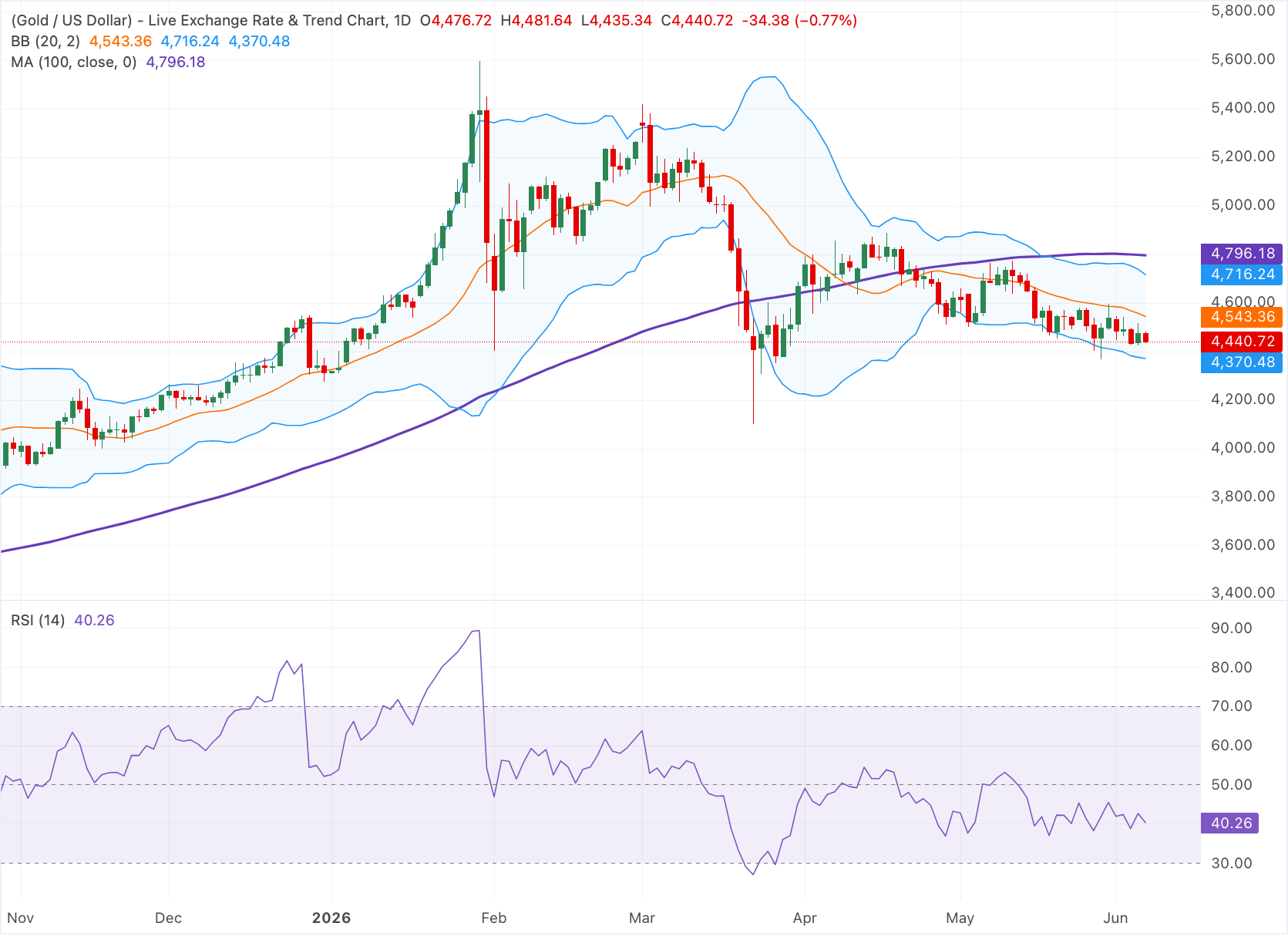
XAU/USD daily chart
Gold keeps the bearish vibe in near term
In the daily chart, XAU/USD holds in a bearish near-term bias as price sits under the 100-day Moving Average and below the Bollinger Bands middle line, keeping the broader downswing intact. The Relative Strength Index (RSI) at 40 is weak but not oversold, suggesting sellers retain control while still allowing room for further downside before exhaustion signals emerge.
On the topside, initial resistance is located at the Bollinger Bands middle band around $4,545, with the upper band near $4,715 and the 100-day MA at $4,795 forming a wider cap if a rebound extends. On the downside, the first notable support is the lower Bollinger band at roughly $4,370; a clear break beneath this zone would open the door to a deeper retracement, while holding above it would hint at scope for consolidation within the current bearish structure.
(The technical analysis of this story was written with the help of an AI tool.)
Gold FAQs
Gold has played a key role in human’s history as it has been widely used as a store of value and medium of exchange. Currently, apart from its shine and usage for jewelry, the precious metal is widely seen as a safe-haven asset, meaning that it is considered a good investment during turbulent times. Gold is also widely seen as a hedge against inflation and against depreciating currencies as it doesn’t rely on any specific issuer or government.
Central banks are the biggest Gold holders. In their aim to support their currencies in turbulent times, central banks tend to diversify their reserves and buy Gold to improve the perceived strength of the economy and the currency. High Gold reserves can be a source of trust for a country’s solvency. Central banks added 1,136 tonnes of Gold worth around $70 billion to their reserves in 2022, according to data from the World Gold Council. This is the highest yearly purchase since records began. Central banks from emerging economies such as China, India and Turkey are quickly increasing their Gold reserves.
Gold has an inverse correlation with the US Dollar and US Treasuries, which are both major reserve and safe-haven assets. When the Dollar depreciates, Gold tends to rise, enabling investors and central banks to diversify their assets in turbulent times. Gold is also inversely correlated with risk assets. A rally in the stock market tends to weaken Gold price, while sell-offs in riskier markets tend to favor the precious metal.
The price can move due to a wide range of factors. Geopolitical instability or fears of a deep recession can quickly make Gold price escalate due to its safe-haven status. As a yield-less asset, Gold tends to rise with lower interest rates, while higher cost of money usually weighs down on the yellow metal. Still, most moves depend on how the US Dollar (USD) behaves as the asset is priced in dollars (XAU/USD). A strong Dollar tends to keep the price of Gold controlled, whereas a weaker Dollar is likely to push Gold prices up.
Author

Lallalit Srijandorn
FXStreet
Lallalit Srijandorn is a Parisian at heart. She has lived in France since 2019 and now becomes a digital entrepreneur based in Paris and Bangkok.