Gold ends the week firm as traders await US inflation data
- Gold advances for the second day on Friday, buoyed by expectations of Fed easing in September.
- US economic data shows deceleration but not enough to stoke recession fears.
- Ongoing Middle East tensions between Israel, Lebanon and Iran keep Gold demand firm.

Gold prices advanced modestly for the second straight day as market participants remain convinced the Federal Reserve (Fed) could begin to ease policy at the upcoming September meeting. This and heightened tensions between Israel, Lebanon and Iran keep bullion bid ahead of the weekend. The XAU/USD trades at $2,432, up by 0.22%.
The latest tranche of economic data from the United States (US) showed the economy is indeed decelerating, but not to reignite fears of a recession. Fears after dismal ISM Manufacturing PMI and July Nonfarm Payrolls (NFP) figures began to dissipate as reflected by US equities printing decent gains late in the New York session.
On Thursday, US Initial Jobless Claims for the week ending August 3 were lower than expected, hinting the jobs market still remains solid despite cooling moderately.
Gold prices remain firm due to the drop in US Treasury bond yields and the Greenback. The US 10-year benchmark note rate is down almost five basis points to 3.944%, while the US Dollar Index (DXY), which measures the buck’s performance against other currencies, falls 0.10% to 103.13.
Analysts at ING suggest that Bullion would remain bullish in the near term. They wrote, “Looking ahead, we believe [G]old should regain its footing once again, amid the ongoing geopolitical uncertainties and expectations of interest rate cuts from the US Fed.”
Tensions in the Middle East would keep XAU/USD bid, with headlines hinting at an escalation of the conflict. Reporting suggests that Israeli defense officials said the army is coordinating with the Pentagon to prepare scenarios to respond to Iran and Hezbollah.
Meanwhile, traders are bracing for next week's data. The US economic docket will be busy, with traders focused on inflation data on the producer and consumer side, retail sales, building permits and consumer sentiment.
Daily digest market movers: Gold edges up despite China’s lack of buying
- July’s Producer Price Index is expected to drop from 0.2% to 0.1% MoM.
- The Consumer Price Index (CPI) is foreseen ticking lower from 3% YoY to 2.9%; core CPI is expected to continue its downtrend from 3.3% to 3.2% YoY.
- Economists expect a jump in US Retail Sales from 0% to 0.3% MoM.
- The golden metal price gathered traction despite reports that China’s central bank restrained itself from purchasing Gold for the third consecutive month.
- The CME FedWatch Tool shows the odds of a 50-basis-point interest rate cut by the Fed at the September meeting at 52.5%, down from 57.5% a day ago.
Technical analysis: Gold price consolidates around $2,430
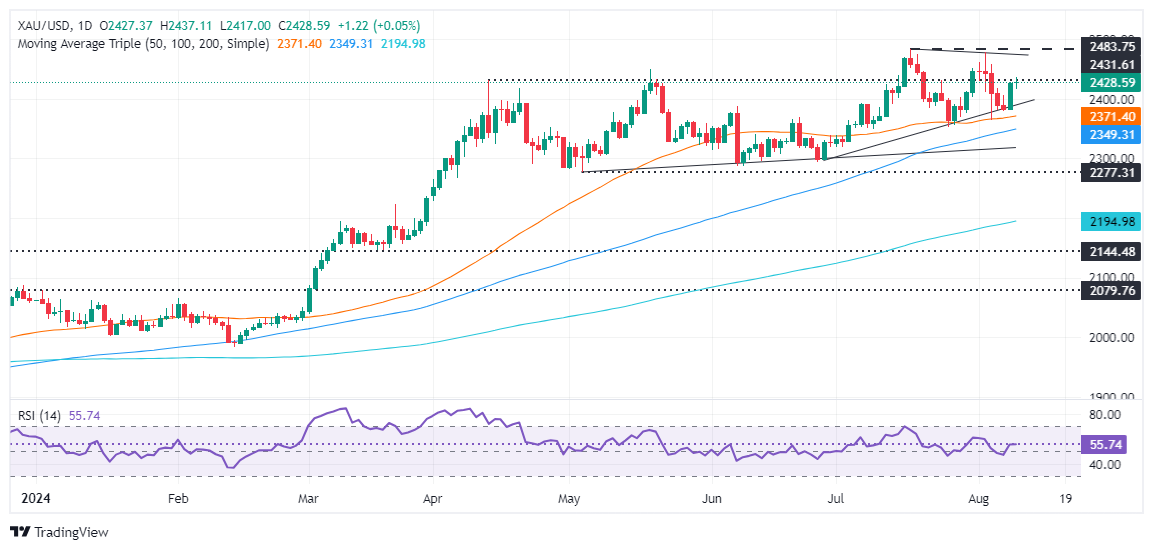
Gold’s uptrend continues, though it faces stirring resistance near $2,430, with buyers unable to clear that area ahead of the psychological $2,450 level mark. The Relative Strength Index (RSI) shows buyers are gathering momentum, meaning higher prices are on the cards.
If buyers push prices above $2,450, the next stop would be the August 2 high at $2,477, ahead of testing the all-time high at $2,483. On further strength, the $2,500 figure is up for grabs.
Conversely, XAU/USD dropping below the 50-day Simple Moving Average (SMA) at $2,370 could intensify the decline, leading to the 100-day SMA at $2,349, followed by a support trendline around $2,320. If this level is breached, the next support would come at $2,300.
Gold FAQs
Gold has played a key role in human’s history as it has been widely used as a store of value and medium of exchange. Currently, apart from its shine and usage for jewelry, the precious metal is widely seen as a safe-haven asset, meaning that it is considered a good investment during turbulent times. Gold is also widely seen as a hedge against inflation and against depreciating currencies as it doesn’t rely on any specific issuer or government.
Central banks are the biggest Gold holders. In their aim to support their currencies in turbulent times, central banks tend to diversify their reserves and buy Gold to improve the perceived strength of the economy and the currency. High Gold reserves can be a source of trust for a country’s solvency. Central banks added 1,136 tonnes of Gold worth around $70 billion to their reserves in 2022, according to data from the World Gold Council. This is the highest yearly purchase since records began. Central banks from emerging economies such as China, India and Turkey are quickly increasing their Gold reserves.
Gold has an inverse correlation with the US Dollar and US Treasuries, which are both major reserve and safe-haven assets. When the Dollar depreciates, Gold tends to rise, enabling investors and central banks to diversify their assets in turbulent times. Gold is also inversely correlated with risk assets. A rally in the stock market tends to weaken Gold price, while sell-offs in riskier markets tend to favor the precious metal.
The price can move due to a wide range of factors. Geopolitical instability or fears of a deep recession can quickly make Gold price escalate due to its safe-haven status. As a yield-less asset, Gold tends to rise with lower interest rates, while higher cost of money usually weighs down on the yellow metal. Still, most moves depend on how the US Dollar (USD) behaves as the asset is priced in dollars (XAU/USD). A strong Dollar tends to keep the price of Gold controlled, whereas a weaker Dollar is likely to push Gold prices up.
Author

Christian Borjon Valencia
FXStreet
Markets analyst, news editor, and trading instructor with over 14 years of experience across FX, commodities, US equity indices, and global macro markets.

















