|

Gold Price Analysis: XAU/USD path of least resistance is up after whipsaw – Confluence Detector

Inflation fears are rising – as seen in both the Consumer Price Index figures and the University of Michigan's Consumer Sentiment data. Is gold still a hedge against rising prices? That remains debatable, but the increase in the precious metal's value is clear. It is more related to the Federal Reserve's insistence that any such move is transitory. 

Where next for gold price from here? 

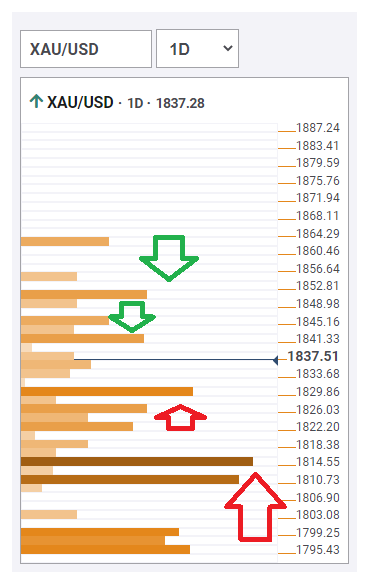
The Technical Confluences Detector is showing that XAU/USD has some support at $1,829, which is the convergence of the Simple Moving Average 5-4h, the previous daily high, the Bollinger Band one-hour Middle, the 5-day SMA and more. 

The gold price has an even more significant cushion at $1,814, which is the meeting point of the Pivot Point one-day Support 1 and the Fibonacci 38.2% one week. 

Looking up, some resistance awaits at $1,841, which is the confluence of the BB one-day Upper, the PP one-day Resistance 2 and more. 

Another minor cap is at $1,850, which is where the PP one-month R2 hits the gold price. 

All in all, XAU/USD has strong support and weak resistance, pointing to further gains. 

XAU/USD resistance and support levels
Confluence Detector

The Confluence Detector finds exciting opportunities using Technical Confluences. The TC is a tool to locate and point out those price levels where there is a congestion of indicators, moving averages, Fibonacci levels, Pivot Points, etc. Knowing where these congestion points are located is very useful for the trader, and can be used as a basis for different strategies.

Learn more about Technical Confluence

Author

Yohay Elam

Yohay Elam

FXStreet

Yohay is in Forex since 2008 when he founded Forex Crunch, a blog crafted in his free time that turned into a fully-fledged currency website later sold to Finixio.


More from Yohay Elam
Share:

Editor's Picks

GBP/USD advaces beyond 1.3450 after BoE decision, US Q2 GDP

GBP/USD gains positive momentum on Thursday, surpassing 1.3450 and trading at fresh multi-week highs. The Bank of England decided to maintain the benchmark rate unchanged at 3.75%. The MPC voted 6-3 to keep rates on hold, with the 3 dissenters favoring a rate hike. US Q2 GDP missing expectations helped the pair advance, while renewed US Dollar weakness across the FX board pushed the pair further up ahead of the monthly close.

EUR/USD confortable around 1.1530, highest in six weeks

The EUR/USD pair trades around 1.1530 in the American session on Thursday, reaching fresh six-week highs. The US Dollar is in sell-off mode, with multiple factors weighing on the American currency. Not only did the Federal Reserve vote divided to keep rates on hold on Wednesday, creating doubts about a September hike, but US Q2 GDP missed expectations. A suspected JPY intervention adds pressure on the Greenback.

Gold recovers the $4,100 level as US Dollar weakens further

Gold trades just above $4,100 amid a US Dollar sell-off. The Greenback enjoyed some near-term demand following Wednesday's post-FOMC downfall, but was unable to retain its gains. The preliminary estimate of the US Q2 GDP showed the economy grew at an annual rate of 1.5%, missing the market's expectations of 2.1%.

Ripple Price Forecast: XRP builds recovery momentum as whales increase exposure
Ripple (XRP) rises toward the pivotal $1.10 resistance on Thursday, marking three consecutive days of gains. This neutral-to-slightly bullish outlook follows the Federal Reserve (Fed) decision to leave interest rates unchanged in the 3.50%-3.75% range.
The FOMC: Rates left on hold; dollar falls as Warsh fails to vote for hike
The Fed kept interest rates on hold today, defying a 30% chance in the Fed Funds Futures market that rates would rise. The Committee voted 9-3 to keep rates on hold, with governors Kashkari, Hammack and Logan all voting to hike rates due to concerns about inflation. The immediate market reaction has been a sharp drop in the USD on a broad basis.
9-3: Is the Federal Reserve’s vote tally Warsh's new forward guidance?
The rate did not move. Neither did the statement, and that’s the more interesting fact. Set the July 29 Federal Open Market Committee (FOMC) statement beside the one issued on June 17, and the two documents are identical apart from a single verb and a paragraph at the bottom naming three dissenters.