Gold afloat while traders fear hawkish Fed on inflation and tariff uncertainty
- Gold has eked out another new fresh all-time high at $3,045 on Wednesday.
- Traders brace for the the upcoming Fed meeting while digesting geopolitical news from Turkey and Ukraine.
- Gold’s rally starts to overheat a bit and might see a pullback soon.

Gold’s price (XAU/USD) is back up marginally on the day, around $3,040 at the time of writing on Wednesday after stretching higher and hitting a new all-time high at $3,045 earlier in the day. The positive move came after headlines emerged that authorities detained Istanbul mayor Ekrem Imamoglu, President Tayyip Erdogan's main political rival, on charges including corruption and aiding a terrorist group.
This headline adds to the geopolitical drivers in Gold after Tuesday’s phone call between United States (US) President Donald Trump and Russian President Vladimir Putin, which did not lead to a ceasefire deal or a major breakthrough. President Trump and President Putin agreed to an immediate pause in strikes against energy infrastructure in the Ukraine war. However, Ukrainian President Volodymyr Zelenskyy said late Tuesday that talks about Ukraine without Ukraine will not bring about results.
Nevertheless, traders in the precious metal might face some headwinds later this Wednesday as the Federal Open Market Committee (FOMC) is set to announce its policy rate decision and publish the Summary of Economic Projections update. After the meeting, Federal Reserve (Fed) Chairman Jerome Powell will comment in a press conference. With the Trump policy in the backdrop, markets will want to know how many, if any, rate cuts the Fed members have penciled in for 2025 and beyond.
Daily digest market movers: Powell's speech to be main driver
- Despite almost euphoric comments from US President Trump and Russian President Putin, several analysts see the recent ‘slim’ ceasefire deal as a small victory, not a step forward to peace. Putin and Trump agreed that there will be no attacks on energy objects for 30 days, Bloomberg reports.
- According to the CME Fedwatch tool, the odds that the Fed will keep interest rates at the current range of 4.25-4.50% on Wednesday are 99%. Meanwhile, rate cut odds for June’s meeting are 64.8%.
- Traders are paring back their bets on further monetary policy easing this year, which would weigh on the precious metal as higher yields are bearish for Gold. On the other hand, there are still concerns about a US slowdown as President Donald Trump’s tariff agenda weighs on consumer sentiment. Investors have been slashing holdings of US equities by the most on record, according to Bank of America's latest survey, underscoring a massive rotation underway in markets, Bloomberg reports.
Technical Analysis: Bearish or bullish for Gold
Gold ekes out another fresh all-time high in early Wednesday ahead of the Fed’s interest rate decision. The tail risk in the event is if the Fed’s dot plot (a chart where every voting FOMC member pencils in where they see the monetary policy rate for 2025 and beyond) pencils in fewer rate cuts than markets anticipate. That would boost the fear of a recession or stagflation in the US, with rates remaining elevated to fight the surging inflation caused by a trade war amid tariffs, and would be negative for Gold.
Regarding technical levels, the new all-time high at $3,045 is the first level to beat. Next for this Wednesday is the R1 resistance at $3,048, just below the $3,050 round number. Once through there, the R2 resistance comes in at $3,063.
On the downside, the intraday Pivot Point at $3,024 is the first line of defense, followed by the S1 support near $3,010 ahead of the $3,000 level. In case the $3,000 mark snaps, look for $2,985 as big support.
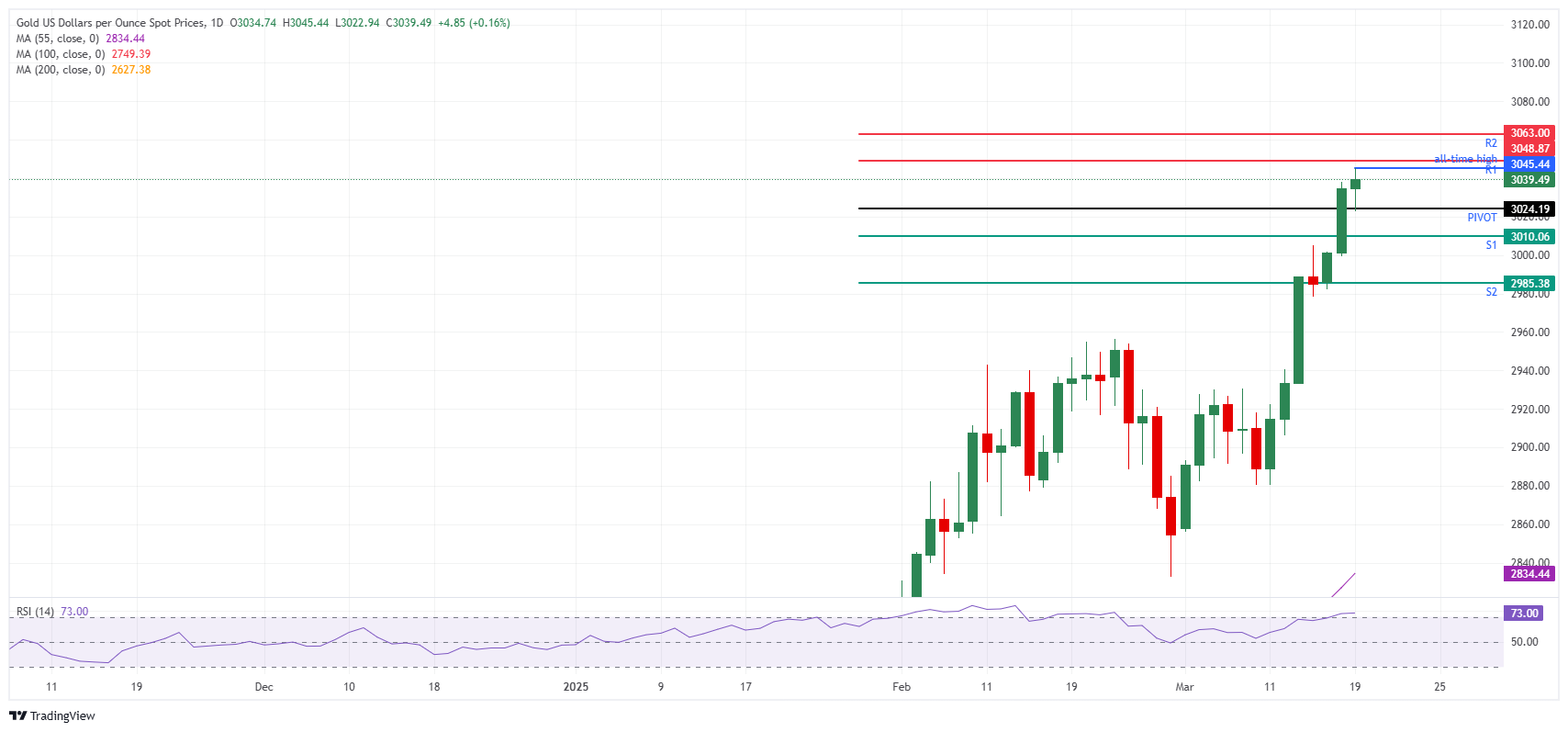
XAU/USD: Daily Chart
Fed FAQs
Monetary policy in the US is shaped by the Federal Reserve (Fed). The Fed has two mandates: to achieve price stability and foster full employment. Its primary tool to achieve these goals is by adjusting interest rates. When prices are rising too quickly and inflation is above the Fed’s 2% target, it raises interest rates, increasing borrowing costs throughout the economy. This results in a stronger US Dollar (USD) as it makes the US a more attractive place for international investors to park their money. When inflation falls below 2% or the Unemployment Rate is too high, the Fed may lower interest rates to encourage borrowing, which weighs on the Greenback.
The Federal Reserve (Fed) holds eight policy meetings a year, where the Federal Open Market Committee (FOMC) assesses economic conditions and makes monetary policy decisions. The FOMC is attended by twelve Fed officials – the seven members of the Board of Governors, the president of the Federal Reserve Bank of New York, and four of the remaining eleven regional Reserve Bank presidents, who serve one-year terms on a rotating basis.
In extreme situations, the Federal Reserve may resort to a policy named Quantitative Easing (QE). QE is the process by which the Fed substantially increases the flow of credit in a stuck financial system. It is a non-standard policy measure used during crises or when inflation is extremely low. It was the Fed’s weapon of choice during the Great Financial Crisis in 2008. It involves the Fed printing more Dollars and using them to buy high grade bonds from financial institutions. QE usually weakens the US Dollar.
Quantitative tightening (QT) is the reverse process of QE, whereby the Federal Reserve stops buying bonds from financial institutions and does not reinvest the principal from the bonds it holds maturing, to purchase new bonds. It is usually positive for the value of the US Dollar.
Author

Filip Lagaart
FXStreet
Filip Lagaart is a former sales/trader with over 15 years of financial markets expertise under its belt.

















