Gold remains depressed below $4,500 as key US macro data looms
- Gold faces rejection near $4,500 as the underlying bullish sentiment prompts profit-taking.
- Rising geopolitical tensions and dovish Fed expectations could support the precious metal.
- Investors now look forward to important US macro releases for some meaningful impetus.

Gold (XAU/USD) trims a part of its intraday losses, though it retains its negative bias through the first half of the European session on Wednesday and remains well below the $4,500 psychological mark. As investors digest the recent US attack on Venezuela, the underlying bullish sentiment turns out to be a key factor that prompted some profit-taking around the precious metal. The downside for the commodity, however, remains limited amid rising geopolitical tensions and dovish US Federal Reserve (Fed) expectations.
In fact, US President Donald Trump threatened to annex Greenland following confrontational rhetoric toward Colombia and Mexico earlier this week. Moreover, traders have been pricing in the possibility of two more interest rate cuts by the US central bank, which acts as a headwind for the US Dollar (USD) and offers some support to the non-yielding Gold. The XAU/USD bears also seem reluctant ahead of this week's important US macro releases, including the closely-watched Nonfarm Payrolls (NFP) report on Friday.
Daily Digest Market Movers: Gold bulls remain on the sidelines and opt to wait for key US macro releases
- Investors appeared to shrug off worries stemming from the US attack on Venezuela over the weekend, with the S&P 500 and the Dow Jones Industrial Average notching fresh record highs on Tuesday.
- Meanwhile, US President Donald Trump openly signaled that Colombia and Mexico could also face US military action as part of a widening campaign against criminal networks and regional instability.
- Moreover, the White House said on Tuesday that Trump is discussing options for acquiring Greenland, including potential use of the US military, in a revival of his ambition to control the strategic island.
- This comes on top of the lack of progress in the Russia-Ukraine peace deal, unrest in Iran, and issues surrounding Gaza, which keeps geopolitical risks in play and should support the safe-haven Gold.
- According to the CME Group's FedWatch tool, traders are pricing in the possibility that the US Federal Reserve will lower borrowing costs in March and deliver another rate cut by the end of this year.
- Richmond Fed President Thomas Barkin said that further changes to the short-term rate will need to be tuned to incoming data amid the risks to both the central bank's employment and inflation goals.
- Friday's release of the closely-watched US Nonfarm Payrolls (NFP) report and the US consumer inflation figures, due next Tuesday, could offer more cues about the Fed's further rate-cut path.
- This, in turn, will play a key role in influencing the USD price dynamics in the near-term and help in determining the next leg of a directional move for the non-yielding yellow metal.
- In the meantime, Wednesday's US economic docket – featuring the ADP report on private-sector employment, ISM Services PMI, and JOLTS Job Openings – might provide some impetus.
Gold needs to find acceptance below $4,450-4,445 to back the case for further losses
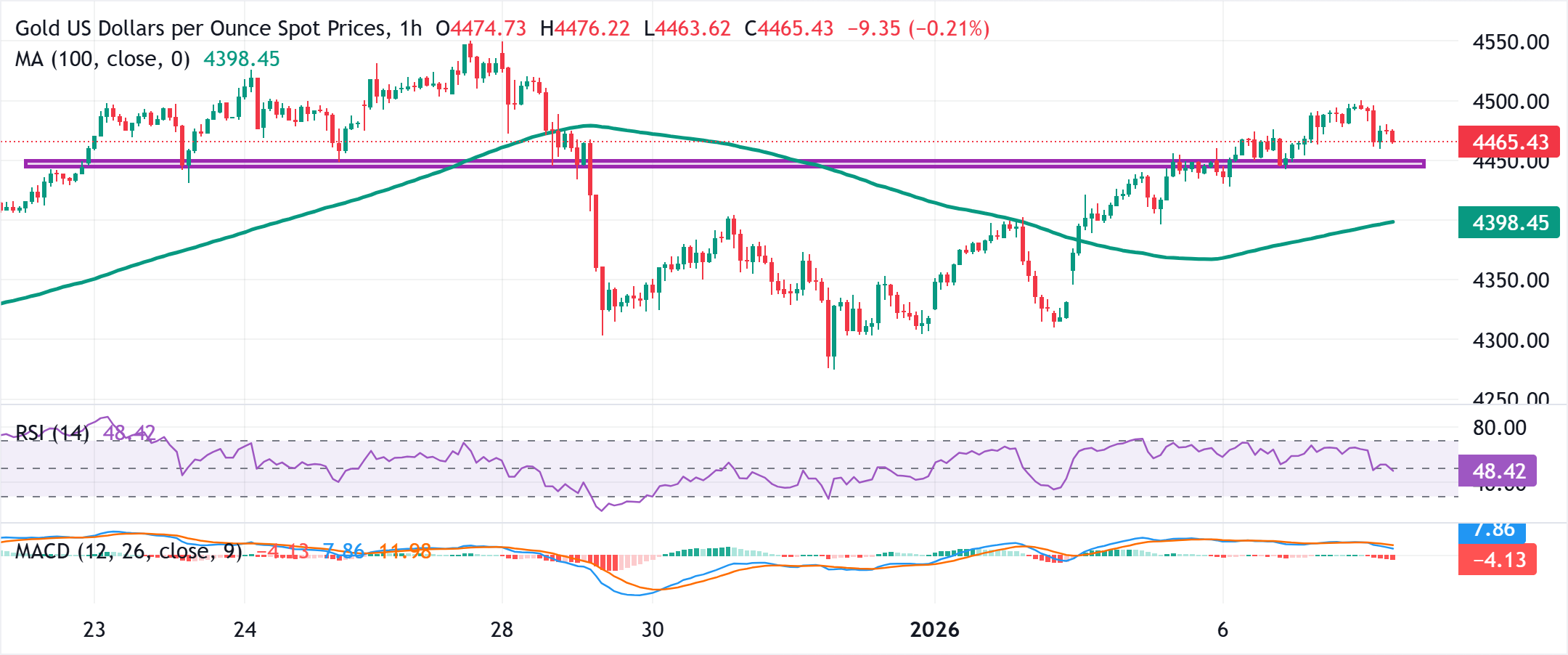
The 100-hour Simple Moving Average (SMA) rises and sits beneath spot prices, suggesting underlying trend support near the $4,400 mark. The Moving Average Convergence Divergence (MACD) slips below the Signal line and holds in negative territory, with the histogram expanding on the downside. The Relative Strength Index (RSI) eased to 48.58, neutral, reflecting balanced momentum after recent softness.
In the near term, momentum would need to stabilize to reassert the bullish tone. A MACD turn toward a bullish crossover and an RSI push back above 50 would support an upswing, while failure to improve could keep the bias heavy and expose a retest of the 100-hour SMA. With price still above that rising baseline, dips could remain contained, but a close beneath it would open room for further downside.
(The technical analysis of this story was written with the help of an AI tool)
Risk sentiment FAQs
In the world of financial jargon the two widely used terms “risk-on” and “risk off'' refer to the level of risk that investors are willing to stomach during the period referenced. In a “risk-on” market, investors are optimistic about the future and more willing to buy risky assets. In a “risk-off” market investors start to ‘play it safe’ because they are worried about the future, and therefore buy less risky assets that are more certain of bringing a return, even if it is relatively modest.
Typically, during periods of “risk-on”, stock markets will rise, most commodities – except Gold – will also gain in value, since they benefit from a positive growth outlook. The currencies of nations that are heavy commodity exporters strengthen because of increased demand, and Cryptocurrencies rise. In a “risk-off” market, Bonds go up – especially major government Bonds – Gold shines, and safe-haven currencies such as the Japanese Yen, Swiss Franc and US Dollar all benefit.
The Australian Dollar (AUD), the Canadian Dollar (CAD), the New Zealand Dollar (NZD) and minor FX like the Ruble (RUB) and the South African Rand (ZAR), all tend to rise in markets that are “risk-on”. This is because the economies of these currencies are heavily reliant on commodity exports for growth, and commodities tend to rise in price during risk-on periods. This is because investors foresee greater demand for raw materials in the future due to heightened economic activity.
The major currencies that tend to rise during periods of “risk-off” are the US Dollar (USD), the Japanese Yen (JPY) and the Swiss Franc (CHF). The US Dollar, because it is the world’s reserve currency, and because in times of crisis investors buy US government debt, which is seen as safe because the largest economy in the world is unlikely to default. The Yen, from increased demand for Japanese government bonds, because a high proportion are held by domestic investors who are unlikely to dump them – even in a crisis. The Swiss Franc, because strict Swiss banking laws offer investors enhanced capital protection.
Author

Haresh Menghani
FXStreet
Haresh Menghani is a detail-oriented professional with 10+ years of extensive experience in analysing the global financial markets.