Gold extends weakness after release of US GDP data
- Gold extends its sell-off after the release of US GDP data.
- The precious metal shrugs off the global growth fears that normally incentivize investors to hoard Gold.
- Gold joins most other commodities as they sell off.

Gold (XAU/USD) extends its sell-off after the release of robust US data on Thursday. It is trading over a percentage point lower in the $2,370s amid widespread declines in stocks and commodities driven by global growth concerns.
Despite being a safe haven, Gold's weakness is partly attributable to technical selling, as it experiences a predicted downward movement within its trading range. Favorable US data, including preliminary Q2 Gross Domestic Product data and preliminary US S&P Global Purchasing Managers Index (PMI) data for July, released on Wednesday may have dampened growing fears of "stagflation," which is characterized by economic weakness coupled with high inflation — a scenario where Gold typically performs well.
Gold falls on technical selling and US data
Gold declines on Thursday after data showed preliminary Q2 GDP growth rose by 2.8% on a annualized basis, beating estimates of 2.0% and the previous quarter's 1.4%, according to data from the US Bureau of Economic Analysis. The data suggests the US economy is in relatively good shape and allays fears of stagflation after the run of underpar US data of recent weeks. It suggests the Federal Reserve (Fed) will not be in a hurry to lower interest rates but will probably take a more measured approach. The increased likelihood of interest rates remaining relatively high for longer is negative for Gold as it makes the non-interest bearing asset less attractive to investors.
Other US data released on Thursday painted a mixed picture, with Durable Goods Orders falling by 6.6% in June but Jobless Claims edging lower.
Gold was already trading on the back foot after the US S&P Global Composite PMI improved to 55 in July from 54.8 in June, on Wednesday. The S&P Global Manufacturing PMI, however, declined to 49.5 from 51.6, while the Services PMI rose to 56.0 from 55.3.
Chris Williamson, Chief Business Economist at S&P Global Market Intelligence, noted, "The flash PMI data signal a ‘Goldilocks’ scenario at the start of the third quarter, with the economy growing at a robust pace while inflation moderates." He added, "In terms of inflation, the July survey saw input costs rise at an increased rate, linked to rising raw material, shipping, and labor costs. These higher costs could feed through to higher selling prices if sustained, or cause a squeeze on margins."
Gold's decline comes despite continued expectations that the Federal Reserve (Fed) will cut interest rates multiple times before the year's end. Lower interest rates generally make non-interest-bearing assets like Gold more attractive, boosting demand.
Meanwhile, there has been some unwinding of the "Trump trade," which has dragged US bond yields lower, positively impacting Gold. In some polls, US Vice president and Democrat candidate Kamala Harris now leads Republican leader and former US President Donald Trump, suggesting a potentially less inflationary outlook for the economy if she wins.
Additionally, there are expectations of increased physical demand from India, the world’s second-largest Gold consumer, following the government's reduction of its Gold import tax from 15% to 6%.
Gold is also expected to benefit from long-term geopolitical factors, particularly plans by BRICS+ nations to replace the US Dollar as the world’s reserve currency with their own Gold-backed alternative. This move aims to prevent the US from leveraging the Dollar in geopolitical conflicts and sanctions against enemy states.
Technical Analysis: Gold continues oscillating in range
Gold is unfolding a new down leg within the widening range it has formed since May. It still appears to be within a sideways market mode rather than a directional trend.
The down leg is expected to fall towards the floor and the 100-day Simple Moving Average (SMA) at circa $2,320. However, the 50-day SMA at $2,360 is likely to present temporary support on the way down.
XAU/USD Daily Chart
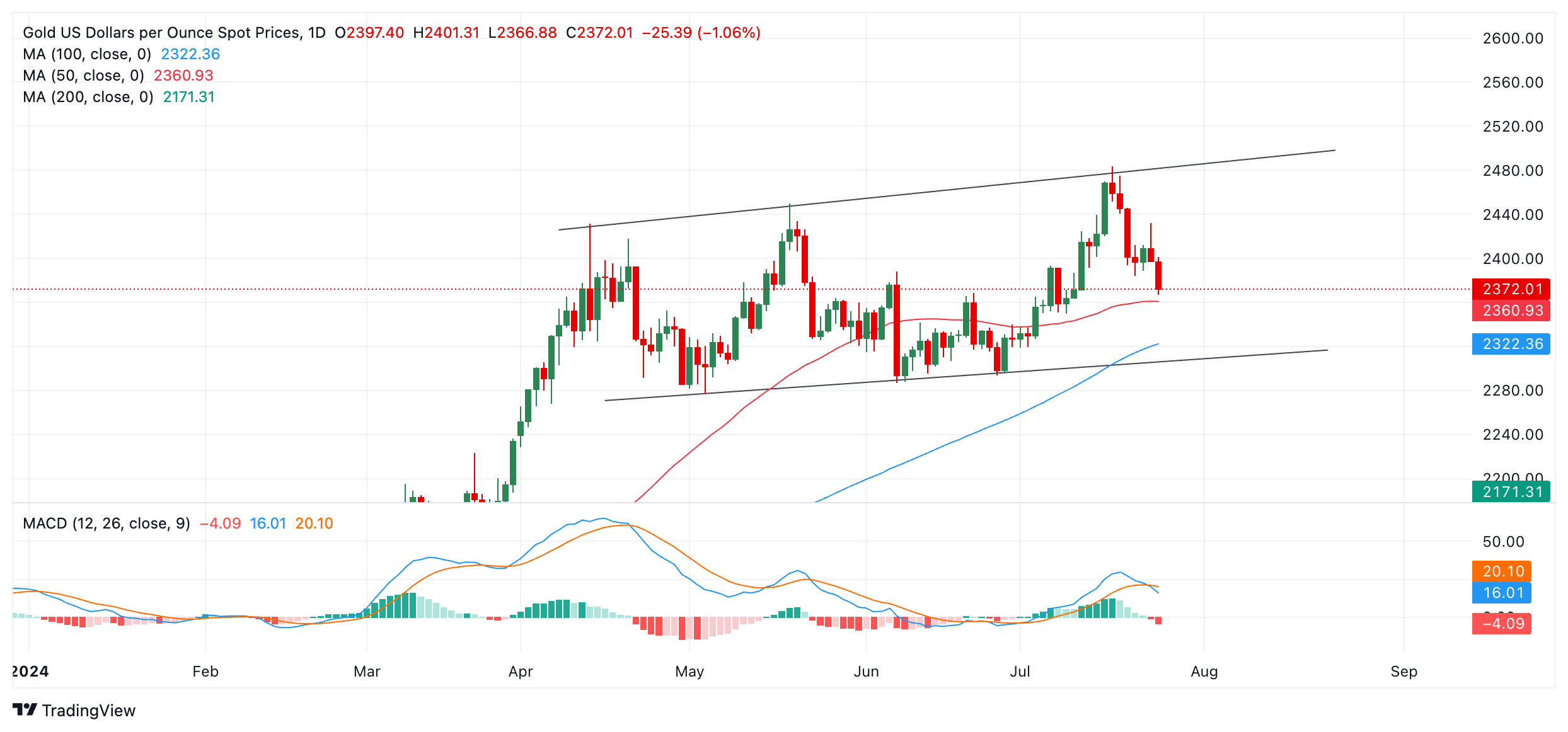
The Moving Average Convergence Divergence (MACD) indicator has crossed below its signal line, adding bearish confirmation to the down move currently unfolding. MACD tends to work particularly well at signaling price turns in sideways markets.
A break above the $2,483 all-time-high would indicate the establishment of a higher high and suggest the possibility of a breakout to the upside and an extension of the longer-term uptrend.
Such a move might unlock Gold’s next upside target at roughly $2,555-$2,560, calculated by extrapolating the 0.618 Fibonacci ratio of the height of the range higher.
Economic Indicator
Gross Domestic Product Annualized
The real Gross Domestic Product (GDP) Annualized, released quarterly by the US Bureau of Economic Analysis, measures the value of the final goods and services produced in the United States in a given period of time. Changes in GDP are the most popular indicator of the nation’s overall economic health. The data is expressed at an annualized rate, which means that the rate has been adjusted to reflect the amount GDP would have changed over a year’s time, had it continued to grow at that specific rate. Generally speaking, a high reading is seen as bullish for the US Dollar (USD), while a low reading is seen as bearish.
Read more.Last release: Thu Jul 25, 2024 12:30 (Prel)
Frequency: Quarterly
Actual: 2.8%
Consensus: 2%
Previous: 1.4%
Source: US Bureau of Economic Analysis
The US Bureau of Economic Analysis (BEA) releases the Gross Domestic Product (GDP) growth on an annualized basis for each quarter. After publishing the first estimate, the BEA revises the data two more times, with the third release representing the final reading. Usually, the first estimate is the main market mover and a positive surprise is seen as a USD-positive development while a disappointing print is likely to weigh on the greenback. Market participants usually dismiss the second and third releases as they are generally not significant enough to meaningfully alter the growth picture.
Author

Joaquin Monfort
FXStreet
Joaquin Monfort is a financial writer and analyst with over 10 years experience writing about financial markets and alt data. He holds a degree in Anthropology from London University and a Diploma in Technical analysis.