|

GBP/USD stumbles putting key support level at risk around 1.2000 with bears lurking the 100-DMA

  • The US Dollar is set to finish the week with solid gains due to Fed’s hawkish comments and US data.
  • US Consumer Sentiment improved, as reported by the University of Michigan.
  • The UK avoided a recession in Q4 2022, though its forward economic outlook suggests a weaker British Pound.
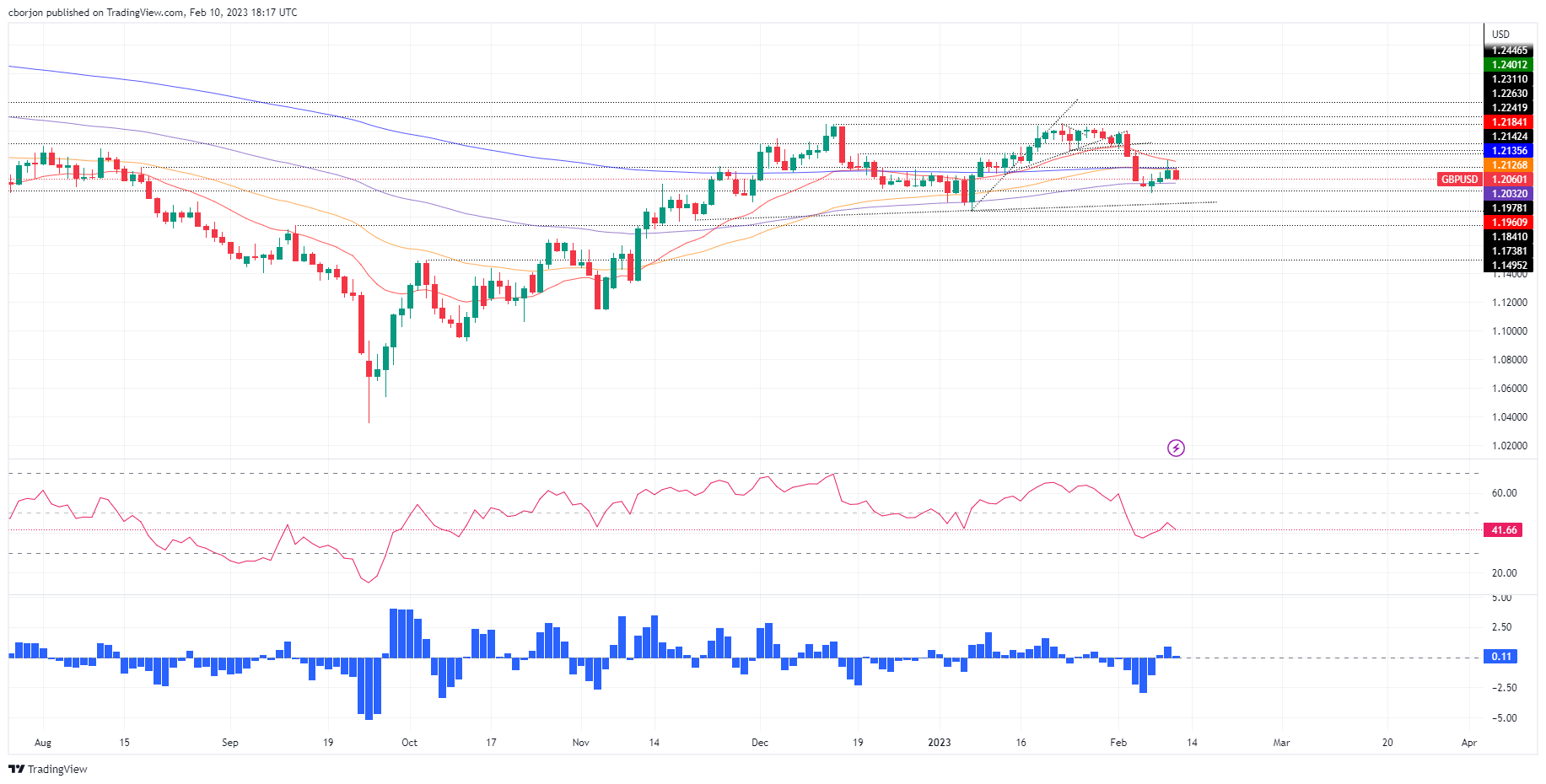
  • GBP/USD Price Analysis: A daily close below 1.2032 would resume a bearish continuation.

GBP/USD snaps three straight days of gains and drops as it tested the 50-day Exponential Moving Average (EMA) at 1.2126, as UK economic data showed the economy did not grow, while consumer sentiment in the US improved. At the time of writing, the GBP/USD exchanges hands at 1.2055.

Improvement in US consumer sentiment and weak UK GDP weighed on the GBP

The GBP/USD extended a leg down after data from the University of Michigan (UoM) reported that Consumer Sentiment surpassed predictions of 65 and increased to 66.4, indicating a better financial situation. In addition, the expected inflation rate for the year rose from 3.9% in January’s final reading to 4.2%, while the inflation estimations for a five-year period remained steady at 2.9%.

Therefore, the US Dollar Index (DXY), a measure of the greenback’s value vs. a basket of peers, advances 0.60%, up at 103.65, underpinned by US Treasury bond yields, which, affected by hawkish Federal Reserve’s (Fed) speakers commentary during the last week, broke the 3.70% threshold, at 3.728%.

During the European session, the UK economic docket revealed that GDP for the last three months of 2022 stood at 0% and avoided entering a recession, foresaw by the Bank of England (BoE). On a monthly basis, December’s GDP contracted by -0.5%, reported the Office for National Statistics (ONS).

In the meantime, a gloomy scenario in the UK suggests that the British Pound (GBP) would be under pressure as the BoE struggles to tame inflation which reached a 41-year high at 11.1% in October of 2022. The BoE’s latest monetary policy meeting revealed a split vote amongst its members. The BoE forward discussions and guidance would be interesting, which could reassure the central bank’s commitment to tackle inflation.

GBP/USD technical analysis

From a daily chart perspective, the GBP/USD would consolidate within the boundaries of the 50-day EMA  at 1.2126 upwards and the 100-day EMA at 1.2032 downwards. However, the Relative Strength Index (RSI) entered the bearish territory, and the Rate of Change (RoC) turned neutral, making a case for a bearish continuation. Therefore, the GBP/USD next support would be the 100-day EMA at 1.2032, followed by the psychological 1.2000 figure. A decisive break could send the GBP/USD to test the YTD low of 1.1841.
GBP/USD

Overview
Today last price1.2058
Today Daily Change-0.0058
Today Daily Change %-0.48
Today daily open1.2116
 
Trends
Daily SMA201.2266
Daily SMA501.2191
Daily SMA1001.1833
Daily SMA2001.1947
 
Levels
Previous Daily High1.2194
Previous Daily Low1.2057
Previous Weekly High1.2418
Previous Weekly Low1.205
Previous Monthly High1.2448
Previous Monthly Low1.1841
Daily Fibonacci 38.2%1.2142
Daily Fibonacci 61.8%1.2109
Daily Pivot Point S11.2051
Daily Pivot Point S21.1986
Daily Pivot Point S31.1914
Daily Pivot Point R11.2188
Daily Pivot Point R21.2259
Daily Pivot Point R31.2325

Author

Christian Borjon Valencia

Markets analyst, news editor, and trading instructor with over 14 years of experience across FX, commodities, US equity indices, and global macro markets.


More from Christian Borjon Valencia
Share:

Editor's Picks

AUD/USD consolidates above 0.7000/two-month low; bearish potential intact

The AUD/USD pair oscillates in a narrow range during the Asian session, and moves little following the release of mixed inflation figures from China. Spot prices currently trade around the 0.7025 region, nearly unchanged for the day, and remain within striking distance of a nearly two-month low set on Tuesday. Renewed hostilities between the US and Iran temper hopes for a deal to end the over three-month-old war.

Japanese Yen languishes despite wholesale inflation accelerates in May

USD/JPY flatlines after experiencing volatility, trading around 160.40 during the Asian hours on Wednesday. The pair continues to hold its ground, reflecting a struggling Japanese Yen that has failed to find support despite a massive acceleration in wholesale inflation. Driven by surging energy costs linked to the ongoing Middle East conflict, Japan’s Producer Price Index jumped 6.3% year-over-year in May. This hot printing comfortably outpaced April’s upwardly revised 5.3% figure and surpassed market consensus of 5.5%, marking the fastest pace of wholesale price growth in three years.

Gold plummets below $4,200 amid US‑Iran tensions ahead of US CPI

Gold extends the recent breakdown momentum below a technically significant 200-day Simple Moving Average (SMA) and drops to a fresh low since March 23, further below the $4,200 mark during the Asian session. Crude Oil prices rise amid renewed hostilities between the US and Iran, fueling inflation fears and bolstering bets for more hawkish central banks.

Bitcoin remains vulnerable, Ethereum weakens further, XRP signals more downside

Bitcoin, Ethereum, and Ripple remain under pressure mid-week, as the broader cryptocurrency market struggles to regain recovery momentum after last week’s massive correction. BTC struggles below $62,000, ETH continues to weaken below $1,650, while XRP’s momentum indicators remain biased toward further downside.

US CPI data set to show inflation at three-year high in May, backing Fed hawkish tilt

The US Bureau of Labor Statistics will publish the May Consumer Price Index (CPI) data on Wednesday. The report is expected to show another step up in consumer inflation, driven by the persistently high Oil prices due to the ongoing crisis in the Middle East.

The US economy defies the rules: 100 days into the Oil shock and the recession signal is still missing

More than three months after the start of the Iran war and the resulting disruption to global energy markets, the US economy continues to display remarkable resilience. The conflict has triggered a sharp rise in Oil prices, reignited inflationary pressures and fueled widespread concerns about a potential economic slowdown.