|

GBP/USD: Demand for weekly put options strongest since September 2016

  • GBP/USD's weekly risk reversals show the strongest bearish bias in over three years. 
  • Investors are hedging for a surprise election outcome. 

Sterling investors are hedging themselves against a surprise election outcome - Labour victory or hung parliament - which could spell doom for the British currency, risk reversals show. 

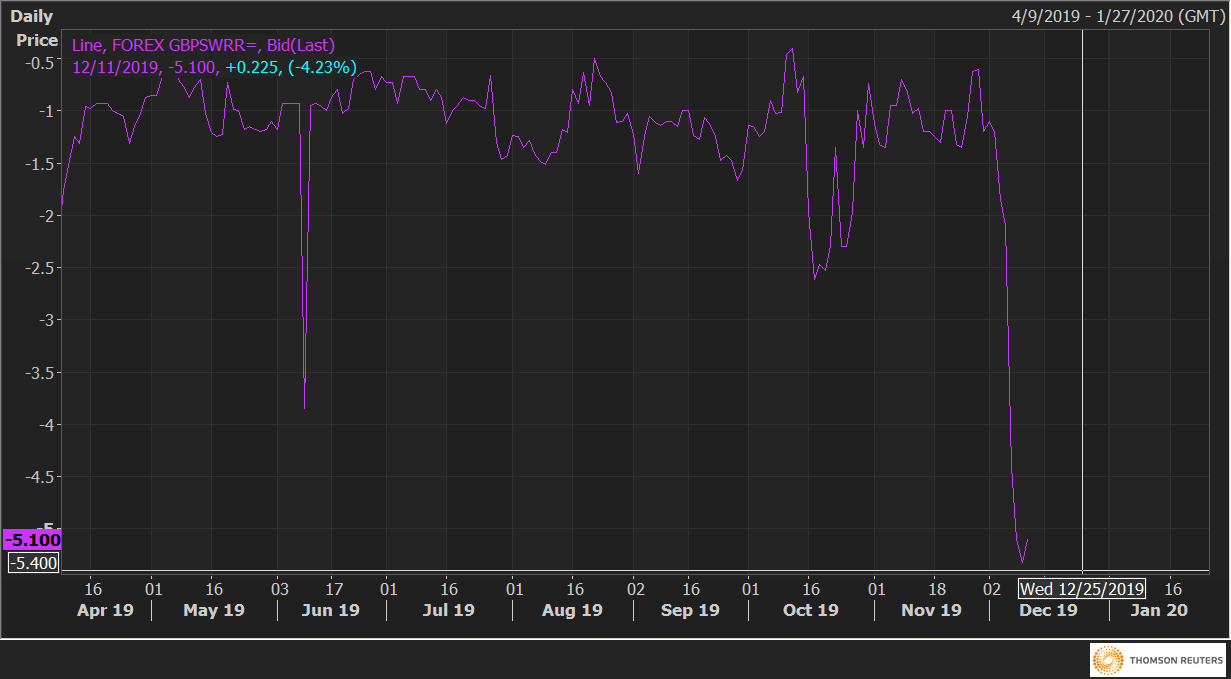
On Tuesday, one-week Sterling risk reversals, a gauge of calls to puts, fell to -5.32, signaling the strongest bearish bias since September 2016. 

A negative number indicates the demand or volatility premium claimed by the put options (bearish bets) is higher than that by the call options (bullish bets). 

One-week risk reversals have witnessed a near-90 degree drop from -0.60 to -5.32 over the last 12 days. During the same time period, GBP/USD rose from 1.29 to 1.3215. 

The divergence is unusual and indicates fear among investors that the election outcome could be different than what opinion polls are predicting. 

Prime Minister Boris Johnson's Tory party will win 339 of the 650 seats in the House of Commons, Labour 231, the Scottish National Party 41, and the Liberal Democrats 15, according to YouGov MRP poll. Johnson's lead, however, has recently narrowed sharply. 

Britons are set to vote on Dec. 12. 

Risk reversals


Author

Omkar Godbole

Omkar Godbole

FXStreet Contributor

Omkar Godbole, editor and analyst, joined FXStreet after four years as a research analyst at several Indian brokerage companies.


More from Omkar Godbole
Share:

Editor's Picks

GBP/USD clings to daily gains near 1.3550

GBP/USD adds to Friday’s advance, briefly hitting three-month tops near 1.3570 before edging lower on Monday. Fading expectations of a Fed rate hike in September weigh on the Greenback, helping Cable to keep its bullish momentum ahead of the release of the UK jobs report on Tuesday.

EUR/USD: Gains appear capped by 1.1600

EUR/USD consolidates its daily gains well north of the 1.1500 hurdle following the closing bell on Wall Street on Monday. The pair’s multi-day bounce comes on the back of renewed selling pressure on the US Dollar investors continue to trim bets of Fed rate hikes. Moving forward, Germany’s ZEW prints are due on Tuesday alongside a slew of US hard data.

Gold bulls take a breather before the next push higher

Gold is retreating after hitting three-day highs just below $4,450 early Tuesday, and is flirting with $4,400 as of writing. Gold bulls take a breather following two consecutive days of gains, assessing the impact of the truce lapse between the United States (US) and Iran on Oil prices and US Treasury bond yields.

US Treasury seeks public comments on proposed rules implementation under GENIUS Act
The US Department of the Treasury is seeking public opinion on its proposed framework for implementing key provisions of the Guiding and Establishing National Innovation for US Stablecoins (GENIUS) Act, which establishes a regulatory framework for stablecoins.
Silver’s new era: Supply deficits meet exploding industrial demand
Silver has experienced a wild ride in 2026, but The Silver Institute President and CEO Michael DiRienzo says investors shouldn’t let the volatility obscure a much bigger story: the underlying silver market remains remarkably strong.
Why is Crude Oil priced for a reopening the ships haven't made?
Fourteen vessels crossed the Strait of Hormuz on Tuesday. Before the war, the count ran near 120 a day. In the sessions since the waterway was publicly declared open, Brent has drifted back to $87 and West Texas Intermediate (WTI) to $81, both a little lower again on Wednesday, with daily momentum on each unwound from the top of its range in late July to the low twenties now.