|

FCEL Stock Price: FuelCell Energy Inc gains after beating revenue estimates last quarter

  • NASDAQ:FCEL adds 4.86% to close the week as the NASDAQ soars to new all-time highs.
  • FuelCell reported larger losses than expected but beat Wall Street revenue expectations.
  • FuelCell CEO is bullish moving forward with the new Biden administration in the White House. 

NASDAQ:FCEL paced the renewable energy sector even though the recent quarterly earnings report returned mixed results. On Friday, FuelCell Energy added 4.86% to close the final trading session of the week at $18.13, which puts it back within reach of the 52-week high price of $20.94. Shares are now up a whopping 68% so far in 2021 and a total of 850% over the past 52-weeks as the bullish sentiment surrounding clean energy firms is skyrocketing now that President-elect Biden is officially in the Oval Office. 

FuelCell reported its quarterly earnings earlier this week and the stock took a dive after results were mixed. While the alternative energy provider was able to top Wall Street’s revenue expectations, its losses were calculated to be $0.08 which was slightly more than the consensus $0.07 estimate. FuelCell CEO Jason Few put emphasis on the company’s revenue growth and cited optimism for significant opportunities on the horizon for FuelCell, and described four products that it was focussing on in the short term: distributed generation, distributed hydrogen, long-duration hydrogen storage, and power generation. 

FCEL stock forecast
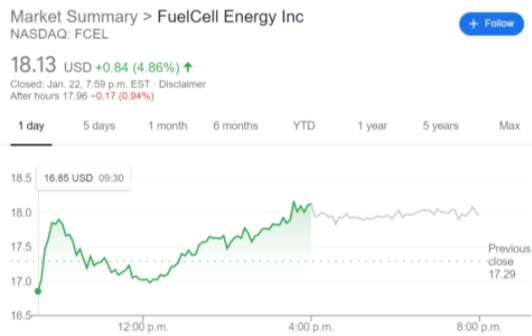
FCEL stock price chart

Like many other alternative energy companies, Few also reiterated his excitement over President-elect Biden and his emphasis on green energy as a focus for America. The FuelCell CEO stated optimism that the United States is now positioned to make up ground on Asia and Europe in terms of its clean energy policies. Despite industry rivals like Bloom Energy (NYSE:BE) recently receiving analyst downgrades as a sector that is too richly valued, FCEL continues to see its price climb back towards a new all-time high. 

Author

More from Stocks Reporter
Share:

Editor's Picks

GBP/USD extends the drop to 1.3360

GBP/USD builds on Monday’s decline and briefly clinches five-day lows near 1.3360 on Tuesday. Cable’s extra pullback follows the better tone in the Greenback as uncertainty in the Middle East prompts investors to adopt a cautious stance. Meanwhile, an apathetic UK labour market report also collaborates with the selling pressure on the British Pound.

EUR/USD stays offered just above 1.1400

EUR/USD keeps the downtrend well in place for yet another day, challenging the 1.1400 contention zone on Tuesday. The continuation of the selling impulse in spot comes amid decent gains in the US Dollar, which continues to find support in the persistent effervescence surrounding the US-Iran crisis.

Middle East crisis intensifies, Gold up

Gold now seems to have embarked on a consolidative phase below the key $4,100 mark per troy ounce in the latter part of Tuesday’s session. Meanwhile, uncertainty surrounding the Middle East conflict and rising expectations for a hawkish Fed policy outlook are expected to limit the precious metal’s bullish momentum in the near term.

XRP rebounds on rising on-chain activity
Ripple (XRP) ticks up and trades around $1.13 at the time of writing on Tuesday. This rebound aligns with a broader recovery in the cryptocurrency market, attributed to reports that mediators between the United States (US) and Iran are seeking a 10-day cessation of strikes to find a way back to the signed Memorandum of Understanding (MoU).
The Iranian war has again risen
The Iranian war has again risen to the top of the economics factor list. There is no end in sight. Intelligence experts say the current level of offense/retaliation will not change minds in Tehran, while in Washington, Trump fears all-out war, which would mean boots on the ground.
US Dollar mid-year outlook: Exceptional currency, exceptional risks?
The US Dollar enters the second half of 2026 in a markedly different position from a year ago. The King currency has recovered, reflecting persistent US inflation, changing expectations for Fed policy, geopolitical tensions and renewed demand for defensive assets.