European equities trim gains after German CPI inflation misses the mark
- Tech rally comes under threat as chipmaker expectations outrun earnings.
- Automotive sector sees downside pressure after EU regulators raid tire manufacturers.
- Germany CPI inflation came in below expectations, pan-EU CPI due Thursday.

European equities saw some weakness on Wednesday with Germany’s DAX index declining four-tenths of a percent after German Consumer Price Index (CPI) inflation missed forecasts, and rising costs associated with developing AI-based hardware and software products irks investors who aren’t seeing as much gain in revenues as hoped for on the back of rising demand for AI-powered products.
Germany’s annualized CPI inflation came in below expectations, printing at 2.9% YoY in January versus the 3.2% forecast and falling even further from the previous period’s 3.8%. With inflation in the German economy receding faster than expected, the Euro area’s key economic powerhouse within the union, markets are stepping into bets of higher and faster rate cuts from the European Central Bank (ECB) ahead of Thursday’s broader EU Harmonized Index of Consumer Prices (HICP).
pan-EU annualized HICP inflation for the year ended in January is forecast to tick down from 2.9% to 2.8% YoY. Money markets now see 150 basis points in rate cuts from the ECB through the end of 2024, up from Tuesday’s 140 bps rate trim forecast.
Germany: Inflation decelerates further in January
Growing protests and demonstrations across Europe threaten stability in the agriculture sector as farmers organize into larger blockades, protesting a lack of support from European government agencies. Farmers are looking for the EU to trim back planned declines in subsidies, as well as seeking additional tariff controls on imports from Ukraine, who has diverted the majority of their foreign-bound agriculture products into European markets since the start of the Russian invasion last year that shut Ukraine out from key export markets to the East.
Automotive and car parts markets got weighed down this week by a raid on tire manufacturers by the EU Commission that are accusing the key parts producers of cartel-like behavior. Major producers including Pirelli, Michelin, and Nokian saw their offices raided by UE antitrust regulators on Tuesday, and markets are awaiting an update from the EU Commission, who have a mandate to remain silent on matters until their initial investigation concludes. European tire manufacturers have been accused of price fixing and colluding against the interest of European consumers.
Major tech giants including Microsoft and Alphabet have reported significant revenue increases in AI-associated spaces recently, but costs are rising quickly in the cutting-edge tech sphere, weighing down investor sentiment. Pivots into supplying AI-focused chips and software see prices and costs soaring faster than income gains, and demand for non-AI chips are weighing down semiconductor players.
The Pan-European STOXX600 major equity index eked out a slim gain of 0.07%, gaining a third of a point to close Wednesday at €485.97, bolstered by mega-cap stock gains in the healthcare and utilities sectors offsetting declines in financials and technology.
France’s CAC40 fell nearly 21 points to end Wednesday down 0.27% at €7,656.75, and Germany’s DAX fell 0.4%, shedding 68.58 points to close at €16,903.76.
London’s FTSE also saw accelerated downside, tumbling 0.47% to close down 35.74 points at £7,630.57.
DAX technical outlook
The German DAX equity index trimmed back into the €16,875.00 level on Wednesday, slipping back from the day’s peak near €16,975.00, losing 0.65% peak-to-trough in the process.
The index recovered back into the €16,900.00 handle heading into the market close, but the index finds itself trading on the south side of the 50-hour Simple Moving Average (SMA) for the second time in a week.
Hesitation in German equities has the DAX struggling to chalk in further gains above December’s peak just shy of the €17,000.00 major price handle, but the major index is still trading firmly into bullish territory well above the 200-day SMA just below €16,000.00.
DAX hourly chart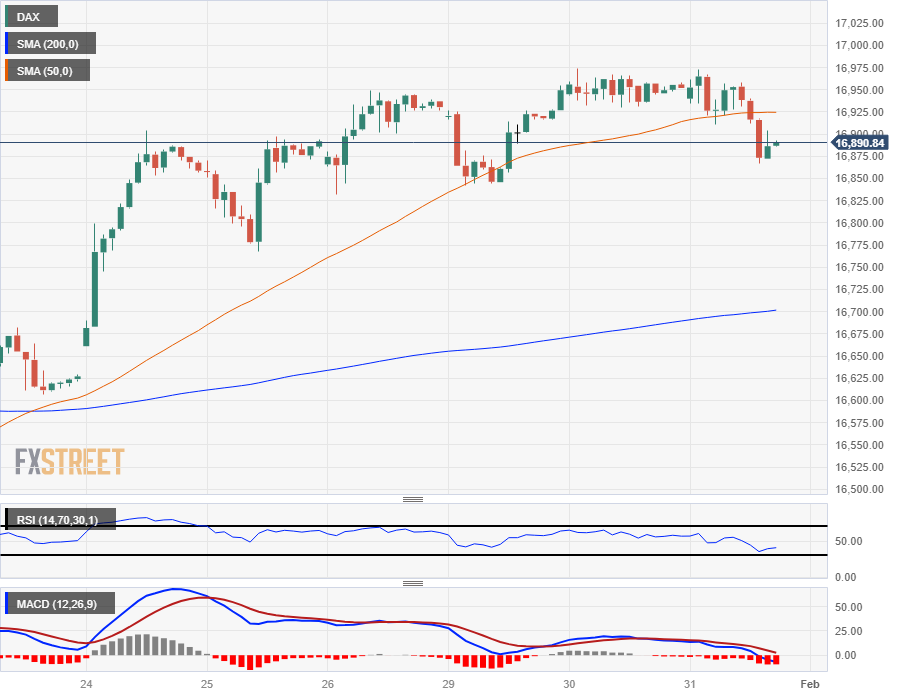
DAX daily chart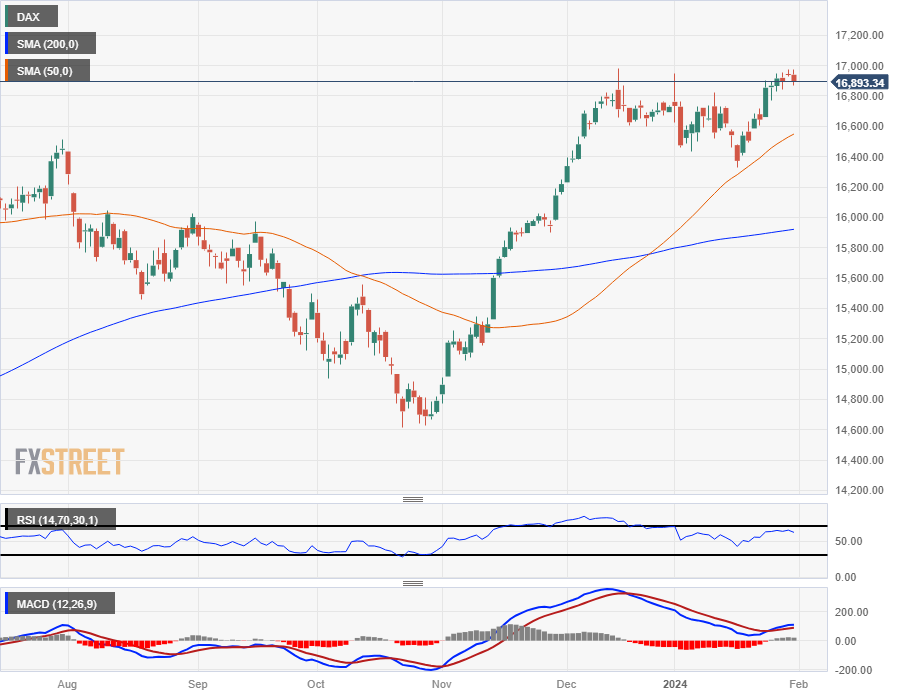
Author

Joshua Gibson
FXStreet
Joshua joins the FXStreet team as an Economics and Finance double major from Vancouver Island University with twelve years' experience as an independent trader focusing on technical analysis.