|

EUR/USD struggles around the two-week high of 1.0700, tumbles to 1.0650s

  • Eurozone S&P Global Manufacturing PMIs were mixed and weighed on the EUR.
  • European Central Bank Nagel said the ECB needs to take further action to tackle inflation.
  • EUR/USD Price Analysis: Failure to crack 1.0700, to pave the way to 1.0600 and below.

The Euro (EUR) sheds some ground against the US Dollar (USD) on the first trading day of 2023 amidst thin liquidity conditions in the financial markets. The release of S&P Global PMIs in the Eurozone failed to bolster the shared currency on Monday. At the time of writing, the EUR/USD is trading at 1.0657 after hitting a daily high of 1.0699.

European equities are trading in the green. S&P Global revealed the Purchasing Managers Index (PMI) for factory activity in the EU, which came mixed with Spain and France’s Manufacturing PMI exceeding estimates, contrarily to Germany, which extended its downward trajectory to 47.1. Italy and the whole Euro area remained unchanged, each at 48.5 and 47.8.

In the meantime, the Bundesbank President and European Central Bank (ECB) policymaker Joachim Nagel crossed newswires on a german newspaper, and he said he’s optimistic that Germany can avoid a serious economic slump. Nagel added that the ECB was not seeing a wage spiral and reiterated that the ECB needs to take further action to curb inflation expectations.

In the meantime, the US Dollar Index, a measure of the buck’s value against a basket of peers, climbs 0.14% to 103.63, off six-month lows hit during the last week at 103.38. the lack of US and Canadian economic data keeps traders leaning on market mood and technicals.

Ahead of the week, the Eurozone economic docket will feature employment data in Germany alongside the inflation rate. Regarding the US economic calendar, the S&P Global Manufacturing PMI for December is expected to remain at 46.2, which could be a prelude to the Institute for Supply Management (ISM) factory activity on Wednesday.

EUR/USD Price Analysis: Technical outlook

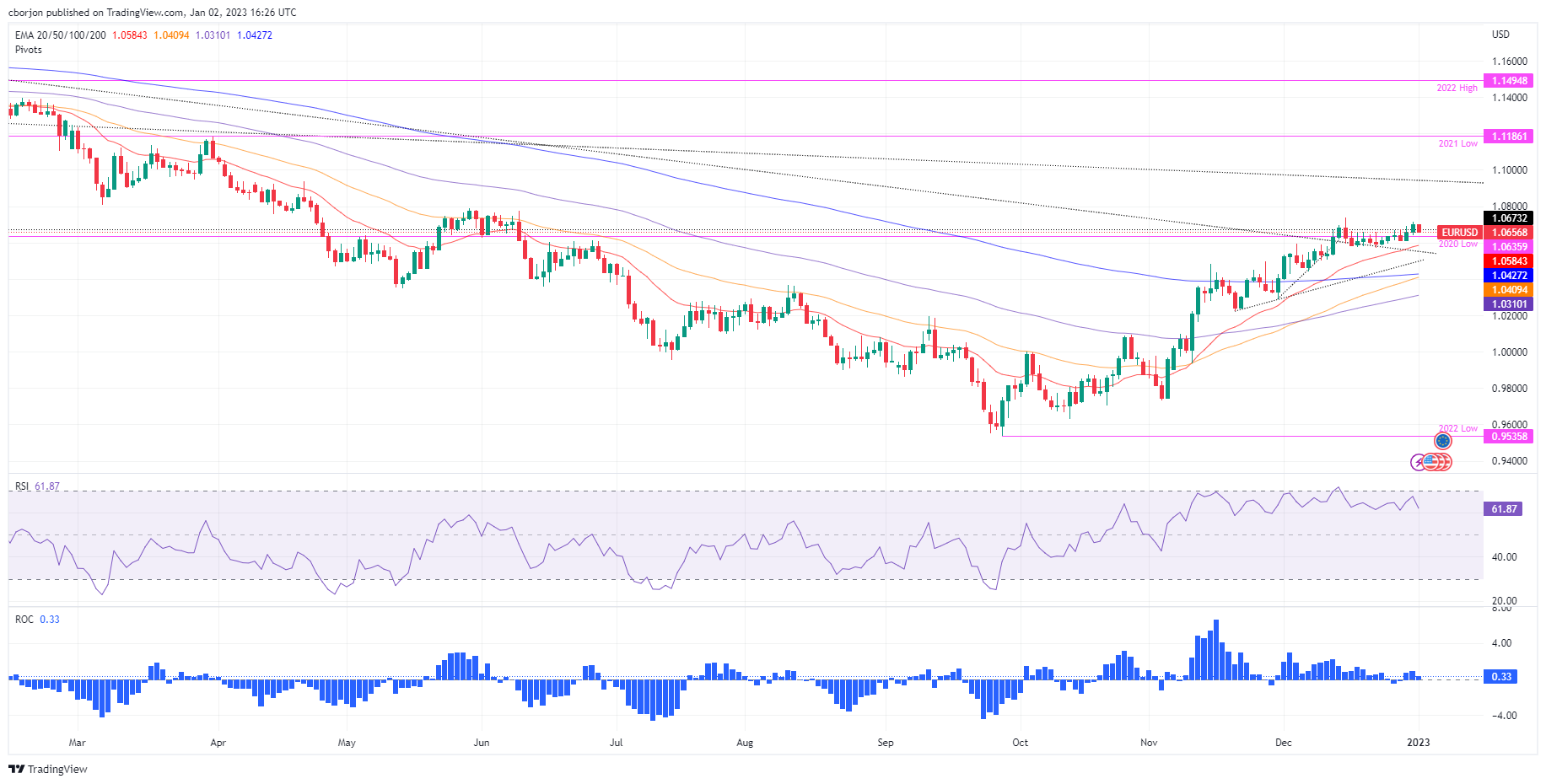
The EUR/USD daily chart suggests the pair might be peaking at around 1.0700, unable to crack in December, and it’s trimming some of its early gains, edged toward 1.0660s. Even though it broke above an eight-month-old downslope trendline, the EUR/USD faltered to extend its gains, opening the door for a re-test of the previously mentioned trendline at around 1.0550. Oscillators like the Relative Strength Index (RSI) and the Rate of Change (RoC) started to aim down, suggesting that sellers are beginning to gather momentum. Therefore, the EUR/USD first support would be the 1.0600 mark, followed by the 20-day Exponential Moving Average (EMA) at 1.0584, ahead of 1.0550.
EUR/USD

Overview
Today last price1.0669
Today Daily Change-0.0037
Today Daily Change %-0.35
Today daily open1.0706
 
Trends
Daily SMA201.0595
Daily SMA501.0347
Daily SMA1001.0126
Daily SMA2001.0325
 
Levels
Previous Daily High1.0713
Previous Daily Low1.0639
Previous Weekly High1.0713
Previous Weekly Low1.0607
Previous Monthly High1.0736
Previous Monthly Low1.0393
Daily Fibonacci 38.2%1.0685
Daily Fibonacci 61.8%1.0667
Daily Pivot Point S11.0658
Daily Pivot Point S21.0611
Daily Pivot Point S31.0584
Daily Pivot Point R11.0733
Daily Pivot Point R21.076
Daily Pivot Point R31.0808

Author

Christian Borjon Valencia

Markets analyst, news editor, and trading instructor with over 14 years of experience across FX, commodities, US equity indices, and global macro markets.


More from Christian Borjon Valencia
Share:

Editor's Picks

AUD/USD holds steady above 0.7000 as traders await RBA rate decision

AUD/USD extends its consolidative price move through the Asian session on Tuesday, trading just above 0.7000 ahead of the RBA rate decision. Meanwhile, the US Dollar sits near a two-month high as oil-driven inflation fears reaffirm Fed hike bets and continue to push US bond yields to multi-year highs. Moreover, the US-Iran standoff underpins the safe-haven buck and caps the currency pair.

USD/JPY consolidates near 157.50 as a bullish USD counters intervention risks

USD/JPY struggles to capitalize on the overnight bounce from a one-week low, consolidating around mid-157.00s during the Asian session on Tuesday. Trump's concerns about the Japanese Yen's weakness fueled speculation about another US-Japan joint intervention. This, along with the hawkish BoJ, underpins the JPY and caps the currency pair. Meanwhile, rising Fed rate-hike bets and oil-driven inflation fears continue to push US bond yields to multi-year highs, keeping the US Dollar pinned near a two-month high and supporting spot prices.

Gold bears await $4,100 break amid Fed hike bets and surging US bond yields

Gold consolidates the previous day's heavy losses to its lowest level since August 5, awaiting a break below $4,100 before the next leg down. Oil-driven inflation fears reaffirm bets of another Fed rate hike in October and continue to push US bond yields to multi-year highs, undermining the non-yielding bullion. Moreover, geopolitical risks help the US Dollar stand firm near a two-month high, which, in turn, favors XAU/USD bears.

HBAR, QNT rally as AI safety and tokenized deposits fuel institutional momentum​
Hedera (HBAR) and Quant (QNT) are among the crypto market’s strongest performers on Monday, as fresh developments around artificial intelligence (AI) and tokenized banking drive renewed institutional attention. HBAR briefly surged above $0.130 before settling around $0.123, gaining 30% over the past 24 hours.
The week ahead: A key moment for the global economy as threats rise

UK diesel hits a record, as economic concerns rise. The market expects an aggressive Fed rate hiking cycle, but is it necessary? Oil supply concerns ease, even as oil prices rise. What’s next for the AI trade.

Fed vs BoJ: Both hiked. The market only believes one of them – and the chart shows which

The Fed and the BoJ have just done something remarkably similar. Both central banks raised interest rates by 25 bps last week, both are confronting inflation risks, and both signal that future decisions will depend on incoming economic data.