EUR/USD steady amid US shutdown deal speculation and cautious ECB tone
- EUR/USD remains flat as White House's backing for a shutdown deal limits Euro gains.
- US government closure hits 41 days; Fed commentary drives sentiment amid sparse data releases.
- Weak US jobs and sentiment data highlight strain, while ECB officials maintain cautious policy tone.

EUR/USD holds firm at around 1.1550 on Monday, virtually unchanged as the Greenback trims some of its earlier losses amid news that the White House backs a deal to end the US shutdown in the coming days, as reported by Bloomberg. At the time of writing, the pair trades flat at 1.1560.
Speculation of US government reopening caps Euro’s advance
The White House expressed support for a bipartisan deal aimed at reopening the government within days. Despite voting and passing the legislation in the US Senate, House Representatives must come back to Washington, as the House Speaker Mike Johnson would give 36 hours’ notice to return to the Capitol once the Senate passes the bill.
In the meantime, the US government shutdown entered its 41st day, and amid the lack of economic data, market participants continued to lean on speeches by Federal Reserve (Fed) officials.
Last week, dismal jobs data revealed by the Challenger report showed that private companies are laying off workers. Meanwhile, the Consumer Sentiment prepared by the University of Michigan (UoM) showed that households are growing pessimistic about the economy.
In Europe, the docket was scarce, featuring European Central Bank (ECB) speakers, led by Vice President Luis de Guindos, and policymakers François Villeroy de Gelhaus and Joachim Nagel.
Daily market movers: EUR/USD consolidates, as US government reopening looms
- The US Dollar Index (DXY), which tracks the performance of the American currency against other six, holds firm at 99.56.
- The Trump administration expressed support for the bipartisan deal to end the US government shutdown, approved on Sunday.
- Fed Governor Stephen Miran was dovish, eyeing a 50 bps cut in the December meeting. Contrarily, St. Louis Fed Alberto Musalem commented that the economy remains resilient and that inflation is closer to 3% than 2%.
- Earlier, San Francisco Fed Mary Daly noted that goods inflation has been “pretty contained,” but acknowledged that recent rate cuts have helped the labor market while adding some upward pressure on overall prices.
- Last week’s Challenger report showed employers announced 153,000 job cuts in October — the highest for that month in two decades. Money markets now price a roughly 66% chance of a Federal Reserve rate cut in December, up from 62% a week earlier, reflecting growing expectations of policy easing amid signs of a cooling labor market.
- Consequently, the divergence on monetary policy between the European Central Bank and the Federal Reserve suggests that further EUR/USD upside is expected.
- European Central Bank Vice President Luis de Guindos said Monday that the current level of interest rates is “appropriate,” noting that inflation is moving closer to the 2% target. Meanwhile, other policymakers have urged caution, emphasizing the need to remain vigilant against lingering price pressures.
- Looking ahead, investors will turn their attention to Tuesday’s release of the German and Eurozone ZEW Economic Sentiment Index for fresh insights into the region’s growth outlook.
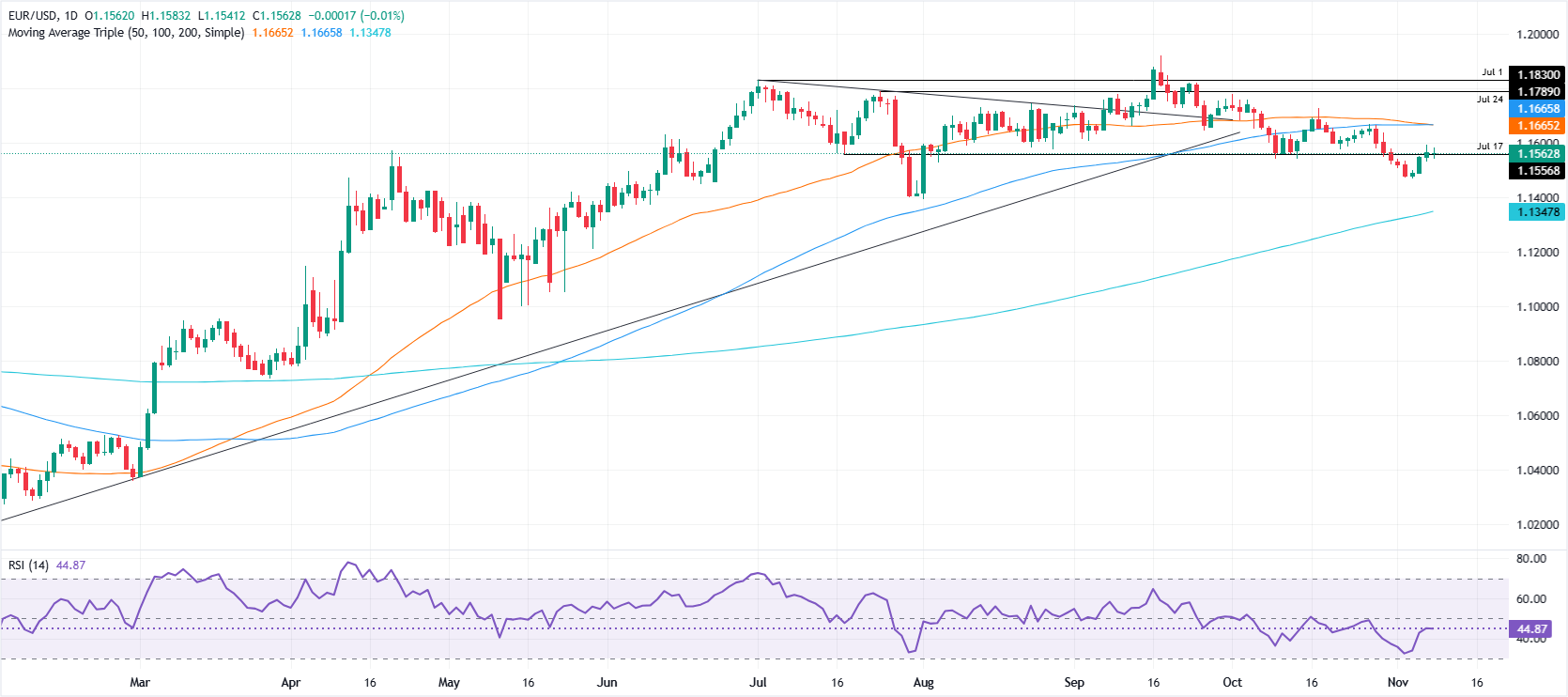
Technical outlook: EUR/USD to remain subdued below 1.16
Despite posting back-to-back bullish days, EUR/USD seems poised to remain downward biased, as sellers lack the strength to push the exchange rate towards the 200-day Simple Moving Average (SMA) at 1.1350.
If the pair remains below key resistance at the 20-day SMA at 1.1592, this will keep key resistance levels out of reach, like 1.1600, then look for a recovery towards 1.1700.
On the flip side, if EUR/USD drops below 1.1500, expect a test of the August 1 cycle low of 1.1391.
Euro FAQs
The Euro is the currency for the 20 European Union countries that belong to the Eurozone. It is the second most heavily traded currency in the world behind the US Dollar. In 2022, it accounted for 31% of all foreign exchange transactions, with an average daily turnover of over $2.2 trillion a day. EUR/USD is the most heavily traded currency pair in the world, accounting for an estimated 30% off all transactions, followed by EUR/JPY (4%), EUR/GBP (3%) and EUR/AUD (2%).
The European Central Bank (ECB) in Frankfurt, Germany, is the reserve bank for the Eurozone. The ECB sets interest rates and manages monetary policy. The ECB’s primary mandate is to maintain price stability, which means either controlling inflation or stimulating growth. Its primary tool is the raising or lowering of interest rates. Relatively high interest rates – or the expectation of higher rates – will usually benefit the Euro and vice versa. The ECB Governing Council makes monetary policy decisions at meetings held eight times a year. Decisions are made by heads of the Eurozone national banks and six permanent members, including the President of the ECB, Christine Lagarde.
Eurozone inflation data, measured by the Harmonized Index of Consumer Prices (HICP), is an important econometric for the Euro. If inflation rises more than expected, especially if above the ECB’s 2% target, it obliges the ECB to raise interest rates to bring it back under control. Relatively high interest rates compared to its counterparts will usually benefit the Euro, as it makes the region more attractive as a place for global investors to park their money.
Data releases gauge the health of the economy and can impact on the Euro. Indicators such as GDP, Manufacturing and Services PMIs, employment, and consumer sentiment surveys can all influence the direction of the single currency. A strong economy is good for the Euro. Not only does it attract more foreign investment but it may encourage the ECB to put up interest rates, which will directly strengthen the Euro. Otherwise, if economic data is weak, the Euro is likely to fall. Economic data for the four largest economies in the euro area (Germany, France, Italy and Spain) are especially significant, as they account for 75% of the Eurozone’s economy.
Another significant data release for the Euro is the Trade Balance. This indicator measures the difference between what a country earns from its exports and what it spends on imports over a given period. If a country produces highly sought after exports then its currency will gain in value purely from the extra demand created from foreign buyers seeking to purchase these goods. Therefore, a positive net Trade Balance strengthens a currency and vice versa for a negative balance.
Author

Christian Borjon Valencia
FXStreet
Markets analyst, news editor, and trading instructor with over 14 years of experience across FX, commodities, US equity indices, and global macro markets.














