EUR/USD retreats from weekly highs amid soft Canadian jobs data, falling EU’s bond yields
- EUR weakens amid falling bond yields; remains supported by monetary policy divergence.
- ECB to tighten monetary conditions despite the Eurozone recession.
- Upcoming US CPI data could set the stage for a surprise at the FOMC meeting.

EUR/USD reversed its course after Thursday’s jobs report in the United States (US) justified the Federal Reserve (Fed) view for skipping a rate hike. Additionally, recent data from Canada pointed to a softening labor market, atoning with recent unemployment claims in the US. The EUR/USD is trading at 1.0753, down 0.26%.
Fed and ECB monetary policies set to diverge, supporting ongoing strength in EUR/USD
The Euro (EUR) feels the pain of falling bond yields across the bloc. That weakened the shared currency, which failed to cling to Thursday’s gains. The EUR/USD stuck to the 20-day Exponential Moving Average at 1.0772., even though Thursday from the US lifted the pair. Data from the US Department of Labor showed that the US labor market is easing, as more Americans filed for unemployment, on its highest jump since October 2021. But, the main driver in the North American session is employment data from Canada.
Statistics Canada revealed the economy slashed 17,300 jobs in May, well below the expected growth of 23,200. Additionally, the Unemployment Rate ticked from 5.1% to 5.2%, a sign of weakness in the labor market.
Although the EUR/USD is retreating from weekly highs, it is set to continue to strengthen, with two central banks set to diverge on their monetary policy stance. In the next week, the Federal Reserve is expected to keep rates unchanged at the 5.0-5.25% area. The European Central Bank (ECB) would likely increase rates toward 3.50%, even though the Eurozone (EU) reported a technical recession after printing back-to-back quarters with negative GDP. However, the ECB will continue to tighten monetary conditions, as stressed by Isabel Schnabel, an ECB Governing Council member, who said: “The costs of doing too little (in monetary tightening) continued to be greater than the costs of doing too much.”
Upcoming events
Next week on Tuesday, the EU docket will feature inflation data in Germany and the ZEW Economic Sentiment Index. On the US front, the Consumer Price Index (CPI) for May, estimates at 4.1% YoY, while core CPI forecasts lie at 5.2%. Upward readings on the CPI could pave the way for a surprise at the following week’s FOMC meeting.
EUR/USD Price Analysis: Technical outlook
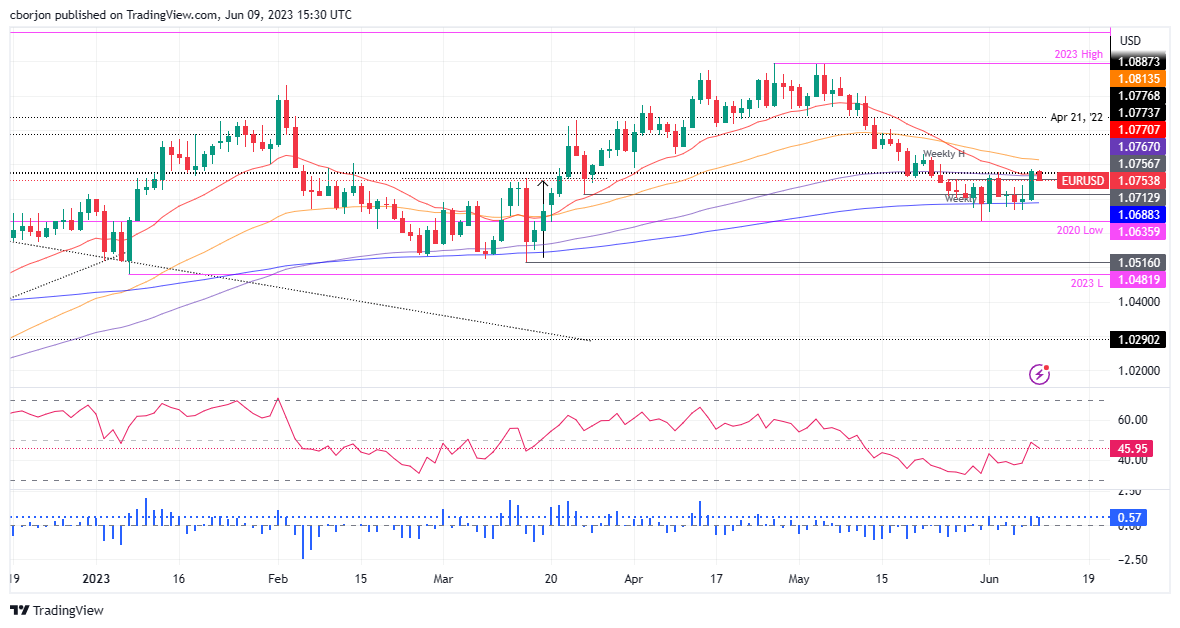
The EUR/USD trades sideways, though slightly tilted to the downside, as the 20, 50, and 100-day EMAs lie above the current exchange rate, providing a solid resistance area above the 1.0767 area. Based on price action, the EUR/USD must likely test the June 7 high turned support at 1.0739 before dropping towards the figure at 1.0700, ahead of the June 8 low of 1.0692. A breach of the latter and the EUR/USD will challenge the 200-day EMA at 1.0688.
Author

Christian Borjon Valencia
FXStreet
Markets analyst, news editor, and trading instructor with over 14 years of experience across FX, commodities, US equity indices, and global macro markets.