EUR/USD rallies above 1.1430 on a 180-pip move as ECB's Lagarde muted on hiking in 2022
- On Thursday, the shared currency advances 1.22% against the greenback.
- The ECB recognizes that inflations risks are tilted to the “upside,” not transitory.
- EUR/USD is bearish biased, but a daily close above 1.1440 could shift the bias towards a neutral-bullish.

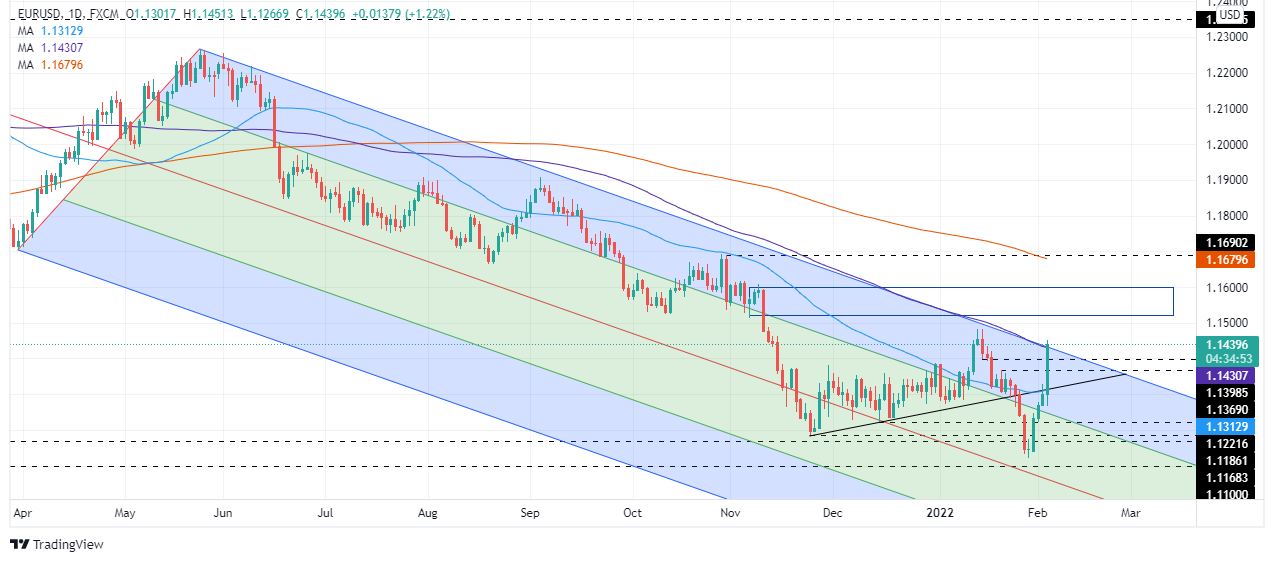
The shared currency rallied almost 180-pips from the daily lows towards 1.1450, 20-pips above the 100-DMA. Nevertheless, it retreated somewhat on top of it, as bulls take a breather towards December’s 2021 highs around 1.1482. At the time of writing, the EUR/USD is trading at 1.1439.
ECB’s hawkish hold spurred a rally on the EUR
Thursday’s session did not disappoint at all. The ECB released its monetary policy decision, where the central bank kept everything unchanged. Nevertheless, it is worth noting that for the first time, the ECB acknowledged that “risks to the inflation outlook are tilted to the upside,” perceived as a hawkish hold by investors, as witnessed by the reaction of the pair.
One thing to punctual is that ECB’s President Christine Lagarde, when asked about hiking rates, backpedaled, refusing to say that “it is very unlikely that we will raise interest rates in the year 2022.” When Lagarde was asked about the possibility of ECB rate hikes in 2022, she said that “she never makes pledges without conditions; will be paying attention to data.”
Analysts at ING mentioned that “Lagarde opened the door to a speeding up of asset purchase reductions and a rate hike this year.”
Meanwhile, when Lagarde’s finished her press conference, Reuters reported that “ECB policymakers see policy change at the March meeting if inflation does not ease.”
In the meantime, the US economic docket featured the ISM Non-Manufacturing PMI for January, which came at 59.9, four-tenths higher than the 59.5 foreseen by analysts, but trailed December’s 62.3 reading. Moreover, Initial Jobless Claims for the week ending on January 29 came at 238K, better than the 245K foreseen by analysts, and lower than the previous week revised upwards, to 261K. The market mainly ignored the news, as EUR/USD traders were focused on the ECB.
Now that the ECB meeting is in the rearview mirror, EUR/USD traders focus on the US Nonfarm Payrolls report for January, expected at 199K. However, Wednesday’s ADP report with companies slashing 300K jobs could prelude the number.
EUR/USD Price Forecast: Technical outlook
The EUR/USD daily chart depicts the pair is testing the 100-DMA at 1.1430, after an upside break of the 50-DMA at 1.1312, in the 180-pip jump. Despite the sharp upward movement, from a technical perspective still bearish biased.
For the EUR/USD from a technical perspective, to shift from a bearish bias to a neutral-bullish stance, first would need a daily close above the confluence of the 100-DMA and Pitchfork’s channel top-trendline lying near the 100-DMA. In that outcome, the first resistance would be January 14 daily high at 1.1482, followed by 1.1500.
Failure at the above mentioned, then the EUR/USD would tumble below 1.1400. The following support would be an upslope trendline, drawn from November 2021, lows around 1.1320-40, and then the 50-DMA at 1.1312.
Author

Christian Borjon Valencia
FXStreet
Markets analyst, news editor, and trading instructor with over 14 years of experience across FX, commodities, US equity indices, and global macro markets.