|

EUR/USD losses traction despite hawkish remarks from ECB officials

  • EUR/USD trading at 1.1027, holding to gains of 0.13% despite the Eurozone Industrial Production plunge.
  • Dutch Central Bank President comments on the need for rate hikes to curb inflation.
  • US Treasury Secretary Yellen states no favorable alternatives to resolve the debt limit issue without Congress’s assistance.

The EUR/USD retreated from daily highs, hitting 1.1053 as the European session ended. The latest week, we have witnessed the US Federal Reserve (Fed) and the European Central Bank (ECB) increasing rates by 25 bps, though divergence would likely favor the latter. Hence, the EUR/USD is trading at 1.1017, with losses of 0.05%.

ECB officials make hawkish remarks as US debt ceiling takes center stage

US equities continued to trade mixed. The EUR/USD pair is clinging to its earlier gains, despite data from the Eurozone (EU), namely Germany, showing that Industrial Production plunged in March to -3.4%, below the -1.3% contraction expected by the consensus. That, alongside the last week, Germany’s Industrial Orders plummeting 10.7% MoM, has raised recessionary fears amongst the EU.

In the meantime, some ECB officials embarked on hawkish remarks, with Dutch Central Bank President Klaas Knot saying that rate hikes are starting to have an effect, but more are needed to curb inflation. Of late, the ECB’s Chief Economist, Philip Lane, commented that inflation will come down, but momentum is still high.

On the US front,  the debt ceiling narrative has taken center stage. According to Janet Yellen, the US Treasury Secretary, there are no favorable alternatives to resolve the debt limit issue in Washington without assistance from the US Congress. In the meantime, US President Joe Biden is expected to meet lawmakers on May 9 to advance in negotiations regarding raising the ceiling.

The US economic docket revealed that Wholesale Inventories were unchanged in March, below estimates of 0.1% MoM, the US Department of Commerce said. Annually based, inventories jumped 9.1% in March, despite the first quarter decline, as more robust US consumer spending contributed to the inventory rundown.

EUR/USD Technical Analysis
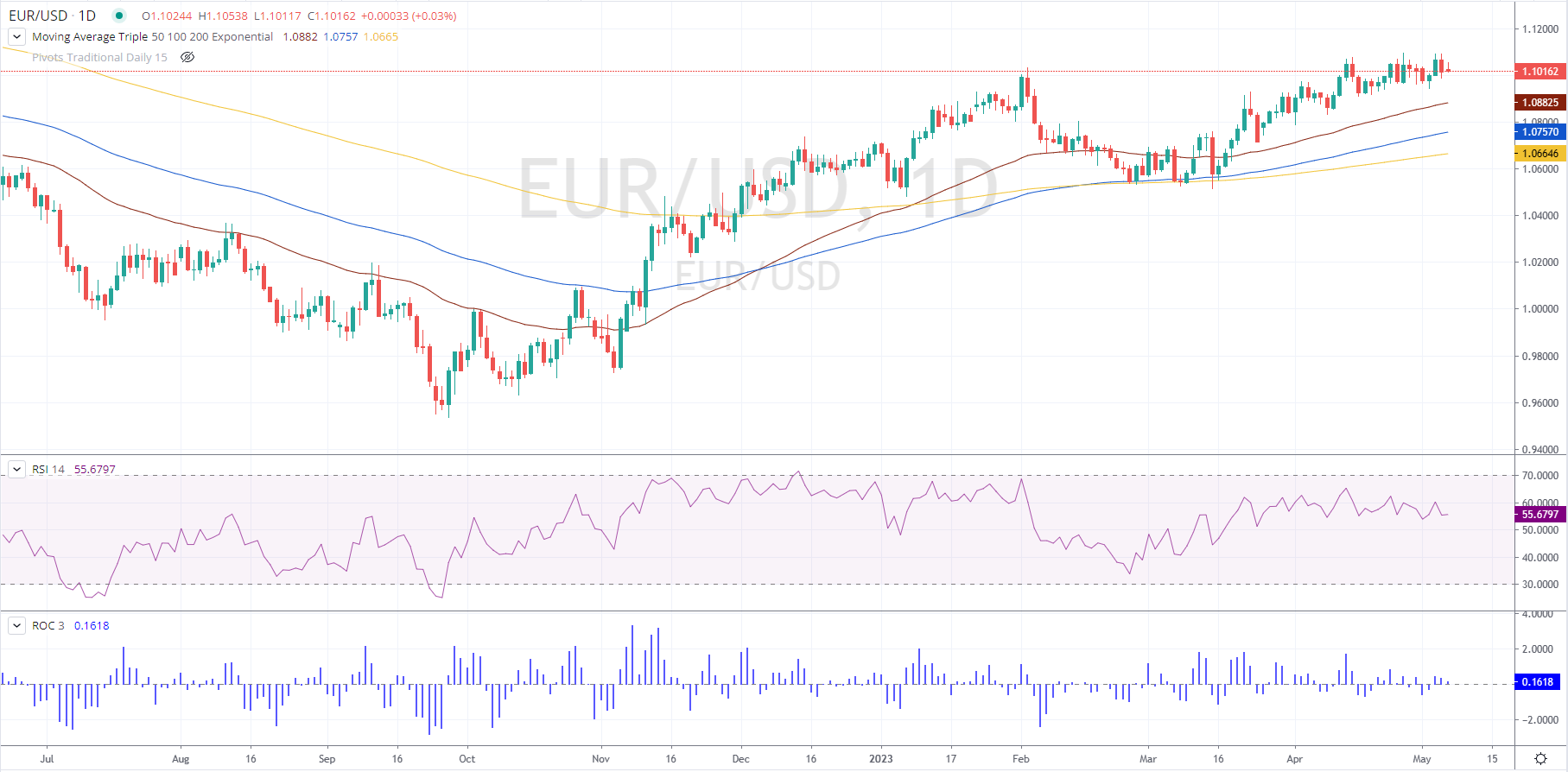
EUR/USD Daily chart

The daily chart’s EUR/USD price action suggests buyers remain in the driver’s seat. Of note is that while the EUR/USD pair is reaching higher highs, the Relative Strength Index (RSI) indicator is not, as it has recorded a successive series of lower peaks. Therefore, a negative divergence between price action and the oscillator is emerging, which could pave the way for further losses. However, the EUR/USD must fall below 1.1000 first, so it can challenge the May 2 daily low of 1.0942. before dropping toward the 1.0900 figure. A breach of the latter will expose the 50-day EMA At 1.0883. Conversely, if EUR/USD buyers reclaim 1.1100, that would keep the EUR/USD uptrend intact.

EUR/USD

Overview
Today last price1.1018
Today Daily Change-0.0002
Today Daily Change %-0.02
Today daily open1.102
 
Trends
Daily SMA201.0989
Daily SMA501.0839
Daily SMA1001.0782
Daily SMA2001.0434
 
Levels
Previous Daily High1.1048
Previous Daily Low1.0967
Previous Weekly High1.1092
Previous Weekly Low1.0942
Previous Monthly High1.1095
Previous Monthly Low1.0788
Daily Fibonacci 38.2%1.1017
Daily Fibonacci 61.8%1.0998
Daily Pivot Point S11.0975
Daily Pivot Point S21.0931
Daily Pivot Point S31.0894
Daily Pivot Point R11.1056
Daily Pivot Point R21.1093
Daily Pivot Point R31.1137

Author

Christian Borjon Valencia

Markets analyst, news editor, and trading instructor with over 14 years of experience across FX, commodities, US equity indices, and global macro markets.


More from Christian Borjon Valencia
Share:

Editor's Picks

AUD/USD consolidates above 0.7000; remains close to monthly top

AUD/USD holds steady above 0.7000 during the Asian session on Friday, trading just below the previous day's monthly low amid diverging forces. A hawkish RBA continues to support the Aussie, while the recent decline in US bond yields keeps the US Dollar depressed near a three-week low. However, oil-driven inflation fears reinforce Fed hike bets, which, along with geopolitical risks, could benefit the safe-haven buck and cap the currency pair.

USD/JPY bounces off one-month low; climbs to 157.00 amid reviving USD demand

USD/JPY rebounds from the 156.00 neighborhood, or a one-month low touched during Friday’s Asian session, with bulls looking to extend momentum beyond 157.00 amid the emergence of some US Dollar buying. Meanwhile, Japan's National CPI rose to a nine-month peak and reaffirmed BoJ rate-hike bets, which could support the Japanese Yen and cap gains for the currency pair.

Gold stalls recovery from three-month low as Fed hike bets and USD uptick cap gains

Gold struggles to capitalize on a modest intraday bounce from levels below the $4,000 psychological mark, or a three-month low set during the Asian session, and sticks to a negative tone for the second straight day. The Federal Reserve recently signaled that there is no urgency to raise interest rates. Traders, however, are still pricing in around an 80% chance that the US central bank will raise borrowing costs again at its December policy meeting.

Bitcoin, Ethereum, and Ripple rebound as major support levels cap recent sell-off

Bitcoin, Ethereum and Ripple rebound modestly on Friday after correcting and testing their key support zone the previous day. BTC holds the 50-day EMA, ETH finds support around the 100-day EMA, while XRP holds the horizontal floor near $1.300. The price action of these top three cryptocurrencies suggests a recovery if this critical support zone holds; a decisive close below these levels suggests a deeper correction.

The week ahead – UK budget, Shell, BP and HSBC and NatWest results
Financial markets have undergone another turbulent week with concerns about public sector debt levels, the impact of energy policy and higher oil and gas prices, and what events in France might mean for the UK economy going forward.
What November 3 means for the Fed's rate path and the US Dollar

The USD faces a decisive period ahead of the November 3 midterm elections. While markets anticipate another interest rate increase from the Fed in December, the battle for control of Congress could reshape fiscal policy expectations and, indirectly, the path of US monetary policy in 2027.